New German Chancellor faces uphill battle amid Trump Tariffs and slowing economy Premium
The Hindu
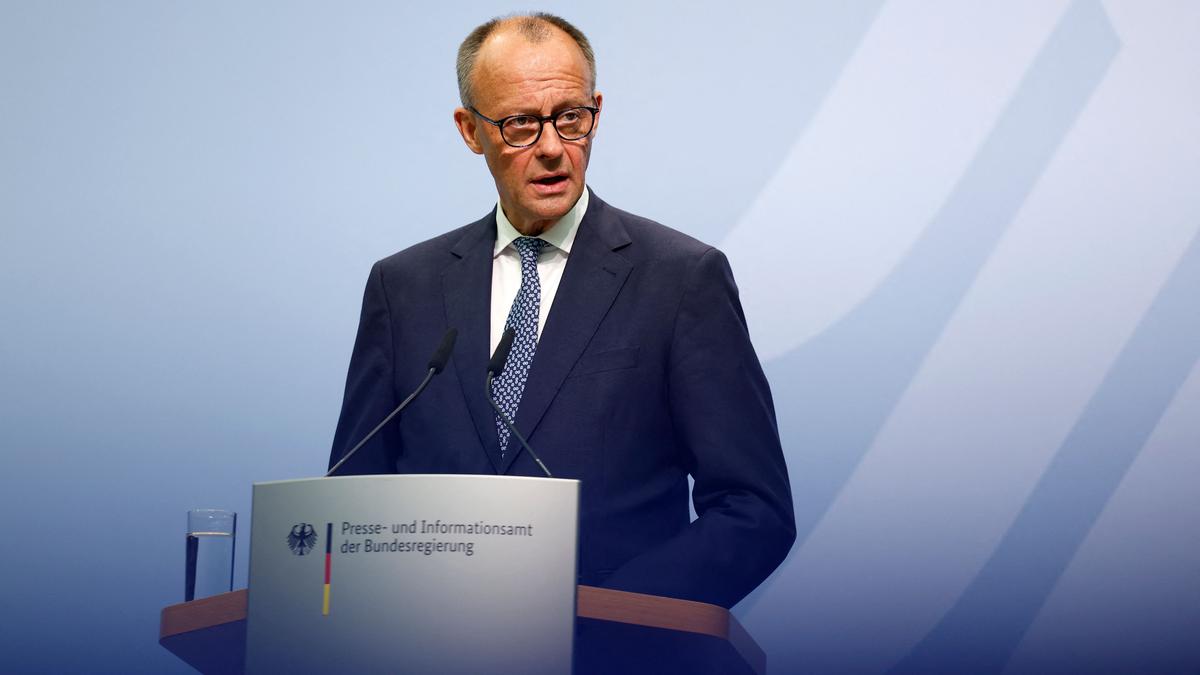
Friedrich Merz becomes Chancellor of Germany amid economic challenges and trade tensions with the U.S., impacting EU industries.
On May 6, Friedrich Merz became the next Chancellor of Germany. In what was meant to be a mere formality of the Bundestag (German Parliament) members electing him to be the next Chancellor, Mr. Merz couldn’t gather enough votes in the first round to be approved by the MPs. This has never happened with any previous Chancellor in post-war Germany. Mr. Merz managed to get 325 votes in the second round (Chancellor candidates need at least 316 votes) and was eventually sworn in. The ruling coalition comprises Mr. Merz’s conservative Christian Democrats (CDU/CSU) and the centre-left Social Democrats (SPD).
Even though migration was one of the key planks that Mr. Merz doubled down on during the election campaign, the focus has once again shifted to the German economy.
Speaking on national TV after becoming the Chancellor, Mr. Merz said, “We are undergoing a profound structural change, but for me the overriding message is that Germany must remain a country of manufacturing industry. We will improve the framework conditions of our economy so that in the coming years we will remain, or again become, an efficient country at the top of the world’s industrialised nations.”
The German economy has shown negative growth for two consecutive years. Things aren’t looking too promising for 2025 either, following U.S. President Donald Trump’s tariff announcements.
Since Mr. Trump’s ‘Liberation Day’ announcement on April 2, imposing 20% tariffs on the EU (now at 10% thanks to the 90-day pause), economic tensions in Germany have been on the rise. Many economic institutes and think-tanks have run simulation studies on the impact this could have on individual EU member countries. Germany, being the country that exports the most to the U.S. (in the EU bloc), faces a lot of challenges.
“The key message to Donald Trump is that Germany is back on track. Germany will fulfil its defence obligations, and it is willing to strengthen its competitiveness. Germany will be a very strong partner within the European Union,” Mr. Merz had said soon after his party won the German elections in February. Mr. Merz also went on to say that President Trump’s policies “increase the risk that the next financial crisis will come sooner than expected.”
Despite the 90-day pause announced by Mr. Trump, the 25% tariffs on cars and car parts are in place. Germany exported close to 4,50,000 cars to the U.S. in 2024. It’s estimated that the new tariffs would add $6,000 on average to every imported car to the U.S.


India pledges 60% non-fossil fuel power by 2035, targeting 47% emissions reduction per GDP unit and enhanced carbon sinks.

Supreme Court rules land acquisition compensation and interest must uphold constitutional guarantees, unaffected by financial burdens.

Election officials accept 23 nominations for Bagalkot bypolls, rejecting three, with polling scheduled for April 9.

Students and women’s self-help groups in Madurai engage in vibrant voter awareness campaigns promoting 100% voting participation.

Congress signals a "friendly fight" with allies in select Puducherry Assembly seats ahead of the April 9 elections.

Airstrike in western Anbar kills 7 Iraqi soldiers, injures 13, prompting condemnation for violating international laws on medical facilities.

Plaque unveiled in Bengaluru honors 11 victims of RCB stampede, emphasizing safety responsibility for future events.

India and the U.S. reaffirm commitment to enhance strategic defense cooperation at the 18th Defence Policy Group meeting in New Delhi.

Chhattisgarh's Deputy CM reports only 30-40 Maoists remain in Bastar, highlighting recent surrenders and future development plans.

Explore the historical and industrial significance of Ariyalur constituency, highlighting its challenges, agriculture, and political landscape.

Dindigul and Madurai Collectors conduct joint inspection

In this episode, Kalki Subramaniam speaks to us about why the Transgender Persons Amendment Bill has sparked protests, and how these amendments threaten to push a marginalised community back into the shadows.

India's EU FTA is poised to attract more German companies, boosting bilateral trade and investment opportunities.