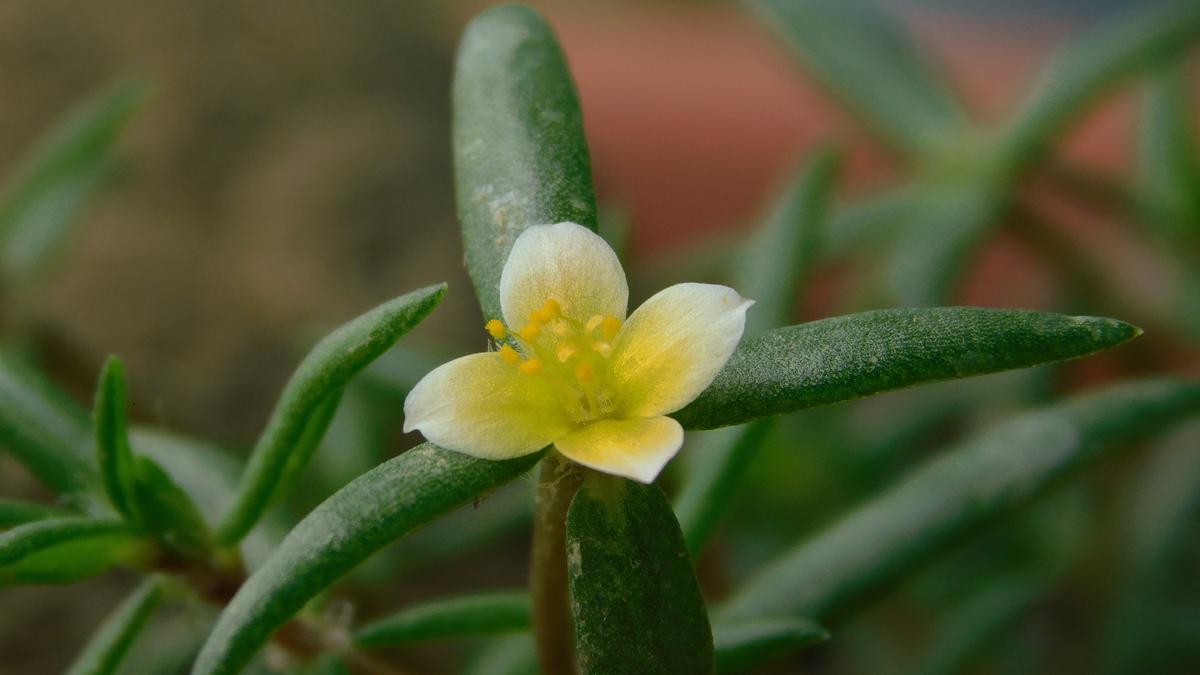
New flowering plant species discovered in Aravali hills landscape near Jaipur
The Hindu
Discovery of new plant species, Portulaca bharat, in Aravali hills near Jaipur highlights India's hidden biodiversity.
A new flowering plant species with unusual morphological characteristics has been discovered in the rocky and semi-arid landscape of Aravali hills near Jaipur, shedding light on the region’s hidden biodiversity. Classified as Portulaca bharat, the plant adds to the list of Indian endemics.
With no other populations currently known, Portulaca bharat has been provisionally assessed as “data deficient” under the International Union for Conservation of Nature Red List guidelines. The plant’s narrow endemism and specific habitat requirements make it highly vulnerable to habitat degradation and climate change.
The plant was first spotted by researcher Nishant Chauhan, a committee member of the Satpura Biodiversity Conservation Society (SBCS), who noticed a unique Portulaca-like succulent growing from the rock crevice on the dry and rocky hill slopes near the historic Galtaji temple on the outskirts of Jaipur.
Mr. Chauhan collected a few live specimens, which were subsequently cultivated under the controlled conditions in Himachal Pradesh’s Hamirpur and later in Lucknow to monitor growth patterns, flowering, and morphological stability across environments.
“After a detailed study and comparison with known species, the plant has been confirmed as a new species to science,” Mr. Chauhan told The Hindu on Monday. The species has been described and published in the latest issue of international scientific journal, Phytotaxa, after a thorough examination of the herbarium collections at the Botanical Survey of India (BSI) and other institutions.
The genus Portulaca currently comprises about 153 species worldwide, primarily found in tropical and subtropical regions. These succulent plants are known for their toughness, water-storing tissues, and adaptation to extreme environments. In India, 11 species are currently known, including four endemics, mostly distributed in dry and semi-arid habitats.
Mr. Chauhan, whose work focuses on the documentation and conservation of threatened plant species, said Portulaca bharat is currently only known from a single location in the Galtaji hills. “Only 10 individuals of this species were found in the wild. The discovery calls for enhanced field surveys, habitat protection, and ex situ conservation efforts, especially in neglected dry zones like the Aravalis,” he said.


The government plans to amend the FCRA, introducing new regulations for NGO asset management and accountability for key functionaries.

The draft policy for “Responsible Digital Use Among Students”, released on Monday by the Department of Health and Family Welfare, has recommended that parents set structured routines with clear screen-time rules and prioritise privacy, safety, and open conversation with children on digital well-being.

Police Observer Sushant Kumar Saxena conducts surprise inspection at Shencottai police station, reviewing warrants and security arrangements ahead of elections.

Andhra Pradesh government to launch key projects in April, focusing on industrial growth and infrastructure development, says Nara Lokesh.

Lok Sabha refers the Corporate Laws (Amendment) Bill to a JPC amid opposition concerns over CSR provisions dilution.

SHG members in Kanniyakumari use snakes and ladders to raise election awareness and boost voter turnout.

Government accelerates consultations for early implementation of the Women’s Reservation Act to ensure women’s representation in 2029 elections.

CM A. Revanth Reddy distributes ₹1 crore insurance cheques to families of deceased Electricity department employees, enhancing financial security for workers.

The Bengaluru Traffic Police (BTP) registered 634 cases of drunk driving during a week-long special enforcement drive conducted across the city between March 16 and March 22.

GHMC intensifies action against property tax defaulters, seizing properties and offering a One Time Settlement scheme for payments.

CCB arrests three drug peddlers in Mangaluru, seizing ₹2.5 lakh worth of MDMA and other valuables.

TVK's 28 candidates in Puducherry include former BJP MLAs, a sitting Independent, and a retired police IG.

BRS submits notice on private member bill to Speaker