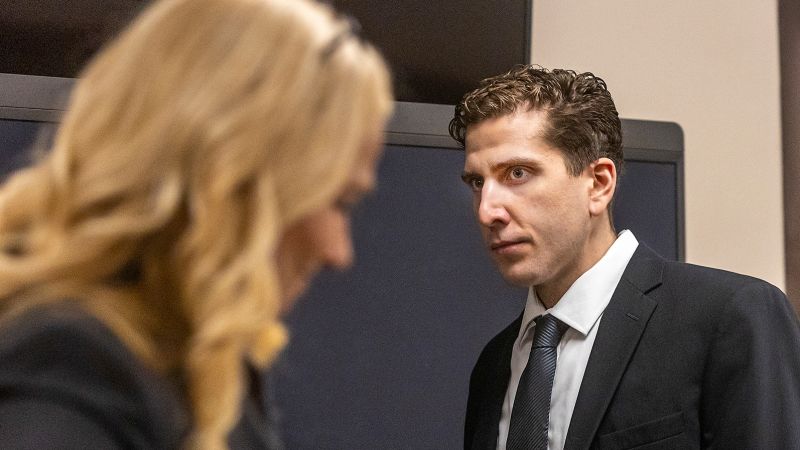
New details emerge in the case against Bryan Kohberger, the man accused of fatally stabbing four University of Idaho students
CNN
More than two years after a quadruple homicide devastated Moscow, Idaho, a judge unsealed the transcript of a recent hearing in the case against Bryan Kohberger – the man accused of stabbing four students to death in an off-campus home.
More than two years after a quadruple homicide devastated Moscow, Idaho, a judge unsealed the transcript of a recent hearing in the case against Bryan Kohberger – the man accused of stabbing four students to death in an off-campus home. The hearing, which was closed to the public, came after defense attorney Anne Taylor claimed investigators acted inappropriately when using investigative genetic genealogy to try to isolate a suspect. Investigative genetic genealogy, or IGG, is a relatively new forensic technique combining DNA analysis with genealogical research. Authorities can take an unknown suspect’s DNA profile and upload it to a public database to learn about the suspect’s family members. Investigators can use that information and other evidence to build a family tree and identify potential suspects. But the defense’s attempt to get a judge to suppress the IGG evidence failed. And Kohberger’s murder trial is expected to begin this summer – with the prosecution seeking the death penalty if the 30-year-old is convicted. Due to a wide-ranging gag order, prosecutors, defense lawyers, and attorneys for victims’ families and witnesses are prohibited from saying anything publicly, aside from what is already in the public record. Here are some of the new details revealed from the transcript of the closed-door hearing:


Any attempt by the United States to take control of Cuba would be met with “impregnable resistance,” Cuban President Miguel Díaz-Canel said Tuesday, as power returned to some parts of the island following a nationwide grid collapse.

Many assume JB Pritzker’s run for president is just a year away. His effort to engineer a victory for his lieutenant governor, Juliana Stratton, in Illinois’ Senate primary was also a victory for him and a political operation with national ambitions.

Lt. Gov. Juliana Stratton’s win in the Senate Democratic primary was also a win for Gov. JB Pritzker, while big-spending groups like AIPAC got mixed results in Tuesday’s contests.

United Farm Workers is not participating in annual celebratory events this month of its co-founder Cesar Chavez over what it calls serious allegations the union did not specify

Illinois Lt. Gov. Juliana Stratton will win the Democratic primary for an open Senate seat, CNN projects, a stunning rise for a little-known state officer now on a glide path to Washington.

President Donald Trump promised his endorsement was forthcoming in the GOP Texas Senate runoff and said he wanted whoever he didn’t pick to drop out. But now — preoccupied with the Iran war and a doomed voting bill — he’s missed a critical deadline.

The Senate has kicked off extended debate on the “SAVE America Act” — one of President Donald Trump’s top legislative priorities.

Organized crime in Latin America is proving difficult to defeat with the kind of decapitation strategy apparently favored by US President Donald Trump.

The conservative movement’s internal debate over the Iran war entered a new phase on Tuesday, with the first resignation of a prominent Trump appointee who criticized the war.

Arizona’s attorney general has filed the first-ever criminal charges in the US against a major prediction market company, accusing Kalshi of running an illegal gambling operation in violation of state law.

President Donald Trump’s brief and aggressive attempt to corral an international coalition to police the Strait of Hormuz concluded in disappointment on Tuesday.

House Oversight Chair James Comer on Tuesday issued a subpoena to Attorney General Pam Bondi to appear for a deposition on April 14 as part of the panel’s Jeffrey Epstein probe.

President Trump’s latest comments about the Iran war make him look out of the loop and unprepared.