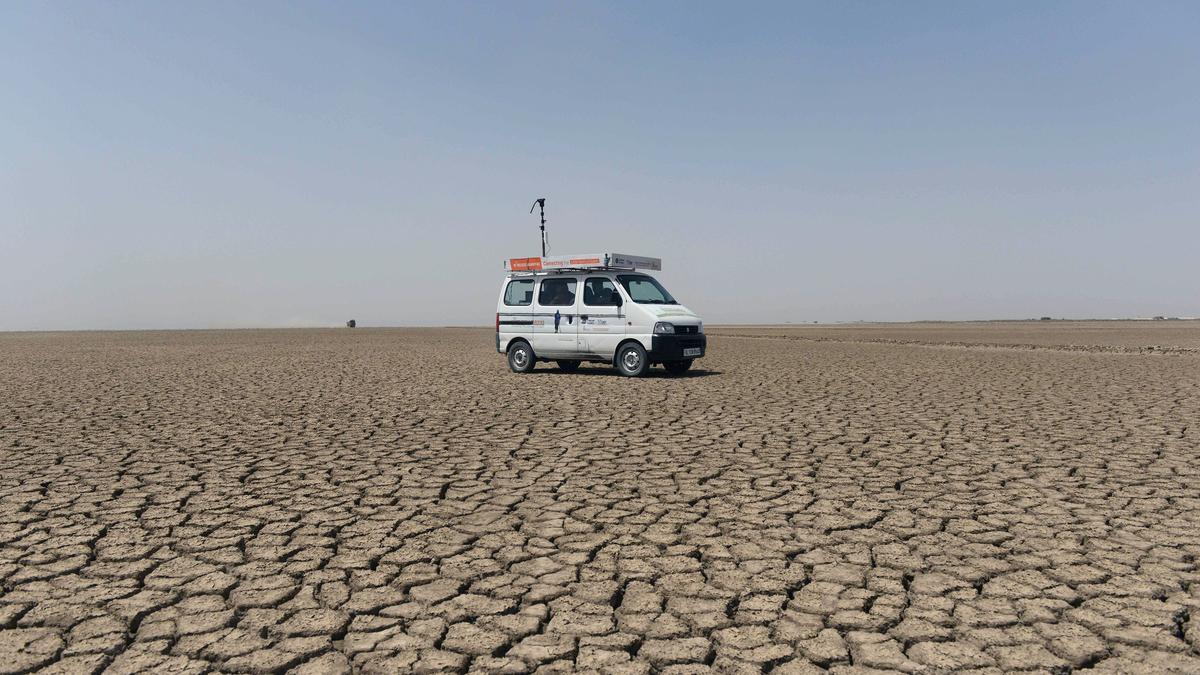
New climate data set for India unveiled by Bengaluru-based Azim Premji University
The Hindu
According to the Climate Change Projections for India (2021-40) report, the projections examine two IPCC (Inter-governmental Panel on Climate Change) scenarios: SSP2-4.5 (moderate emissions and adaptation) and SSP5-8.5 (high emissions with heavy fossil fuel reliance).
The average annual maximum temperature will experience an increase of 1.5 degree Celsius by 2057 under ‘the middle of the road’ emission scenario while the more extreme ‘fossil-fueled development’ emission scenario predicts this temperature rise will occur a decade earlier, by 2047.
This is one of the many key findings of the Azim Premji University’s new climate data set for India, which was unveiled on November 17.
According to the Climate Change Projections for India (2021-40) report, the projections examine two IPCC (Inter-governmental Panel on Climate Change) scenarios: SSP2-4.5 (moderate emissions and adaptation) and SSP5-8.5 (high emissions with heavy fossil fuel reliance).
In other words, the ‘middle of the road’ emission scenario assumes that society will take moderate steps to reduce emissions and adapt to climate change, which will lead to moderate effects in the future. The ‘fossil-fueled development’ emission scenario presumes that society will continue to rely heavily on fossil fuels for energy, leading to a future with very high emissions and severe impacts.
Another finding is that India’s average summer maximum temperature will have a 1.5-degree Celsius increase by 2043, according to the ‘middle of the road’ emission scenario and by 2041 for the ‘fossil-fueled development’ emission scenario.
Under the low emission scenario, 196 districts in India will experience a summer maximum temperature increase of at least one degree, with 70 districts projected to experience a similar annual maximum temperature change.
“The highest change is expected in Leh at 1.6 degree Celsius for both summer and annual maximum temperatures. The winter minimum temperature is projected to change by 1.5 degree Celsius or more for 139 districts, while 611 districts will see a 1 degree Celsius or more temperature change,” the report states


The ₹88.41 crore AMRUT scheme aims to eliminate Kavali's water scarcity, transforming the town’s infrastructure and services.

A 4.1 magnitude earthquake struck Sikkim's Mangan district; no casualties or property damage reported.

Telangana government updates building rules, increasing TDR usage, allowing more floors, and easing setback regulations for developers.

The escalating Israel-Iran conflict over the South Pars gas field threatens global energy security and impacts India's energy imports.

Delhi's weather forecast: clear skies, maximum temperature around 30°C, and moderate air quality with an AQI of 154.

Union Minister Kiren Rijiju meets Tamil Nadu Bishops and pastors to discuss minority welfare and counter anti-BJP narratives.

Japan may consider minesweeping in the Strait of Hormuz post-ceasefire, says Foreign Minister Motegi, amid ongoing regional tensions.

Delhi University job fair guidelines excluding School of Open Learning students spark protests over equity and access to opportunities.

Rwanda's Fanny Utagushimaninde, at 15, becomes the youngest player to score a T20 international century.

Assembly polls 2026: Follow updates from The Hindu on the upcoming elections in five States, on March 22, 2026

Currently, only the services in the 32 series stop at the section of the road adjacent to the Broadway terminus, temporarily closed on account of reconstruction work. Small traders association tells R. Ragu that ensuring the services now accommodated at the temporary terminus at Island Grounds stop at NSC Bose road would benefit visitors to the markets in Parrys

The Hindu photo feature on Aragam which is now known as book village. Photos and text by Imran Nissar

The silent reading movement in the Mylapore-Mandaveli-RA Puram area showed up first at Nageswara Rao Park around two years ago, with modest ambitions, when Balaji launched it along with other reading enthusiasts from the region. This initiative has now moved parks, and seems to set to get entrenched in one. Due to renovation work at Nageswara Park, the reading session became irregular. With the Nageswara Rao park work gaining more surface area, it had to be shifted elsewhere. And it seems set to continue with a newly discovered green patch in RK Nagar in the Sundays to follow.