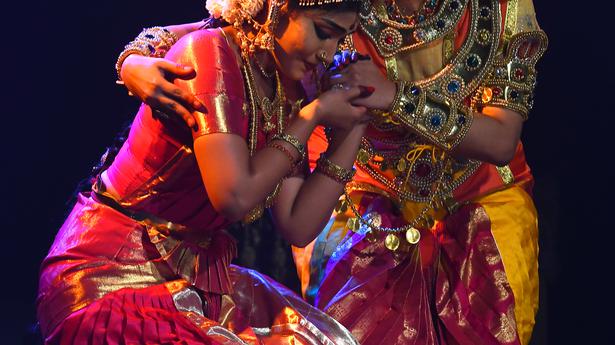
Never a dull moment at Anita Guha’s ‘Praise of the Seven Hills’
The Hindu
Anitha Guha’s ‘Praise of the Seven Hills’ had drama, pace, and well-choreographed patterns
Rarely will you go ‘ah’ in a themed Bharatanatyam production, but Anitha Guha’s ‘Praise of the Seven Hills’ on Lord Venkateshwara made you appreciate her skill and knowledge. As the performance was based on devotional shlokas and songs written by Sri Muralidhara Swamigal, she built on the descriptive lyrics and the beautiful melody to create a lively Bharatanatyam-theatre show.
Anitha layered the songs with musical inputs and jathis with the help of P.R. Venkatasubramanian. One could sense Anitha’s dexterity, as she combined compositions, brought in groups of dancers and additional entries and exits, while keeping the pace intact. All this she achieved through a flawless performance by 32 of her students at Bharathanjali.
It premiered online during the pandemic for the Global Organisation for Divinity’s fundraiser ‘Rise of Marghazi’ II Series, and was staged live for the first time recently in Chennai.
Credits for the production should go to Sriranjani Santhanagopalan and Vignesh Eashwar (vocal), an expert band of musicians, Revathi Sankkaran (anchor) and senior disciples such as Smriti Sudhakar, Madhavi Prakash, Sanjana Narayanan, Nutana Nair, Sandhya Shankar, Anjali Hariharan, Ravali, Sandhya, Varsha, among others.
Anitha emphasises precision in jathis, formations, movements, entries, and exits. Her style being unabashedly dramatic, the enthusiasm in the nritta segments can appear exaggerated. Was it the addition of the synthesiser, one was not sure. Lowering the volume in recording would help reduce the aggressive overtone.
The first was simply the best: ‘Srinivasa Karavalambam’ (Ragamalika, Mishra Chapu), a poetic shloka that described the beauty of Srinivasa in white and blue. The verses were interspersed with interesting sollus, performed by varying groups of dancers in different formations, as they wove in and out. The effect was electric, even ethereal. It is hard to understand the rigour that goes into attaining the split-second timing. From the beginning, when a group of young, bright dancers entered the stage, the atmosphere remained racy, and edgy.
The subsequent piece was also a combination of two separate happenings in the temple — god’s procession (Mallari) and the celebratory folk dance, both tuned interestingly in Gambhira Nattai (Adi). The Mallari presented in various nadais, alternating with the dances, was marked by perfect timing and synchronisation.


The Karnataka government will discuss with officials the possibility of creating a portal for unemployed youth to share their details and access job opportunities in micro, small and medium enterprises (MSMEs), Minister for Small Industries and Public Enterprises Sharanabasappa Darshanapur said in the Legislative Council on Tuesday.

AIADMK's 2026 manifesto promises free rations, women's benefits, education reforms, and economic growth initiatives for Tamil Nadu.

U.S.-Israel war on Iran LIVE: Follow The Hindu for updates on the West Asia conflict on March 24, 2026

Join the 'Click & Commit' campaign on World TB Day, uniting Chennai's community to pledge against tuberculosis.

Brahmin candidates join Naam Tamilar Katchi, marking a significant shift in Tamil Nadu's political landscape and inclusivity.

Over 750 wheelchairs are prepared in Thoothukudi for accessible voting, ensuring convenience for differently abled and elderly voters.

Madras HC dismisses S.P. Velumani's petition challenging I-T assessment of ₹7 crore as unexplained election expenses from 2016.

The Lok Sabha passes a contentious Transgender Bill, sparking praise from the government and criticism from opposition parties.

Kamal Haasan announces support for DMK in 2026 elections, emphasizing the need for 'Dravidian Model 2.0' for Tamil Nadu's welfare.

Y.S. Sharmila critiques massive concessions for the AMNS steel plant while advocating for the Visakhapatnam Steel Plant and job creation.

Puducherry Assembly elections test the INDIA bloc's unity as parties file nominations amidst seat allocation uncertainty.

T.N. CM Stalin advocates for constitutional safeguards to maintain state representation in delimitation amid women’s reservation discussions.

Rohit Pawar files complaint in Bengaluru alleging conspiracy in Ajit Pawar's air crash; Maharashtra police had refused FIR.