Nepal, a crucible of fragile coalitions Premium
The Hindu
Whether a ‘Prachanda’-led coalition in Nepal will last is moot
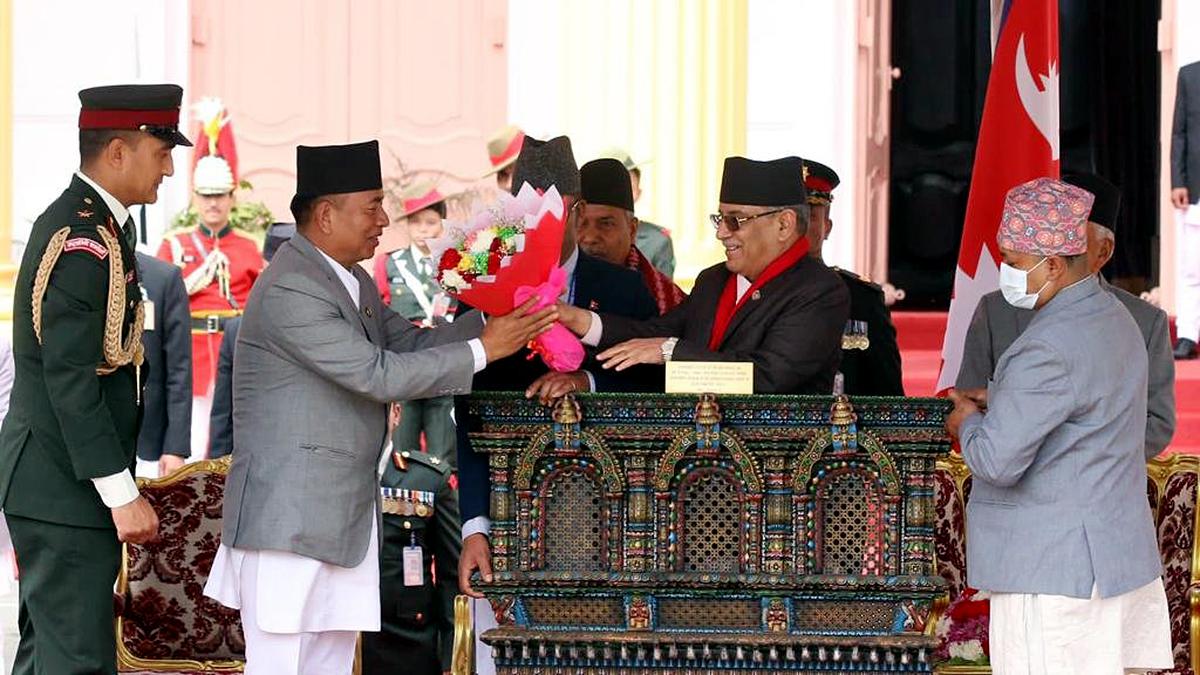
In a short span of time since being in power from December 25, 2022, Nepal Prime Minister Pushpa Kamal Dahal ‘Prachanda’, supremo of the Maoist Centre (MC), has had to face a vote of confidence twice — on January 10, 2023 and again on March 20. Though it would seem unusual, it is not an unexpected happening given the state of disarray contemporary Nepali politics is in after the general election in November 2022.
As in the earlier three general elections, the November 2022 election too resulted in a hung Parliament, where the Nepali Congress (NC), the Unified Marxist-Leninist (UML) and the MC were placed first, second and third, respectively, in the House of Representatives. The smaller parties and independents have a combined strength of 76 seats.
The NC-led five-party ruling alliance (formed in July 2021 with the aim of checking the rise of K.P. Oli and his party, the UML) consolidated further with a pre-poll alliance, thus gaining in the elections in two ways. This camp scored a majority, falling short by only two seats, in the 275-member House; the net result is that each of the alliance partners gained more than what they could have achieved in their individual capacity. But when this alliance was about to form a government, things crumbled, which was not unexpected. In the first instance, Sher Bahadur Deuba, President of the NC, did not keep his word in giving ‘Prachanda’ prominence as head of the post-election government. He relied on Mr. Oli’s false assurance to back the NC’s plan B, i.e., invoke Article 76(3) of the Constitution that has a provision for the formation of a minority government by the largest party in Parliament.
In the second instance, ‘Prachanda’ has a track record of being a leader who shifts stands for the sake of power, an example being his move from being a lead actor of a radical/progressive/pro-identity group to admission into the NC-UML-led conservative camp in 2015, at a critical time of Constitution making. There was also a break up of the alliance with the UML in 2016, and again in 2021 (after sensing that Mr. Oli was not honouring an agreement to hand over premiership in his favour) to team up with the NC. There was also a pre-poll alliance with the UML in the 2017 general election despite his party finding a place in the Deuba-led cabinet.
The ambition of ‘Prachanda’ to become the first Prime Minister in a power-sharing arrangement by rotation of premiership was fulfilled by the UML; consequently, a new seven-party coalition government was formed. This lasted for only two months, which was not unexpected because of the incompatibility within the Prachanda-Oli team.
An ambitious ‘Prachanda’ had to govern under the shadow of a hawkish Mr. Oli, whose will prevailed in even the distribution of cabinet portfolios (the Prime Minister’s party did not get strategic portfolios such as home, finance, and foreign affairs). The UML, with 78 seats in the House, dominated the MC with 32 seats. Fringe coalition partners took sides with Mr. Oli. Surrounded by UML-men in strategic posts such as speaker of the House, chair of the National Assembly, chief justice of the Supreme Court, and even the heads of all 12 constitutional commissions (auxiliary government), Prime Minister ‘Prachanda’ was close to being a toothless tiger. To counter the UML’s high-handedness in state affairs, ‘Prachanda’ used the election of President to escape, for which he had to breach an earlier agreement to support the UML’s candidate.
In a confidence vote in support of ‘Prachanda’ on January 10, 2023, the NC indicated that it was aligned with the MC’s game-plan which, in retrospective, was the first step in damage control, kept it out of power despite being the largest party in the federal Parliament and also with four out of seven provincial Assemblies.


The ‘Swastha Mysuru’ initiative aims to promote healthy living and preventive healthcare in Mysuru through community engagement and awareness.

Farmers in Ongole protest against BJP's policies, citing dangers to their livelihoods and demanding support for local agriculture.

From March 24, paneer queserotta, prawn tostadas, beef birria and more feature on MadCo's special Mexican pop up menu by Chef Mathangi Kumar alongside experimental cocktails, including a marigold highball

Revenue Minister Krishna Byre Gowda defends subsidies as crucial for economic growth, emphasising their role in boosting consumer demand during recessions.

Three doctors were arrested by the Mico Layout traffic police on Monday (March 23) after a video allegedly showing them triple-riding without helmets with one of the pillion riders seen drinking from a bottle went viral on social media.

Assembly protest ends in arrests as BJP targets Government over guarantees

Andhra Pradesh accelerates city gas distribution with streamlined approvals, enhancing access to cleaner energy and supporting sustainable urban development.

Sattankulam father-son custodial deaths case: Trial court convicts all nine accused police personnel
Nine police personnel convicted in Sattankulam custodial deaths; sentencing to be announced on March 30.

Minister Laxmi Hebbalkar supports local protests against a solid waste management plant in Turmuri, addressing residents' concerns.

Sattankulam father-son custodial deaths case: Trial court convicts all nine accused police personnel
Nine police personnel convicted in Sattankulam custodial deaths; sentencing to be announced on March 30.

Erode district conducts first EVM randomisation for April 23 Assembly elections, ensuring transparency and fairness in allocation.

TNCC conducts public consultation in Erode to gather community input for its upcoming election manifesto.

CID to investigate sexual assault allegations against suspended Moodbidri Police Inspector P.G. Sandesh, reveals Home Minister Parameshwara.