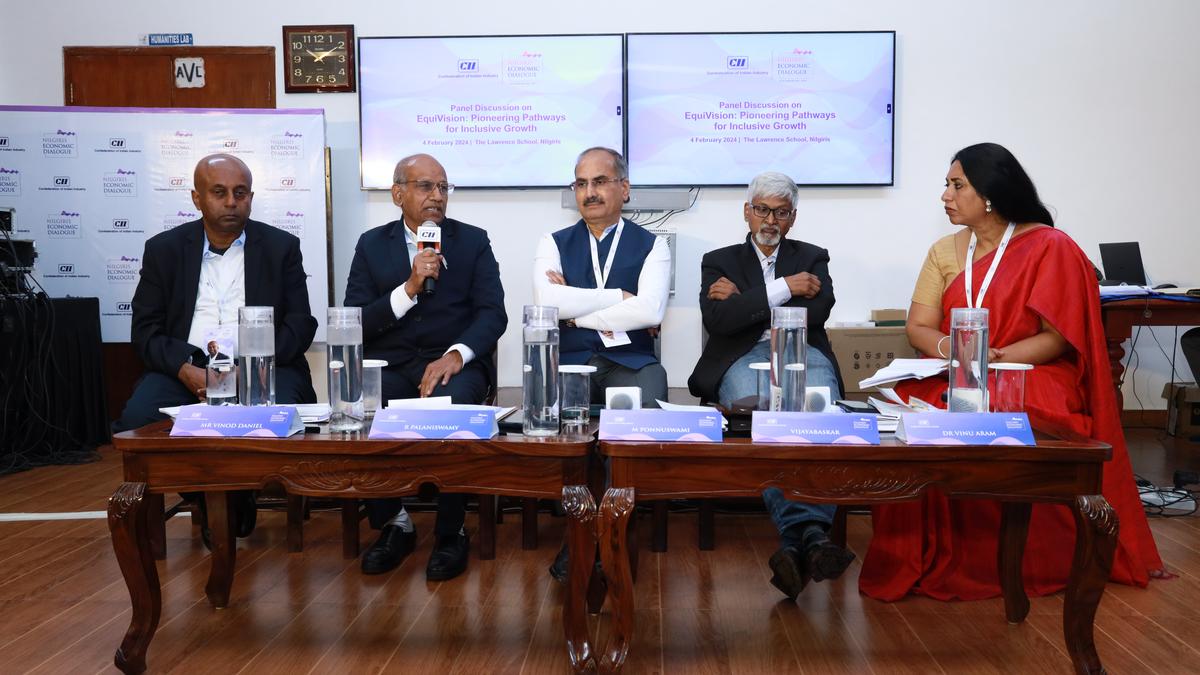
NED: panel discussion highlights the significance of inclusiveness in economic growth
The Hindu
Business leaders discuss the need for inclusive growth, focusing on women and child development at The Nilgiris Economic Dialogue.
Business leaders discussed and highlighted the need for inclusive growth, with focus on women and child development, at the concluding day of the The Nilgiris Economic Dialogue (NED) organised by the Confederation of Indian Industry, Tamil Nadu, at the Lawrence School in Ooty on Sunday.
Setting the context for the session, Srivats Ram, Vice-Chairman of CII, Tamil Nadu and Managing Director, Wheels India, said India has seen transformational growth post liberalisation and aspires to be a developed economy by 2047. However, there is growth in some segments and even within States, the growth is limited to some areas. Tamil Nadu and the southern States have progressed in inclusiveness because of education and policies. It is important to ensure that development happens across regions.
In a panel discussion on “EquiVision: Pioneering Pathways for Inclusive Growth” moderated by Kezevino Aram, president of Shanti Ashram International Center for Child and Public Health, M. Ponnuswami, former chairman of the CII, Tamil Nadu State Council and Chairman and Managing Director of Pon Pure Chemicals Group, said every one will grow if they are given the right opportunities in both, education and employment. The per capita income of the State will go up if more number of women enter into formal work.
M. Vijayabaskar, Additional Full-Time Member of the State Planning Commission, Government of Tamil Nadu, said social stability is important for long term economic growth and the stability comes with inclusiveness. In Tamil Nadu, a major challenge is lack of opportunities matching the high education mobility.
According to R. Palaniswamy, retired IAS officer and advisor-education of TVS Srinivasan Services Trust, businesses should align their activities with that of the government to get better results.
Vinod Daniel, CEO and Managing Director of India Vision Institute and International Museum Expert, spoke about the need to quantify the impact of such measures and have data on them. There should be neutral platforms for all people to come and learn. There is a need to sensitise the public on inclusiveness, he said.
Later, in a session on “Inclusiveness from a Tribals Viewpoint”, Northay Kuttan, chairman of The Nilgiris Tribal Heritage & Cultural Protection Society, urged the participants to look at the tribal communities in such discussions. He also played a short video on the tribal communities in the Nilgiris.


Kerala's political parties continue to marginalize women candidates, highlighting a troubling disconnect between gender demographics and representation.

The High Court of Karnataka on Tuesday ordered the issue of a notice to the State government on a PIL petition, which had complained about disturbances caused to people residing in the localities around the National Public School situated in Rajajinagar 5th block due to use of loudspeakers with high volume in the school and parking of school buses in residential areas.

China is extensively mapping ocean floors to enhance submarine warfare capabilities against the U.S. and allies across key oceans.

AIADMK's 2026 manifesto promises free rations, women's benefits, education reforms, and economic growth initiatives for Tamil Nadu.

The vehicle towing drive will soon resume in the city to ease traffic congestion. The Bengaluru Traffic Police (BTP), in coordination with the Greater Bengaluru Authority (GBA), is set to relaunch the vehicle towing drive across the city shortly to tackle traffic congestion and illegal parking.

Panic buying, not shortage, is leading to long queues at Hyderabad petrol pumps.

District Collector urges collective action against TB during World TB Day rally, highlighting screening efforts and patient support initiatives.

DMK finalises seat-sharing for the 2026 Tamil Nadu Assembly elections, contesting 175 seats with allies DMDK and VCK.

Collector V. Saravanan and Police Commissioner Kamini promote voter awareness through outreach programs and traditional events in Tiruchi.

Mysuru DC stresses precautionary measures to reduce road accidents, urging officials to identify and address high-risk areas.

Growing influence of Artificial Intelligence highlighted

Telangana MP urges quick approval and funding for Musi River and 7,444 km sewerage projects during AMRUT review meeting.

Former Udupi MLA K. Raghupathi Bhat, who had launched an indefinite dharna in front of the Udupi Urban Development Authority (UUDA) office on Monday against the Authority’s alleged illegal refusal to grant single site approval for 1.1 acres of his land at Badanidiyur, ended his dharna on Tuesday.