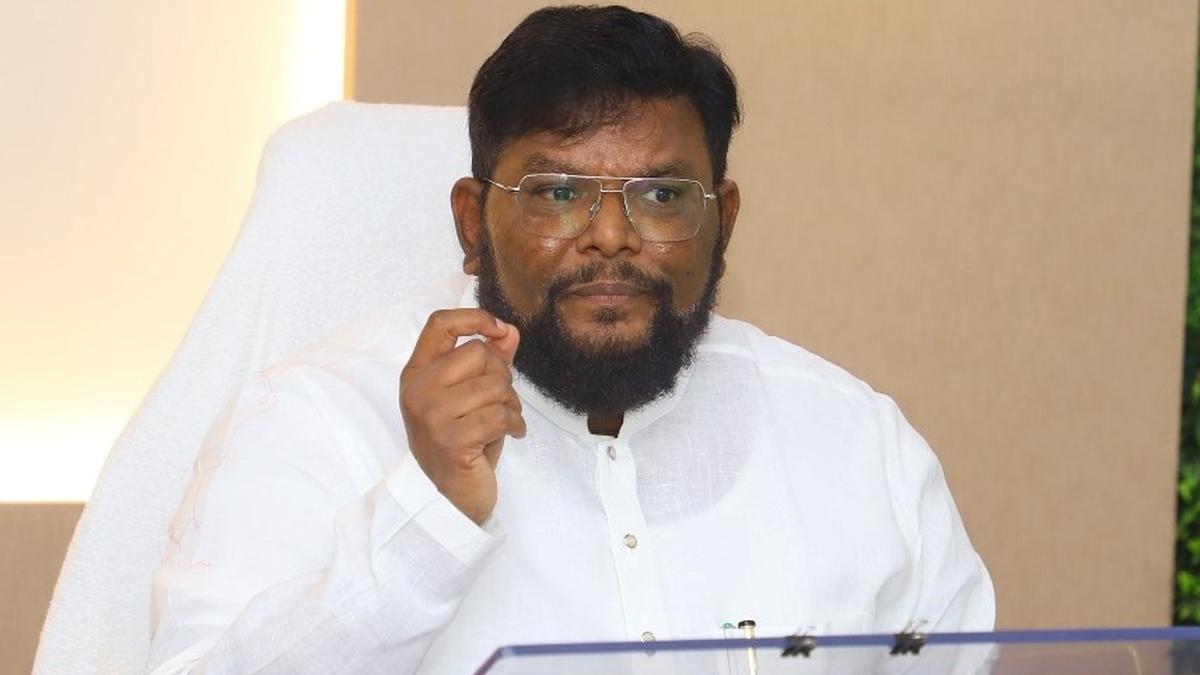
Nearly 50% of assets under encroachment in Andhra Pradesh, says Waqf Board Chairman Abdul Azeez
The Hindu
Nearly 50% of assets under encroachment in Andhra Pradesh, says Waqf Board Chairman Abdul Azeez. Around 30,000 acres of land that is free from encroachment will be leased out through public auction, and the funds accrued thus will be used for the uplift of the community, he says.
Almost 50% of the 1,986 immovable assets of the Andhra Pradesh Waqf Board is under encroachment. Out of the total land extent of 65,783.88 acres, nearly 31,594.20 acres is under resumption by the State government, according to Waqf Board Chairman Sk. Abdul Azeez.
In an exclusive interview to The Hindu, Mr. Azeez said, “The Waqf Board is initiating action under the provisions of the Waqf Act, 1995. It is obtaining details of occupied properties in consultation with the revenue authorities.”
Around 30,000 acres of land that was free from encroachment would be leased out through public auction soon, he said.
Without revealing the current market value of the lands, Mr. Azeez said, “The valuation suggests a highly promising opportunity for both investors and developers. We are under the process of obtaining permission from the government for leasing out the lands.”
When asked about the plans to utilise the funds thus accrued, Mr. Abdul Azeez said, “The objective is to uplift the community through a comprehensive approach, focusing on education, employment, and infrastructure development. By enhancing access to quality education, we aim to equip individuals with the knowledge and skills needed for success.”
“Skill development programmes will empower people to improve employability, fostering local talent and providing opportunities for sustainable growth. Additionally, the development of institutional infrastructure, such as schools, community centres, and transport systems, will create a solid foundation for long-term prosperity,” he said.
Earlier, the Waqf Board had tried to lease out its properties, but a group of people among the community opposed giving lands to the industry. Those assets had been lying vacant for seven years without any revenue, he observed.


Anuradha Jonnalagadda took over as in-charge Vice-Chancellor of the University of Hyderabad, focusing on continuity during the transition.

Telangana government awaits committee report on TGSRTC staff absorption, with decisions to be made at an appropriate time.

Telangana's revised pay scale implementation for employees will take timer. The tenure of Pay Revision Commission extended. Govt likely to take decision on reccomendation based on its report.

Vizianagaram's SP A.R. Damodar highlights 20 accident-prone areas and urges drivers to prioritize safety with helmets and seat belts.

Kerala HC stays disqualification of SNDP Yogam leaders, reversing a single judge's order regarding financial and regulatory compliance issues.

Karnataka announces daily supply of 10,000 LPG cylinders to hotels, easing the commercial shortage for the hospitality industry.

Malayalam superstar Mohanlal will be reuniting with filmmaker Priyadarshan, it was announced recently. It will mark the 100th film of Priyadarshan and is backed by Mohanlal’s longtime collaborator, Antony Perumbavoor

Gautham Vasudev Menon loses Madras High Court appeal, ordered to pay ₹4.25 crore to R.S. Infotainment with interest.

AIADMK faces its toughest challenge in 53 years as it prepares for the crucial 2026 T.N. Assembly elections.

Lakmé Fashion Week x FDCI 2026 in Mumbai: What worked and what didn’t

Telangana CM announces underpass beneath Begumpet Airport runway to alleviate traffic congestion in Hyderabad.

Congress leader Ramesh Chennithala claims an alliance between Pinarayi Vijayan, Modi, and Shah aims to undermine UDF in Kerala elections.

CCB arrests Bengaluru couple for running a fake government job scam, cheating over 100 victims out of crores.