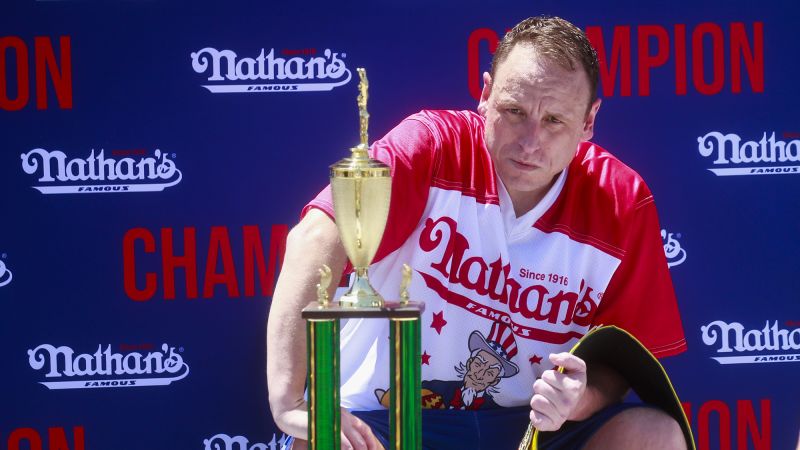
Nathan’s hot dog eating champ Joey Chestnut out of this year’s contest over vegan beef… sponsorship
CNN
Dynastic hot dog eating champion Joey Chestnut will not compete in this year’s Nathan’s hot dog eating contest after he struck a deal with plant-based food company Impossible Foods.
Dynastic hot dog eating champion Joey Chestnut will not compete in this year’s Nathan’s hot dog eating contest after he struck a deal with plant-based food company Impossible Foods. “We are devastated to learn that Joey Chestnut has chosen to represent a rival brand that sells plant-based hot dogs rather than competing in the 2024 Nathan’s Famous Fourth of July Hot Dog Eating Contest,” the Major League Eating organization, which oversees the event, said in a statement. Chestnut won the “Mustard Yellow Belt” 16 times, ate a world record 76 hot dogs and buns in 10 minutes in 2021 and has reportedly made hundreds of thousands, if not millions, of dollars for his competitive eating of hot dogs and other foods. A representative for the MLE said that the company tried to accommodate Chestnut and his management team, which included allowing him to compete in a rival unbranded hot dog eating contest on Labor Day. The MLE has also emphasized that Chestnut was not banned for life from competing, citing his 20-year relationship with the league. The organization said that to come back Chestnut must renounce deals with brands that rival Nathan’s. “Joey Chestnut is an American hero. We would love nothing more than to have him at Nathan’s Famous International Hot Dog Eating Contest, which he has dominated for years. We hope that he returns when he is not representing a rival brand,” the MLE said in a statement.


Former judges side with Anthropic and raise concerns about Pentagon’s use of supply chain risk label
Nearly 150 retired federal and state judges have filed an amicus brief on Tuesday supporting AI company Anthropic in its lawsuit against the Trump administration for designating it a “supply chain risk,” CNN has learned.

Attacks on commercial ships in the Middle East this month have all but closed the vital Strait of Hormuz to oil tankers. One of the few alternative routes for oil exports from the region goes through the Red Sea. But now even that lifeline is in danger.

When Mona Panjwani opened One40 Rooftop, a swanky restaurant in lower Manhattan last year, one of the biggest dilemmas besides the menu was choosing the reservation platform.

What could get more expensive because of the war in Iran?

Gas prices have skyrocketed due to the US-Israel war on Iran, putting even more financial strain on many Americans’ wallets.

United Food and Commercial Union Local 7, the union representing the 3,800 striking workers, said that JBS failed to meet its demands during contract negotiations over higher wages, life-saving safety equipment and improved healthcare.

Every day brings a new complaint — or three — from the Trump administration about the American news media’s coverage of the Iran war.

Traffic through the strait, normally the conduit for a fifth of global oil output, has been severely curtailed since the start of the Iran conflict. But Iran itself is shipping oil through the waterway in almost the same volumes as before the war, earning the cash needed to sustain its economy and war effort.

How Anthropic may benefit from its fight with Trump

The price of oil rose to its highest level since July 2022 Sunday evening as the Trump administration suggested the war with Iran could last several more weeks and President Donald Trump called on the international community for help reopening the Strait of Hormuz to oil tankers.

When Melanie Galeaz posted a fan edit of “Heated Rivalry,” she didn’t know it would lead to her dream job.

The worst global oil crisis in decades could become a major problem for the Federal Reserve, whose policymakers meet this week to determine the next moves for the US economy.

President Donald Trump’s attack dog atop the FCC, Brendan Carr, garnered lots of attention on Saturday for threatening the licenses of local broadcasters over news coverage he deemed to be “fake.”