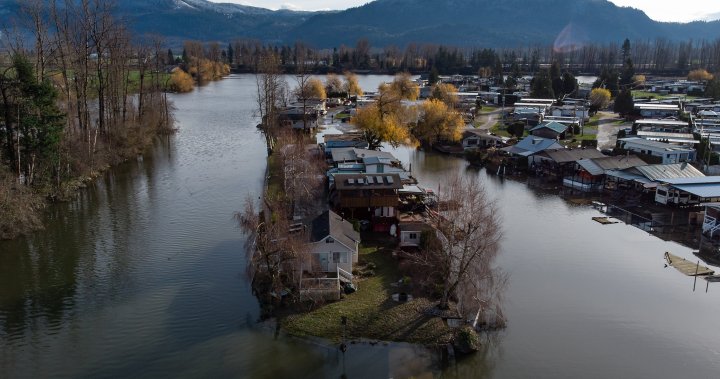
NASA predicts more extreme weather events but ‘we can stop making it worse’
Global News
NASA experts predict that more extreme heat waves, intense rainfall, and coastal floodings will continue to happen in Canada and the rest of the world.
Since record-keeping began in 1880, 2021 recorded the sixth-highest global surface temperature — a trend that experts say will continue and bring forth extreme weather events impacting infrastructure and agriculture in the future.
In a virtual briefing Thursday, climate researchers from NASA said that over the past five years, there has been “no shortage of extremes” and they predict that more extreme heatwaves, intense rainfall, and more coastal floodings will continue.
According to NASA’s annual Global Climate Report published Thursday, Canada and the rest of North America had their seventh warmest year on record in 2021 with a temperature that was 1.40 C (2.52 F) above average.
In an interview with Global News’ Jackson Proskow, Gavin Schmidt, Director of NASA’s Goddard Institute for Space Studies said that the world has reached a plateau of warming that’s actually part of an ongoing continued warming. This is because of the increases in greenhouse gases, notably carbon dioxide and methane, he said.
“We’re seeing global warming…having impacts directly on weather extremes (as shown by) the heat waves in Western Canada last summer, changes in coastal flooding, and changes in intense precipitation,” said Schmidt.
“All of these things are now being more and more strongly tied to the fact that we have warmed the planet by more than a degree Celsius over the last 100 years,” he added.
Overall, the February 2021 temperature departure for North America was -1.34 C (-2.41 F) — North America’s coldest February since 1994, according to the NASA report on how a warmer climate has impacted the weather.
According to the Government of Canada, the Prairies had maximum temperatures that were as high as -34.0 C (-29.2 F) and nighttime wind chills between -45 C to -55 C (-49 F to -67.0 F), setting many new record temperatures going back 50 years.


Prime Minister Mark Carney endorsed a statement after it was released by allies Thursday, expressing willingness to contribute to efforts to reopen the Strait of Hormuz..

James 'Jimmy' Gracey was reported missing after he didn't return to the short-term rental where he was staying with friends during spring break.

The Mina Al-Ahmadi refinery in Kuwait, which can process some 730,000 barrels of oil per day, is one of the largest in the Middle East.

U.S. intelligence, military and law enforcement officials unanimously agreed that an intelligence assessment doubting a foreign role in the 'Havana syndrome' should be withdrawn.

The federal Conservatives accuse the government of being too secretive about the war and point out that Canada's allies are sharing such information openly at daily briefings.

Canada is amongst several nations who 'condemn in the strongest terms recent attacks by Iran on unarmed commercial vessels in the Gulf.'

Gas prices in Canada have been climbing sharply since the Iran war began, but how much higher they could go is unclear as consumers struggle with the higher cost of living.

The Oscar-winning actor has denied all allegations against him and maintains that the incidents raised in the lawsuits either did not happen or were consensual.

European leaders have deflected entreaties from U.S. President Donald Trump to send military assets to secure the Strait of Hormuz.

All six crew members of a KC-135 Air Force refueling aircraft were killed last week in a plane crash over friendly territory in western Iraq, supporting operations against Iran.

U.S. Director of National Intelligence Tulsi Gabbard testified that the regime remains intact and Tehran and its proxies remain capable of attacking U.S. and allies' interests.

James 'Jimmy' Gracey was reported missing after he didn't return to the short-term rental where he was staying with friends during spring break.

The U.K. Health Security Agency described the event as 'rapidly evolving' and warned of the potential for further cases.