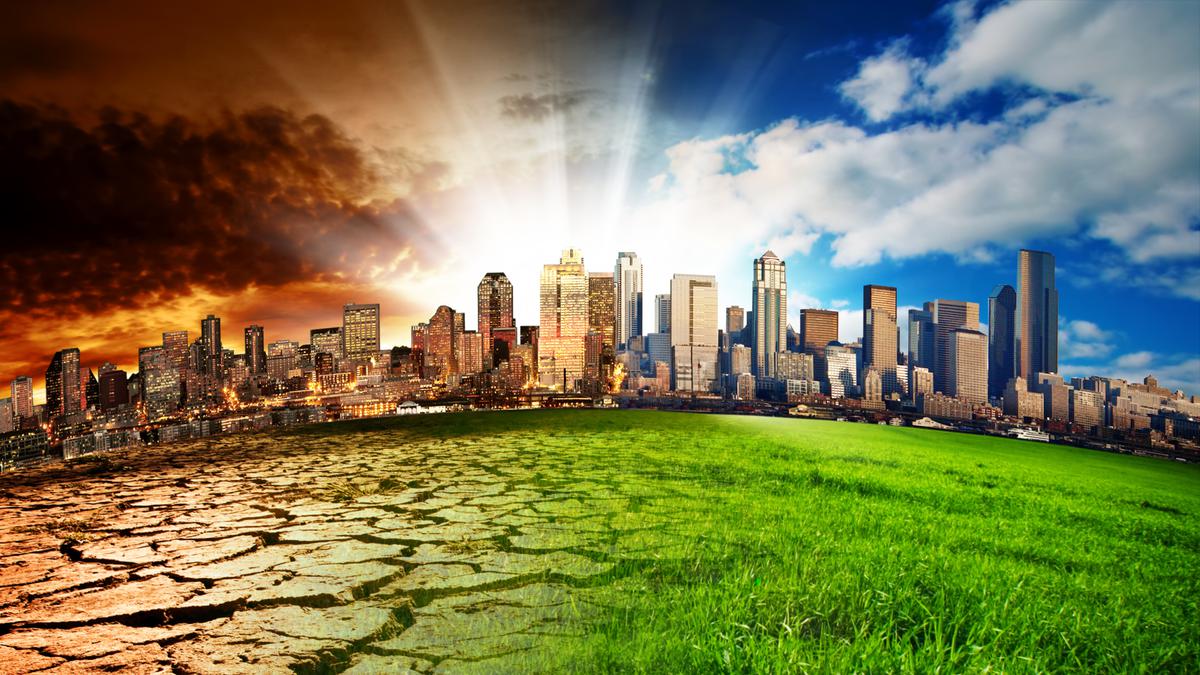
Must the idea of a city die? | Historian Peter Frankopan discusses climate change and his new book ‘The Earth Transformed’
The Hindu
British historian Peter Frankopan on his new book, the role of climate in the history of civilisation, and why city living is a strain on resources
In his latest book, The Earth Transformed: An Untold History, Oxford historian Peter Frankopan traverses a wide span, geographically and historically, to map the role of climate in the history of civilisation. Through the story of the rise and fall of kingdoms, empires and colonies, he argues that humanity’s current engagement with global warming isn’t new and the attempts at decoding the whims of climate processes, consequences of over-exploiting nature, controlling climate and ecological crises have been central to the concerns of thinkers and rulers for long.
In the introduction, you write that ‘The book will explain how our world has always been one of transformation, transition and change because outside the Garden of Eden, time doesn’t stand still.’ Historians have always been chronicling change and the various ages (stone, bronze, industrial, information) are witness to transformations humanity has wrought on Earth. What ‘untold’ aspects do you highlight?
Yes, historians have been chronicling change. The Vedic texts — like many of the first written records in different cultures — were in some ways about transformation, transition and change. My book is different for three reasons. First, it covers the natural history of the world from the creation of the Earth to the present day, so the chronological range is unusual. Second, it is a truly ‘global’ history, which means the focus is not just on Europe and Europeans, or on India and Indians, but on parts of the world that historians have often ignored completely — such as the Americas before Columbus, sub-Saharan Africa, Polynesia and Micronesia, and the steppes of Central Asia. Above all though, what makes it ‘untold’ is the fact that history has always been based on written texts and on archaeological finds. Today, however, we are living through a revolution in how we can understand the past thanks to leaps and bounds in biological sciences, plant sciences, statistical modelling, genomics and more. Historians have never been able to measure the genetic similarities of populations of the Indian subcontinent and Scandinavia; or rainfall levels in Angkor, the capital of the great Khmer empire; or the differences in rice strains and their adaptability to climatic shifts. Today we can; that means that the story of the past can be told in full technicolour, rather than dull monochrome.
Humans are considered a resilient species as they adapt to various ecological niches. However, this often results in them over-exploiting their surroundings before leaving for new pastures. Do you think such resilience is an admirable trait or, should we see it as a refusal to learn?
One of the problems is that we tend to over-prioritise humans’ innate resilience. Our species has been on this Earth for really quite a short period of time. If we take the first writing scripts as the start of ‘recorded history’ — meaning, when we can start to learn what our ancestors were thinking and thinking worthy of recording — then we make up 0.00001% of the time this planet has existed. To think in terms of innate resilience is to assume we can conquer evolution and that adaptability is not a problem for us. Biology suggests another set of answers. However, when we think about past adaptation, the tipping point has usually come because of settlements that have become victims of their own success: locations that are favourable either attract more settlers or enable demographic growth locally. This puts pressure on resources; and if those resources become exhausted because of over-exploitation or affected because of weather events, war, disease and so on, then large settlements can suddenly become very vulnerable.
From various epochs you have picked examples of an awareness among social elites of different societies of how human activities impacted weather patterns and climate change. What’s different about humanity’s current preoccupation with the impact of climate change?
People have always been worried about the weather, about climate and about climate change. The difference today is threefold. First, there are more of us on this planet than ever before — not least in India, which is not only the most populous country on Earth, but has the highest number of inhabitants ever. Second, the pace of climatic change is unusually fast. And third, we are playing a role in some of those changes because of how we live and behave. There have been many natural shifts in climate in the past; this time, we are involved in accelerating warming patterns.


Discover the Minor Planet Centre, the key hub for tracking and verifying observations of small solar system bodies.

In this week's Science for All newsletter, XX explains

Test your knowledge with the quiz on Science films at the Oscars through history

Set between the Siwalik hills and the plains, Butwal offers travellers a mix of regional cuisine, pilgrimage trails to Lumbini and the comfort of Hyatt’s new hospitality landmark

Explore 2026's wallpaper trends in India, highlighting botanicals and handmade designs that enhance modern homes with nature-inspired aesthetics.

Mercedes-Benz CLA 250+ with EQ Technology review: design, performance, range and features explained. Discover how the new electric CLA combines advanced AI, long range, fast charging and futuristic styling for the next generation of luxury EVs.

AI tool for sparrow conservation

BTS’s comeback with ‘Arirang’ marks a major global music event. When does the album release, and where can you watch their concert live stream? We have all the details

The 2026 U.S. cholesterol guidelines urge starting screening and treatment at 30 to prevent cardiovascular disease effectively.

Olam Festival 2026 in Thiruvananthapuram returns March 27-29 with 120+ vendors, music, art, and cultural zones.

A few storytellers in Thiruvananthapuram share their journeys, challenges, and evolving methods on World Storytelling Day, inspiring young minds.

76-year-old Kurian Jacob from Kerala triumphs with seven medals, including five golds, at the Open Masters Games in Abu Dhabi.

Explore the nature of the human mind as an emergent property of brain activity and complex neural interactions.