Musiri’s ‘korai pai’ weavers yet to get in the groove
The Hindu
Business has been affected due to rising raw material cost
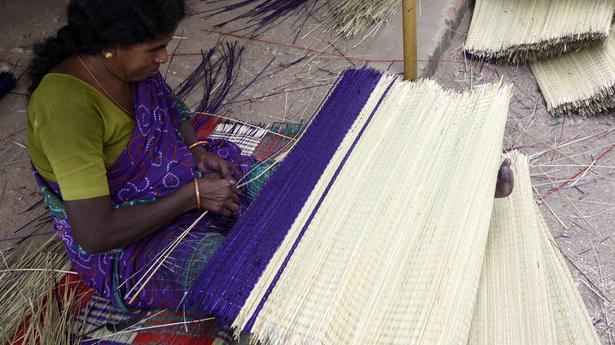
Up until a few decades ago, when sitting, dining and sleeping on the floor were the norm, the korai pai or grass mat used to be the chief furnishing in any Tamil home. Made with dried halfa grass that grows on river banks, the kora pai is washable and is available in different sizes. Gifting a new mat to the bride was one of the many wedding traditions in southern India.
The love for mats has endured despite the changing tastes in interior decoration.
“A properly woven korai pai can last for two years without damage. Since it is a natural fibre, keeping it in a damp environment can cause mildew; but if rolled and kept in a dry conditions, the mat is reusable with just minor wear and tear,” said S. Karthik, who runs the online section of his family-run business ‘The Grass Mats’ in North Theraniyampatti village, Musiri.
With an abundant supply of river-fed korai grass in the region, mat manufacturing has been a leading cottage industry in Musiri.
The Grass Mats unit has 11 machines that can weave up to 1,000 korai pais in a day. “We grow our own korai grass for the factory. And though only one worker is needed to oversee the mat-making machine, the rest of the process, from harvesting the grass, to splitting, drying and then dyeing it, are all labour-intensive. Getting enough workers has been tough during lockdown, but we are slowly getting back to pre-pandemic production volumes,” Mr. Karthik told The Hindu.
The mats are available in a range of designs and colours, edged with cloth basting that is manually sewn at the end. “The jacquard designs, which incorporate coloured grass with patterns of birds or flowers and are given as part of the wedding trousseau, are the costliest items in our shop,” said Mr. Karthik.
Business has not been as stable for mat weavers who rely on external grass supplies. “The cost of transporting the raw stock has risen so much that we have stopped manufacturing this year. A mat that sells for ₹200 may cost more than ₹500 to make when you add the fuel and vehicle overheads,” said a mat weaver in Mela Vadugapatti, Musiri.


Execution of development projects, infrastructure augmentation to occupy centre stage in electioneering

Telangana Cabinet approves Hate Speech and Parents Support Bills, ensuring accountability for neglecting elderly and curbing hate-driven offences.

EU and Australia finalize a free trade agreement and establish a new defense partnership to enhance economic and military cooperation.

U.S.-Israeli war on Iran LIVE: Iran faces deadline of US President Donald Trump warning to open Strait of Hormuz. Follow The Hindu for more LIVE updates on March 23 2026 on Iran-Israel war.

KPCC chief Sunny Joseph emphasizes UDF's focus on Sabarimala and corruption while expressing confidence in winning Kerala's upcoming Assembly elections.

A military plane crash in Colombia leaves 125 aboard, with at least 48 survivors rescued amid ongoing recovery efforts.

‘Symposium’, a new platform to promote lifelong learning and counter misinformation among youth, was launched in Hyderabad.

By using TB as an entry point, integrated healthcare delivery can optimise and improve public health efficiency

Residents of Chettichavadi express concerns over deteriorating groundwater quality due to long-standing garbage dumping issues in Salem West.

Community Health Officers in Vijayawada protest for reduced workload and continued incentives amid growing dissatisfaction over salary changes.

Telangana faces 13,929 healthcare vacancies, primarily in doctors and nurses, as recruitment efforts aim to address the shortage.

For most patients with TB who are severely underweight, nutritional support is an essential and not optional part of treatment

Family of custodial death victims demands harsh punishment for nine convicted policemen to prevent future abuses of power.