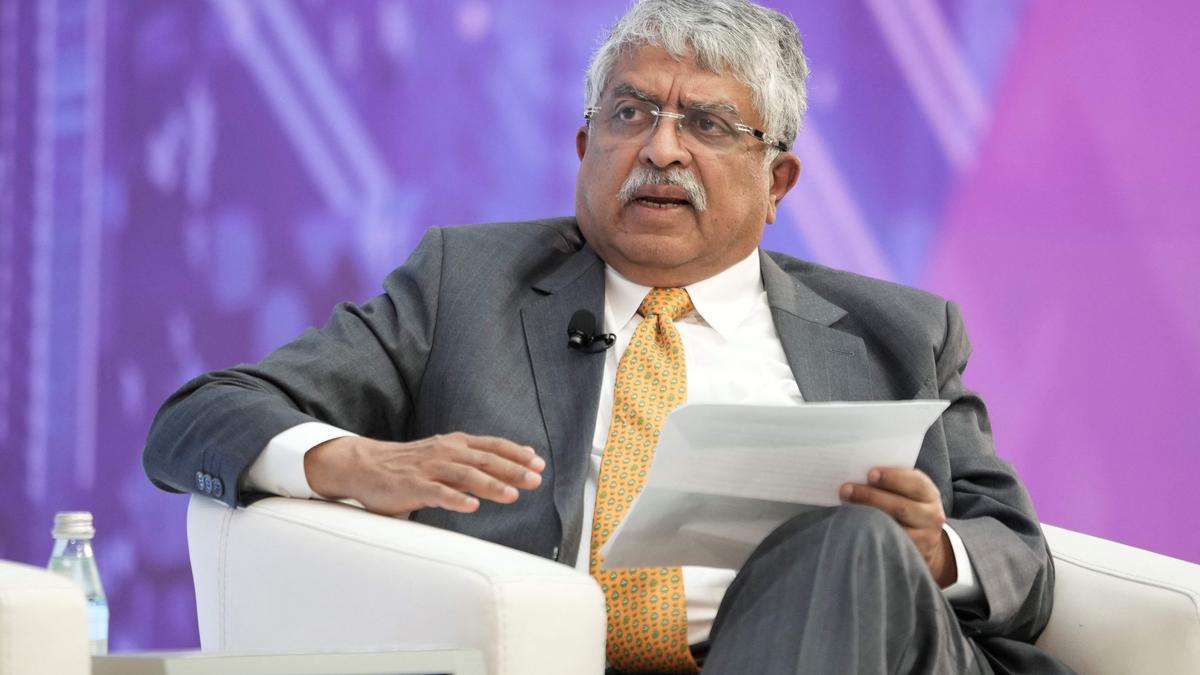
Multiple colliding market trends made Infosys reexamine business fundamentals: Nandan Nilekani
The Hindu
Infosys Chairman Nandan Nilekani discusses global market trends, supply chain risks, AI challenges, and climate change impact on businesses.
Multiple trends were colliding, in the global markets, and that led Infosys to reexamine the fundamentals of its businesses, said Nandan M. Nilekani, Chairman, Infosys.
“As we contemplate the developments of the last few months, we know we are in an era of uncertainty that we have never seen before. Multiple trends are colliding and leading us to reexamine the fundamentals of our businesses,” he wrote to shareholders in the company’s annual report FY’25.
He said, “As geopolitics becomes front and centre in our lives, we are having to take cognizance of the world not as one single global market but as fragmented blocs and countries. This means making strategic choices and even navigating between these blocs.”
According to Mr. Nilekani, COVID brought into focus the critical and pressing need to de-risk the supply chain and build viable alternatives. “It was no longer enough to deliver just-in-time; we had to also factor in for just-in-case,” he told shareholders.
He further said, now tariffs were further driving home the point that the company has to diversify its sourcing. “Tariffs will be differentiated across products and countries and will likely keep changing. Bilateral and regional rules of trade will dominate. Supply chains will continue to shift as tariffs become another form of arbitrage,” he pointed out.
On AI, he wrote, its advent with all its possibilities and potential created another arc of uncertainty. As enterprises looked at applying AI to every aspect of the business, some long standing challenges would become imperative and self-evident to firms. For example, the need to modernise legacy systems, and the need to create data architecture so that all the firm’s data would become consumable by AI, in a holistic manner, could no longer be put off, he elaborated.
“Firms will need to have an AI foundry for rapid innovation and an AI factory to scale successful innovations across the enterprise. While embracing AI will bring a goldmine of opportunities, it will not be entirely without some foreseeable risks,” he further wrote. Mr. Nilekani also stated that regulatory variances across regions would need to be incorporated into one’s strategy. “The early learnings from enterprise AI adoption gives us a glimpse of these potential challenges that lie on the path ahead,” he said.


The rupee declines 20 paise to 93.73 against the dollar as global oil prices rise and investor uncertainty persists.

Siemens said on Monday that the Iran war has led to customers holding back on new investments as prices increase for raw materials and energy.

OpenAI said its close ties with Microsoft could be a potential risk to its business, telling investors that the software company is responsible for “a substantial portion of our financing and compute,” CNBC reported

LPG crisis: Alternative solutions are being considered, with ammonia cylinders being increasingly used for industrial applications amid delays in commercial LPG deliveries.

India monitors U.S. military pause on Iran as oil prices dip; External Affairs Minister engages with GCC nations for support.

India monitors U.S.-Iran tensions as Trump pauses attacks, leading to a significant drop in oil prices.

Union Minister Ashwini Vaishnaw launches three initiatives to enhance India's creative economy through AI training, citizen platforms, and advanced tech access.

Two Indian-flagged LPG tankers approach the Strait of Hormuz, navigating safely amidst regional tensions to reach Indian ports.

Gold and silver prices plummet over 7% due to West Asia tensions, inflation fears, and a stronger dollar.

Asian shares fall as rising oil prices and escalating Iran conflict diminish hopes for U.S. interest rate cuts.

Japan's SoftBank Group said Saturday it plans to build a huge new gas-fired power plant in the US state of Ohio

Silver prices plunge 9% to ₹2.06 lakh per kg in futures trade amid weak global cues and rising macroeconomic pressures.

OpenAI plans to nearly double its workforce to 8,000 from 4,500 by the end of 2026, the Financial Times reported on Saturday, citing two people with knowledge