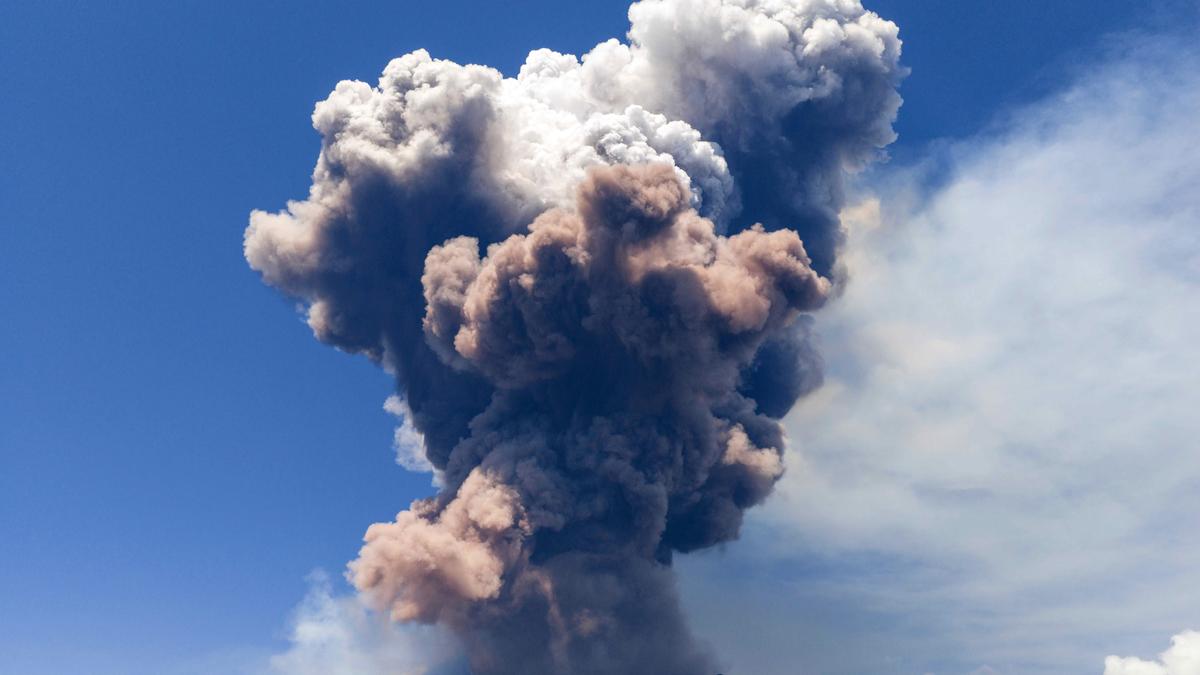
Mount Etna erupts: All about Europe’s most active volcano
The Hindu
A UNESCO world heritage site, Mount Etna is not only Europe’s but also one of the world’s most active volcanoes.
Mount Etna in Sicily, Italy erupted once again on Monday (June 2, 2025), putting up a spectacular display even as it sent a cloud of smoke and ash up several kilometres into the air. According to the authorities, the eruption does not pose any threat to people, although the alert level of the Catania Airport was raised. The ash cloud ended by afternoon.
A UNESCO world heritage site, Mount Etna is one of Europe’s, and the world’s, most active volcanoes. At least 2,700 years of eruption activity have been documented for the volcano, which, according to UNESCO, is one of the world’s longest documented records of historic volcanic activity.
Mount Etna roughly stands at an impressive 3,300 metres, which is approximately four times the height of Burj Khalifa, the world’s tallest building.
Unlike many other volcanoes that remain dormant for years before they erupt, Etna remains in an almost constant state of unrest.
Mount Etna is a type of a stratovolcano, which is a conical style volcano. According to the British Geological Survey, stratovolcanoes are formed from viscous lava that does not flow easily and instead, deposits around the vent, adding to the slope structure. Around 60% of the earth’s individual volcanoes are stratovolcanoes.
Mount Etna usually erupts in either effusive or strombolian style. An effusive way of volcanic eruption is characterised by the outpour of lava onto the ground, while strombolian activity is more explosive.
According to Italy’s National Institute of Geophysics and Volcanology (INGV), Mount Etna’s eruptive activity started around 500,000 years ago.


Kim Jong Un vows to solidify North Korea's nuclear status and labels South Korea as its "most hostile" adversary.

U.S.-Israel war on Iran LIVE: Follow The Hindu for updates on the West Asia conflict on March 24, 2026

Trump claims “very good” talks with Iran, despite Tehran’s denial, as U.S. negotiators plan potential meetings in Pakistan.

Netanyahu discusses U.S.-Israeli military gains with Trump, emphasizing commitment to protect Israel's interests amid ongoing conflicts.

Pakistan reaffirms commitment to combat terrorism as Afghan ceasefire approaches end amid rising tensions and recent casualties.

Trump postpones military strikes on Iranian power plants for five days amid escalating tensions and ongoing diplomatic discussions.

Shorts News:Watch: NATO chief: 22-nation group forming to secure Strait of Hormuz

Saudi Aramco reduces crude supply to Asia for April, citing disruptions from the Iran-Israel conflict affecting trade routes.

Tencent launched a tool on Sunday to integrate its WeChat messaging platform with the OpenClaw agent

An Air Canada flight collided with a Port Authority vehicle at LaGuardia Airport, causing significant damage and police response.

Saudi Arabia and the UAE face missile attacks, with casualties reported and air defenses engaged amid escalating regional tensions.

Slovenia's parliamentary election results show a tight race between liberals and populists, signaling potential political instability ahead.

IEA chief warns of a potential energy crisis worse than the 1970s, with 11 million barrels lost daily amid regional conflicts.