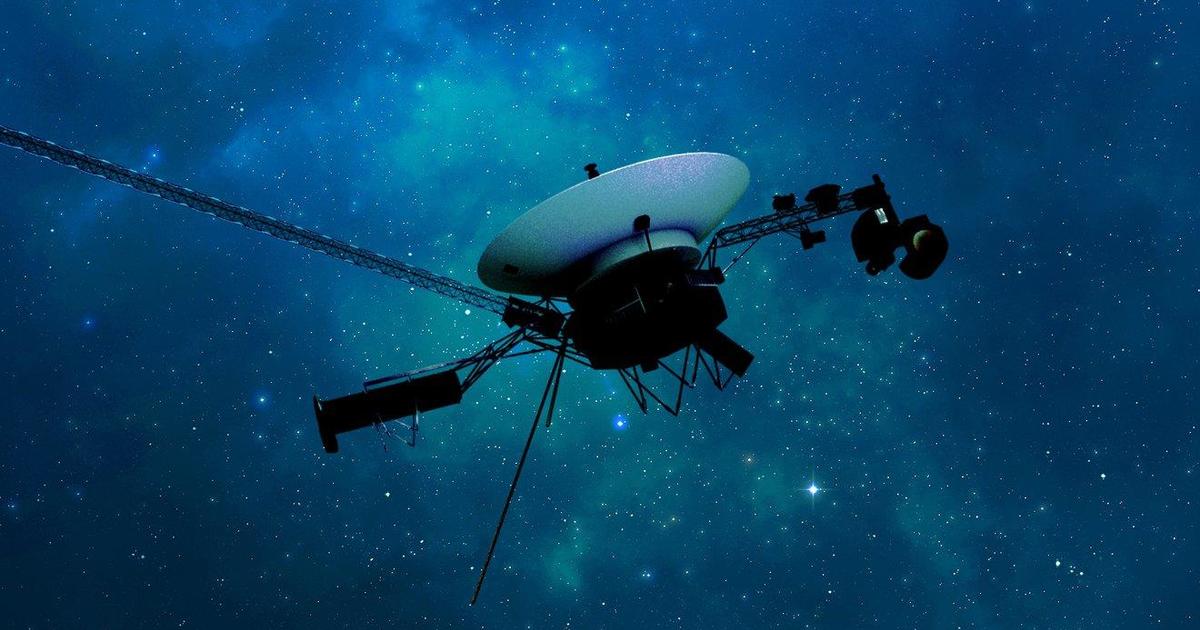
Most distant spacecraft from Earth sends data to NASA for first time in 5 months
CBSN
The most distant spacecraft from Earth has resumed sending data after a five-month gap, NASA said Monday.
NASA's Voyager 1 spacecraft was launched in 1977, about two weeks after the launch of its twin, Voyager 2. The spacecraft has spent over 45 years studying the outer solar system and has made flybys of Jupiter and Saturn and traveled more than 46,000,000,000 miles.
In November 2023, the spacecraft stopped sending "readable science and engineering data," NASA said in a news release. Mission controllers were able to determine that Voyager 1 was still receiving commands from Earth and operating normally, but the science data could not be read and researchers did not know the status of the craft's onboard engineering systems.


Washington — Pentagon officials have made detailed preparations for deploying U.S. ground forces into Iran, multiple sources briefed on the discussions told CBS News. In:

Delays at major U.S. airports across the country persist as Transportation Security Administration officers continue to work without pay and call-outs mount as the partial government shutdown drags on. In:

For U.S. consumers, soaring oil prices due to the Iran war don't just mean pain at the pump — the impact is also likely to be felt by shoppers both in stores and online. In:

A second Marine Expeditionary Unit of about 2,200 Marines and three warships is headed toward the Middle East, as the war with Iran continues. In:

We may receive an affiliate commission from anything you buy from this article. In:

Police in Barcelona, Spain, said the death of James "Jimmy" Gracey, a University of Alabama student from Illinois who went missing on vacation, was likely an accident. In:

A 31-year-old Georgia woman has been charged with murder by police who say she took pills to induce an abortion in violation of a state law that bans it after the earliest weeks of pregnancy. In:

The Justice Department says it has shuttered four websites that were allegedly used by Iranian government-linked groups to post hacked information and threaten regime critics.

A federal arts commission on Thursday approved the final design for a 24-karat gold commemorative coin bearing President Trump's image to help celebrate America's 250th birthday on July 4. In:

The Federal Communication Commission announced Thursday evening that it had approved the $6.2 billion merger of major broadcast station owners Nexstar and Tegna. The move came on the same day that attorneys general in eight states and DirecTV filed separate lawsuits seeking to block the deal, arguing that it will lead to higher prices for consumers and stifle local journalism. In:

Requiring photo ID to vote and proving citizenship to register both find wide and often bipartisan support. In:

Mortgage rates in the U.S. jumped this week to the highest level in three months, as the Iran war fans inflation fears and puts pressure on the U.S. housing market. Edited by Alain Sherter In:

Soaring energy prices due to the Iran war could provide a massive windfall for U.S. oil companies. Edited by Alain Sherter In: