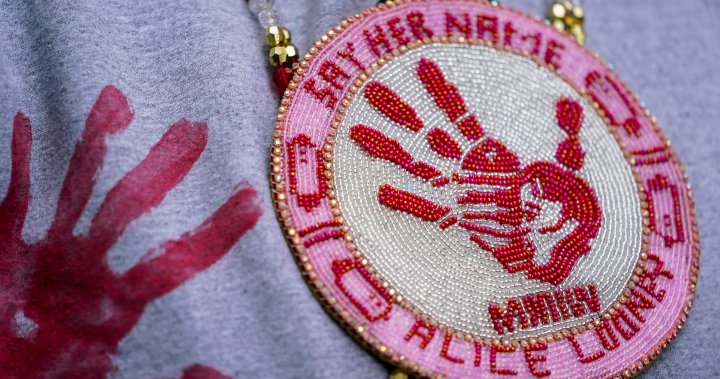
‘More than just stats’: Victoria march for MMIWG centres families
Global News
Victoria's Stolen Sisters Memorial March is in its 14th year, and this year will take place on Saturday, Feb. 10. It always maintains the same message — uplifting families.
Every February on and around Valentine’s Day, First Nations, Inuit and Métis people organize marches for missing and murdered Indigenous women and girls (MMIWG) across the country.
Inspired first by the Women’s Memorial March that started in Vancouver in 1992 after Cheryl Ann Joe, a shíshálh Nation woman, was found murdered, Victoria’s Stolen Sisters Memorial March has taken on a life of its own. Now in its 14th year, the march still maintains the same message — uplifting families.
“It means many things to our community, it’s grassroots, it’s not a protest,” said Lisa deWit, a member of Wet’suwet’en First Nation, Laksilyu clan, who is part of the march’s committee. “This march is centred in love and it’s a memorial to remember women, children and LGBTQ2S+ who have gone missing or been murdered.
“It’s also to hold space for those of us who are mourning, left in limbo or still searching.”
For deWit, whose aunt disappeared in October 2017, these marches that happen across British Columbia and the rest of Canada are needed.
“It’s an opportunity to remind greater society as a whole that this issue is still present,” she said. “Perhaps it inspires others to get curious, to understand the systems that are contributing to our women disappearing and being murdered — (the MMIWG crisis) is more than just stats.”
But the stats are harrowing.
According to the Assembly of First Nations, Indigenous women make up 16 per cent of all female homicide victims, and 11 per cent of missing women, yet Indigenous people make up only five per cent of the population of Canada.


U.S. President Donald Trump said on Sunday that he would order federal immigration agents to airports to assist TSA. Canadians landing the U.S. should be prepared.

Three overpasses in Saskatoon have been hit in the past three weeks, with charges announced against the driver in the first incident.

Auditor General Karen Hogan says there are critical weaknesses in the integrity controls for the International Student Program.

Return trips by Canadian residents from the U.S. fell 22 per cent in January compared with a year earlier, according to the latest data.

Three byelections are being held on April 13 and the results could have an impact on both the makeup of Parliament and how long it lasts.

Ontario's provincial members of parliament are heading back to Queen's Park Monday, as the legislature sits for the first time since December.

Members of Parliament are back in the House of Commons today, where the government is expected to face tough questions about new auditor general reports and the war in Iran.

Two Air Canada pilots are dead after their flight originating from Montreal collided with a fire truck at New York’s LaGuardia Airport Sunday night.

With more rain in the forecast, crews continue to deal with a mudslide earlier this week that covered a road in Coquitlam in debris, posing risk to Metro Vancouver's water supply.

A former BC Ferries CEO says the Queen of the North sinking remains ‘disturbing’ 20 years later. The ferry struck an island in Wright Sound on March 22, 2006. Two people died.

The 2026 Kraft Hockeyville top two contestants have been named. The winner receives $250,000 for ice rink upgrades, and the runner-up will receive a prize worth about $100,000.

The Office of the Parliamentary Budget Officer scrutinizes federal spending decisions and helps to cost out campaign proposals during elections.

Man’s best friend is proving to be a true lifeline. All across Saskatchewan, service dogs are providing essential, life-changing support every day.