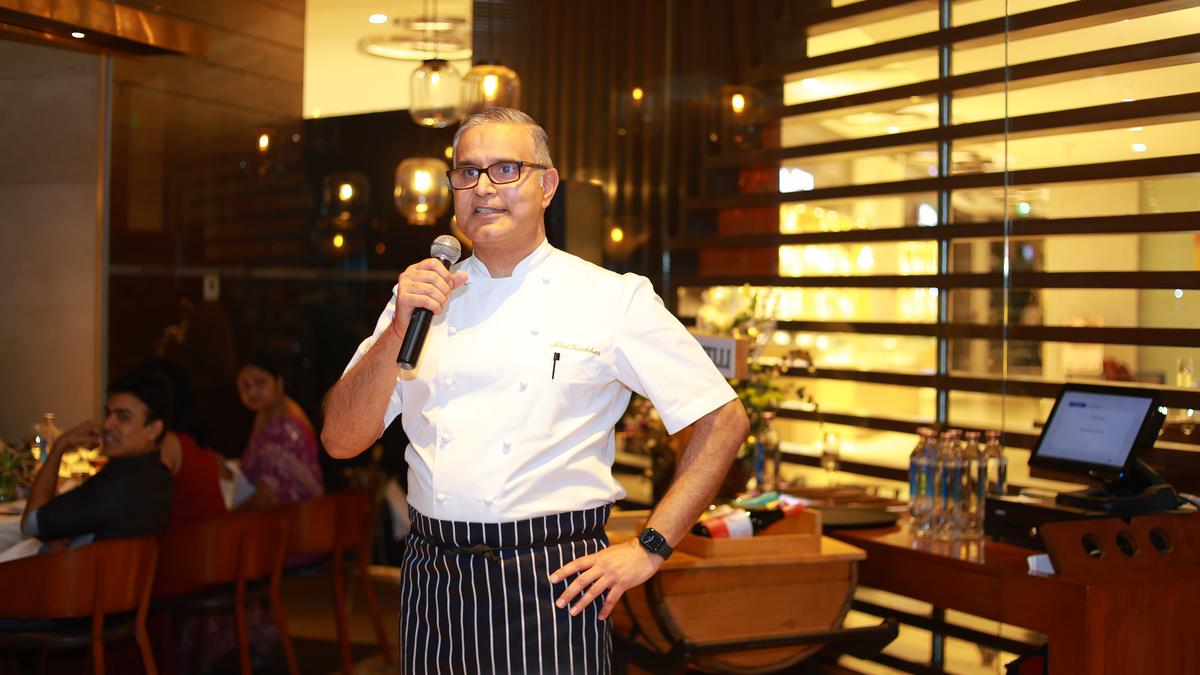
More than curry talk with Chef Atul Kochhar
The Hindu
Chef Atul Kochhar discusses cuisines of India, authenticity, and the importance of traditional ingredients in a culinary journey.
When Chef Atul Kochhar visited Hyderabad to present a culinary event, he wasn’t sure what food to pick and what to avoid. So, along with his team, he created a menu that mapped his journey with Indian food, for a culinary session organised by Swiggy Dineout at The Westin.
Known for his love for Indian cuisine, he says he respects it and considers he is still learning about its vastness. The two-time Michelin star chef says, “My personal opinion is that there is nothing called Indian cuisine because it is not singular; I prefer cuisines of India because that does some justice to what India as a country has to offer in terms of food.”
Curry talk
As an India-born chef he objects to the generalisation Indian food is subjected to. “It is always curry and naan! The task is not simply about educating Westerners. Indians also need to learn and embrace the beauty and variety offered by the States of India. I don’t consider myself an expert. I have a long way to go. “
He adds “I grew up in South India and honestly, people in South India don’t know how diverse their food culture is. There is so much within the five states to learn. A foreigner’s perspective has always been curry but that outlook is elevated thanks to The World’s 50 Best, Michelin Guide and the likes of the late Egone Ronay (Hungarian food critic), who have done a lot in recognising the depth of the country’s cuisine.”
Atul also mentions the work of chef Garima Arora — the first Indian woman chef to win a Michelin star — chef Srijith Gopinathan and chef Himanshu Arora in popularising Indian cuisine in the rest of the world.
Talking about labels of authenticity, Atul feels the term ‘authentic’ should be done away with when describing food in the Indian subcontinent. “The right word should be ‘traditional’. We are traditional people who live with our ethos to food, life and music. Authentic I feel is time-bound, what is authentic today may not remain authentic to my son and so on. A change in ingredients and the quality of produce contribute largely to the flavour profile of food. When I was working with The Oberois, the day bell pepper came into the kitchen, the executive chef called in all the young chefs to see it. It was first brought in from Shimla, where it was first cultivated in India. It was a new ingredient The same goes for asparagus and broccoli; now broccoli and bell pepper are common ingredients.”


The Lok Sabha passes a contentious Transgender Bill, sparking praise from the government and criticism from opposition parties.

Kamal Haasan announces support for DMK in 2026 elections, emphasizing the need for 'Dravidian Model 2.0' for Tamil Nadu's welfare.

Y.S. Sharmila critiques massive concessions for the AMNS steel plant while advocating for the Visakhapatnam Steel Plant and job creation.

Puducherry Assembly elections test the INDIA bloc's unity as parties file nominations amidst seat allocation uncertainty.

T.N. CM Stalin advocates for constitutional safeguards to maintain state representation in delimitation amid women’s reservation discussions.

Rohit Pawar files complaint in Bengaluru alleging conspiracy in Ajit Pawar's air crash; Maharashtra police had refused FIR.

Armed extremists attack Mongkot Chepu village again, firing on students and injuring civilians amid rising tensions in Manipur.

TGNPDCL bags ‘Governance Now’ award

Perundurai's industrial growth faces challenges of pollution, water scarcity, and healthcare, impacting residents ahead of the 2026 elections.

The Travancore Devaswom Board asserts that courts should respect community beliefs in its Supreme Court submission on Sabarimala's entry issue.

Karnataka cancels Deendayal Upadhyay event at KSOU due to protocol violations, citing inconsistency with university objectives.

Illegal pickle unit busted in Hyderabad, one arrested; unhygienic stock worth ₹3 lakh seized

Karnataka has entered a state of demographic transition where a large working-age population will no longer be enough to drive economic growth, and future gains will depend on how productively people are employed, the ‘State of Working India 2026’ report said.