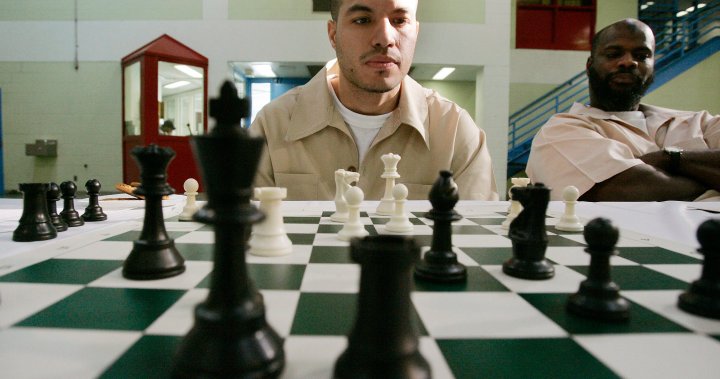
More than a game: How chess is helping prisoners in Canada
Global News
While chess may seem like just a board game to some, it is now being used in prison systems in Canada and across the world to help rehabilitate prisoners.
While chess may seem like just a board game to some, it is now being used in prison systems in Canada and across the world to help rehabilitate prisoners.
For the last ten years, Carl Portman has led a prison chess program in the U.K. that he says has worked wonders on the disposition of convicted felons.
“It’s actually perfect for prison,” he told Global News. “Chess is about making good choices.”
Portman said that he has received testimonials from countless prisoners over the years who attest to how the game has helped them.
One said that instead of committing a crime after being released, he is now going to the chess club. Another said that he now thinks before acting, which prevented him from getting back into the drug trade, while a third said the game helped him reconnect with his son after being released because he knew he played as well.
Portman said that chess teaches you to think before acting and to take responsibility for your actions because once you make a move you can’t take it back. You have to live with the consequences.
“(There’s) a lot of shouting and swearing and cursing,” he said.
Chess has now made its way to the Canadian prison system, and research has begun to explore how the game might change a prisoner’s brain for the better.


The Oscar-winning actor has denied all allegations against him and maintains that the incidents raised in the lawsuits either did not happen or were consensual.

European leaders have deflected entreaties from U.S. President Donald Trump to send military assets to secure the Strait of Hormuz.

All six crew members of a KC-135 Air Force refueling aircraft were killed last week in a plane crash over friendly territory in western Iraq, supporting operations against Iran.

U.S. Director of National Intelligence Tulsi Gabbard testified that the regime remains intact and Tehran and its proxies remain capable of attacking U.S. and allies' interests.

James 'Jimmy' Gracey was reported missing after he didn't return to the short-term rental where he was staying with friends during spring break.

The U.K. Health Security Agency described the event as 'rapidly evolving' and warned of the potential for further cases.

U.S. benchmark crude fell US$1.24 to US$94.53 per barrel. Brent crude, the international standard, rose to US$104.17 per barrel. That's down from more than US$106 on Monday.

Volodymyr Zelenskyy urged Ukraine's allies not to forget about his country, and suggested the U.S. and others should make use of Ukraine's anti-drone technology during the war.

Trump’s visit to China is seen as an opportunity to build on a fragile trade truce, but it has become tangled in his effort to find an endgame to the war in Iran.

White House economic adviser Kevin Hassett said oil tanker traffic in the Strait of Hormuz starting to move is "a sign of how little Iran has left."

The secretary of Iran’s Supreme National Security Council, and the head of the Revolutionary Guard’s all-volunteer Basij force, were “eliminated last night," Israel said.

Explosions were heard in Maiduguri, the Borno state capital, where Nigeria’s homegrown jihadi Boko Haram extremists have waged an insurgency for more than a decade.

Iran is reportedly allowing some ships to travel through the Strait of Hormuz, a vital shipping chokepoint to access the resource-rich Persian Gulf.