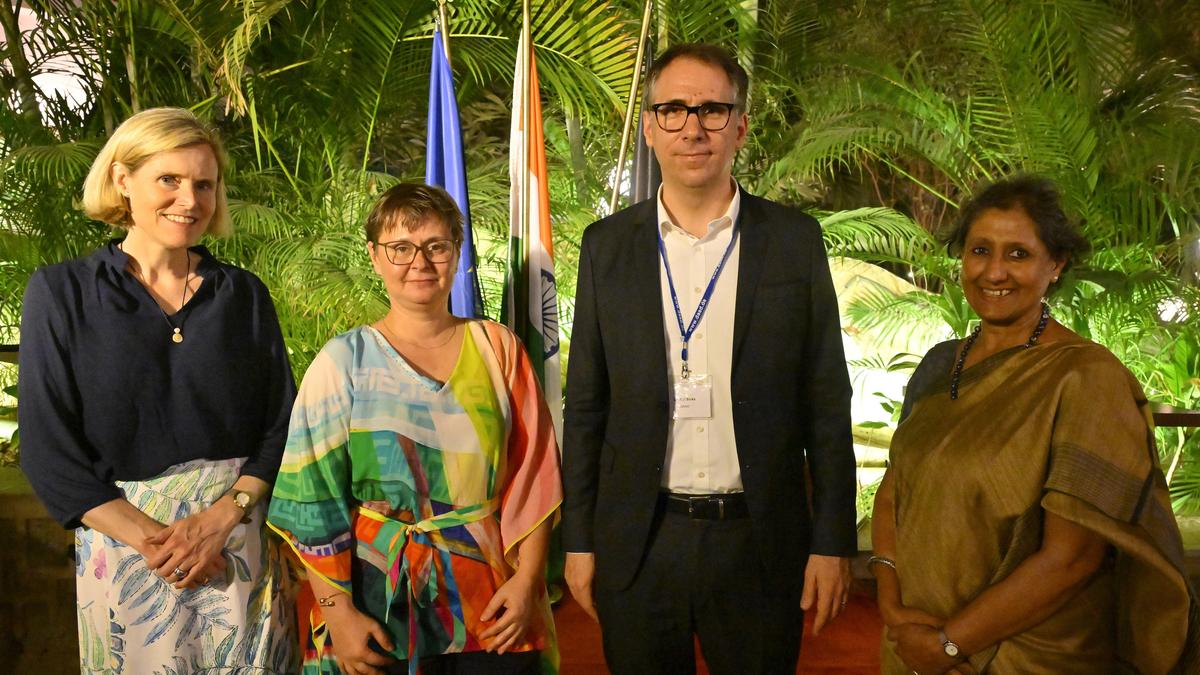
More potential for academic cooperation between India and Germany: Consul General Misera-Lang
The Hindu
Germany and India strengthen academic ties through partnerships and collaborations, fostering educational growth and innovation for the future.
Germany and India are both expanding partnerships in many fields and closer academic cooperation holds a lot of potential, Consul General, German Consulate Chennai, Kathrin Misera-Lang said here on Monday.
Ms. Misera-Lang was leading a high-profile delegation from German Academic Exchange Service or Deutscher Akademischer Austauschdienst (DAAD) comprising 27 members, including directors of DAAD New Delhi and rectors of 18 German institutes of higher education, to premier institutes in Hyderabad.
The delegation is on seven-day trip for its DAAD higher education policy visit to India and Hyderabad was their first stop. The tour concludes in Delhi with an education fair later this week.
Ms. Misera-Lang said the biennial visit was to form new networks, learn about the Indian higher education system, and strengthen relationships with already partner institutes such as the Indian Institute of Technology Hyderabad, the International Institute of Information Technology Hyderabad, and University of Hyderabad. With improved collaborations, she said more German students would study and research in Hyderabad soon.
Speaking to The Hindu, DAAD Secretary General Kai Sicks said Germany has about 50,000 Indian students as per latest numbers, compared to 6,000 students 10 years ago. And India remains an important geopolitical region and an important ally in Germany, for Germany.
“The academic bridge between India and Germany is strong and future-ready. The presence of top representatives of Germany’s institutions in Hyderabad is a message of clear will and express ambition to intensify academic ties,” he said.
Mr. Sicks added that funding for education and research is “more committed and considered an investment,” even for Indo-German ties. As of 2023, DAAD funded 1.4 lakh German and International students with primary funding from the German Federal Foreign Office, the European Union, and various organisations.


Telangana's revised pay scale implementation for employees will take timer. The tenure of Pay Revision Commission extended. Govt likely to take decision on reccomendation based on its report.

Vizianagaram's SP A.R. Damodar highlights 20 accident-prone areas and urges drivers to prioritize safety with helmets and seat belts.

Kerala HC stays disqualification of SNDP Yogam leaders, reversing a single judge's order regarding financial and regulatory compliance issues.

Karnataka announces daily supply of 10,000 LPG cylinders to hotels, easing the commercial shortage for the hospitality industry.

Malayalam superstar Mohanlal will be reuniting with filmmaker Priyadarshan, it was announced recently. It will mark the 100th film of Priyadarshan and is backed by Mohanlal’s longtime collaborator, Antony Perumbavoor

Gautham Vasudev Menon loses Madras High Court appeal, ordered to pay ₹4.25 crore to R.S. Infotainment with interest.

AIADMK faces its toughest challenge in 53 years as it prepares for the crucial 2026 T.N. Assembly elections.

Lakmé Fashion Week x FDCI 2026 in Mumbai: What worked and what didn’t

Telangana CM announces underpass beneath Begumpet Airport runway to alleviate traffic congestion in Hyderabad.

Congress leader Ramesh Chennithala claims an alliance between Pinarayi Vijayan, Modi, and Shah aims to undermine UDF in Kerala elections.

CCB arrests Bengaluru couple for running a fake government job scam, cheating over 100 victims out of crores.

The enduring legacy of Araiyar Sevai

Telangana integrates with the 'Vahan' platform and eliminates 2% tax on second vehicles, enhancing transport services and transparency.