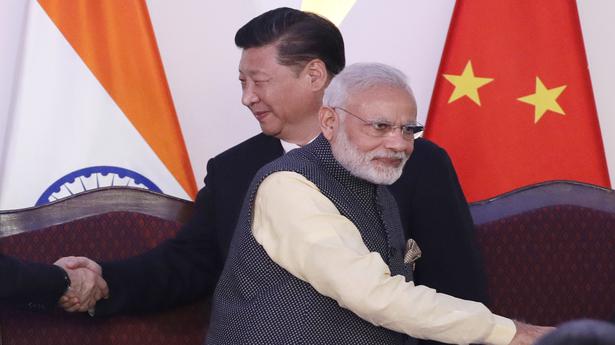
Modi, Xi weigh meeting as chill remains in ties
The Hindu
MEA backs German envoy’s comments on Beijing’s ‘outrageous’ claims on Arunachal Pradesh, in its latest message to China
India and China are weighing a first meeting between Prime Minister Narendra Modi and President Xi Jinping in almost three years, even as a chill remains in relations with an as-yet-unresolved border crisis and increasingly sharp recent exchanges between the two countries.
While this meeting could come as early as mid-September, with both leaders currently expected to be present at the Shanghai Cooperation Organisation (SCO) summit in Uzbekistan, the G20 meet in mid-November in Indonesia, where both have confirmed their attendance, offers another possibility.
A meeting does, however, come with risks for New Delhi, which has viewed warily China’s recent attempts to portray ties as “normal” despite the situation at the Line of Actual Control (LAC), a perception that a high-level meet may reinforce. New Delhi reluctantly hosted Foreign Minister Wang Yi in March as he visited the region, but conveyed a strong message that India would not accept China’s demand to keep the border “in an appropriate place” and restore relations.
India has since kept up that messaging in public. On Thursday, the Ministry of External Affairs (MEA) backed the German Ambassador to India's comments calling China's claims on Arunachal Pradesh as "outrageous" and its transgressions at the LAC a "violation of international law". Responding to German envoy Phillip Ackerman's comments, which had generated anger in Beijing, MEA spokesperson Arindam Bagchi said the international community has a "proper appreciation" of India’s stand on boundary issues.
On August 29, Mr. Jaishankar, in a speech in New Delhi on August 29, repeated for the third time in recent weeks India’s stand that normalcy in ties was predicated on normalcy on the border, a position he expressed last month during visits to Australia and Brazil, saying it was not “a conditionality we are imposing” but “stating the facts” on past agreements between the two sides. China’s military, for its part, last week cited those same agreements, which India has accused China of violating, to oppose upcoming India-U.S. high altitude military exercises, calling them “meddling”.
Mr. Jaishankar also indicated that differences went beyond the border, and pushed back against Mr. Xi’s earlier call for an “Asia for Asians”, describing it as “a sentiment that was encouraged in the past, even in our own country, by political romanticism”. He also cautioned, when speaking of an “Asian century”, against “overtones of triumphalism with which India at least should not be comfortable”.
Past meetings between Mr. Modi and Mr. Xi have been seen by both sides as helping calm border tensions — a brief conversation in July 2017 on the sidelines of a summit was seen as breaking the deadlock that led to the resolution of the stand-off in Doklam the following month. In recent months, however, the Chinese military has continued with a hardline stance on slow-moving LAC talks and refused to restore the status quo, a stand which, given Mr. Xi’s apparently tight control over the People’s Liberation Army (PLA), appears to be following his direction.


The government plans to amend the FCRA, introducing new regulations for NGO asset management and accountability for key functionaries.

The draft policy for “Responsible Digital Use Among Students”, released on Monday by the Department of Health and Family Welfare, has recommended that parents set structured routines with clear screen-time rules and prioritise privacy, safety, and open conversation with children on digital well-being.

Police Observer Sushant Kumar Saxena conducts surprise inspection at Shencottai police station, reviewing warrants and security arrangements ahead of elections.

Andhra Pradesh government to launch key projects in April, focusing on industrial growth and infrastructure development, says Nara Lokesh.

Lok Sabha refers the Corporate Laws (Amendment) Bill to a JPC amid opposition concerns over CSR provisions dilution.

SHG members in Kanniyakumari use snakes and ladders to raise election awareness and boost voter turnout.

Government accelerates consultations for early implementation of the Women’s Reservation Act to ensure women’s representation in 2029 elections.

CM A. Revanth Reddy distributes ₹1 crore insurance cheques to families of deceased Electricity department employees, enhancing financial security for workers.

The Bengaluru Traffic Police (BTP) registered 634 cases of drunk driving during a week-long special enforcement drive conducted across the city between March 16 and March 22.

GHMC intensifies action against property tax defaulters, seizing properties and offering a One Time Settlement scheme for payments.

CCB arrests three drug peddlers in Mangaluru, seizing ₹2.5 lakh worth of MDMA and other valuables.

TVK's 28 candidates in Puducherry include former BJP MLAs, a sitting Independent, and a retired police IG.

BRS submits notice on private member bill to Speaker