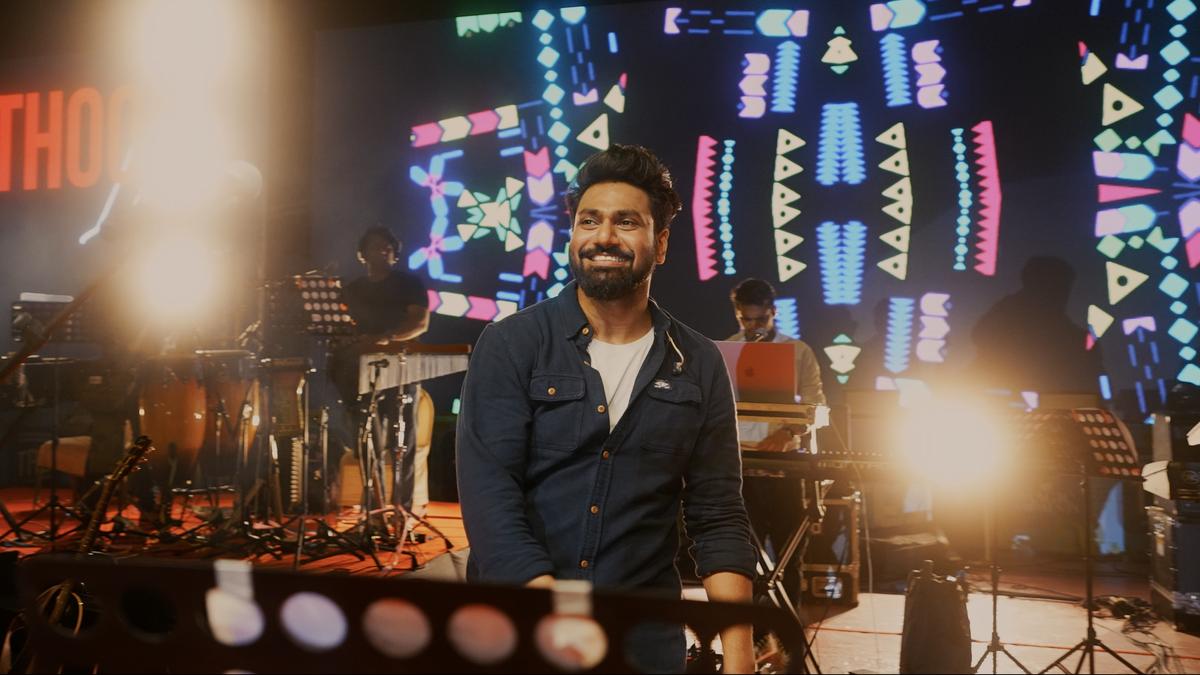
Mithoon, the maestro of melodies
The Hindu
Mithoon, the master of melody in Bollywood, shares his musical journey
There is a reason Mithoon is called the master of melody. For nearly 20 years, he has created the soundtrack of modern love in Bollywood — from the 2013 hit Aashiqui 2 with ‘Tum Hi Ho’ to Sanam Re and ‘Tujhe Kitna Chahein Aur Hum’ (Kabir Singh). His songs have become favourites for those in love or dealing with heartbreak. Despite the fame, Mithoon remains grounded. “I am just a seeker,” he says over the phone. “Anyone true to their art knows it is a gift from above.”
Now, with his first independent album Master of Melody, he is stepping outside the film format to offer listeners a more personal collection. “The idea came from T Series’ Bhushan Kumar,” he shares. “My music has a certain fabric. Melody has always played a central role in my connection with listeners. Bhushan felt we should create something that celebrates that very fabric, unapologetically.”
Comprising six songs, the album is less about experimentation and more about immersion. “I wouldn’t call it an experiment,” he clarifies. “It is more of an indulgence. Without the constraints of cinematic narrative, I could just be myself.”
Music runs deep in Mithoon’s blood. As the son of composer Naresh Sharma and nephew of Pyarelal (of the legendary Laxmikant-Pyarelal duo), he inherited more than just musical genes, he inherited a rich legacy. “It gave me discipline and solid training, both in Hindustani classical and Western notation systems,” he says. “But legacy cannot give you your message. Every generation has its own story to tell.”
He did tell the stories as a composer and as a lyricist. The dual role adds emotional depth to his songs, making them feel less like compositions and more like conversations. “Music is a feeling, not just sound,” he says. “Sometimes the melody comes first, sometimes the words. Writing my own lyrics helps me finish the song faster, it is a complete expression.”
A big part of Mithoon’s journey is tied to filmmaker Mohit Suri, who he credits with encouraging his songwriting. Their creative bond continues with the forthcoming film Saiyaara, a project that marks Suri’s first collaboration with Yash Raj Films. “The music will be out next week,” Mithoon reveals. “It is quintessential us, not in sound, but in emotion.”
Then there’s Arijit Singh, whose career is inseparable from Mithoon’s early vision. “When I first heard Arijit, I did not want someone to impress me, I wanted someone to express emotion. He did that. No filters, just raw honesty.” But he refuses to take credit for the singer’s meteoric rise. “I just do my job — match the right voice to the right song.”


South African naturalist Steve Boyes speaks on ghost elephants, ancestral tracking, and Werner Herzog’s documentary exploring Angola’s elusive highland giants

Actor-director Amol Palekar will receive META's Lifetime Achievement award for 2026 on March 25 in New Delhi.

India's artists unite against rising censorship, advocating for creative freedom and support for marginalized voices in the arts.

Written and directed by Kunal, the film also stars Sparsh Shrivastava and Vanshika Dhir

This year, Bharatnatyam artistes will present the Tyagaraja Aradhane as a dance performance

This year, Bharatnatyam artistes will present the Tyagaraja Aradhane as a dance performance

The actor, along with director Sushant Shah, speak about their upcoming series ‘Chiraiya’, Divya’s process of working on the dialect, Sushant’s approach to telling a story about women, and more

An independent video, ‘Feel the Spark’ by Raleigh Rajan with vocals by Ciera Dumas that celebrates Tamil literary giants, garnered 1.4 million views in less than 36 hours.

In ‘Jack Ryan: Ghost War’, John Krasinski is back as the savvy CIA analyst, diving headfirst into a high-stakes mission that unravels a deadly conspiracy and pits him against a rogue black-ops unit

Shriram Bharatiya Kala Kendra’s Shankarlal festival showcased rare ragas, radiant artistry, and inclusive performances, from Pt Madhup Mudgal’s serene morning ragas to Ramana Balachandran’s Saraswati veena.

Explore "Threads that Bind: The Kantha Project," an exhibition in Delhi reimagining kantha as a medium of repair and renewal.

Sean Penn skips the Oscars to meet Ukraine's Zelenskyy, who praises him as a "true friend" amid the war.

The teaser of Tamil star Suriya’s much-awaited film with director Venky Atluri, titled Vishwanath and Sons, was unveiled by the makers on Monday