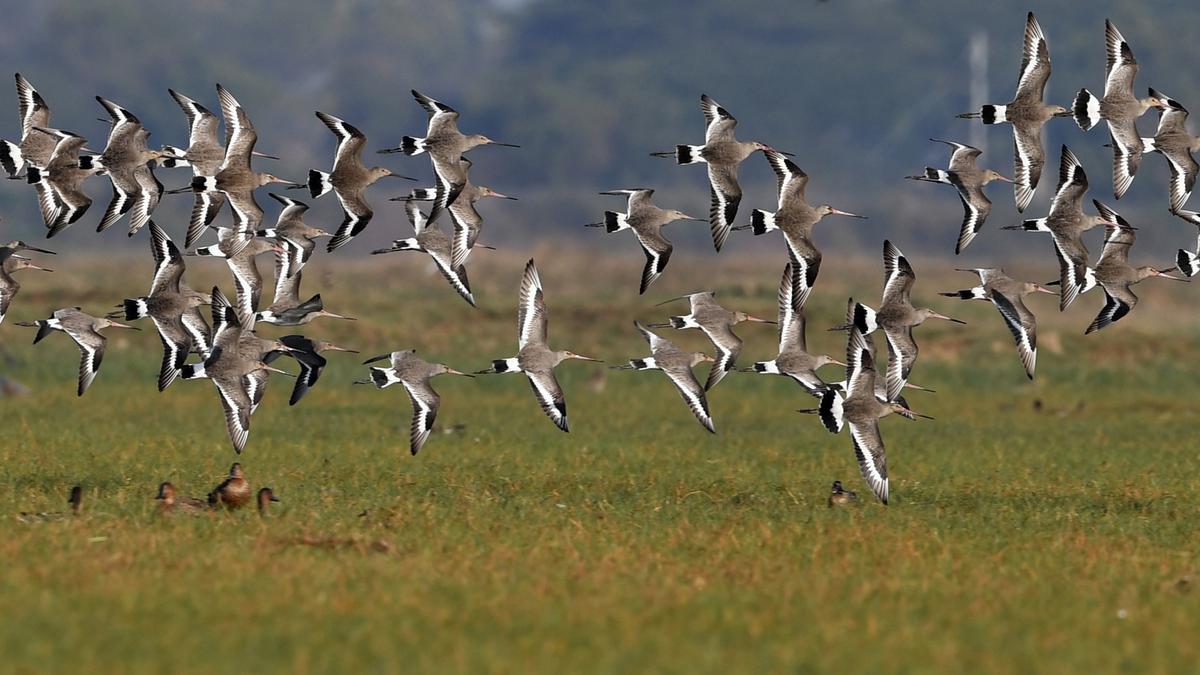
Migratory birds arrive in larger numbers at Mangalajodi in Odisha
The Hindu
Mangalajodi, India’s largest wintering ground for waterbirds in Odisha, was once a poaching ground and today stands as a success story of an award-winning community-led eco-tourism hub
The flutter of a group of northern pintails breaks the misty morning silence at Mangalajodi, the northeastern edge of Chilika Lake, Asia’s biggest brackish water lagoon in Odisha. Slicing through the still waters, a boatman rows a group of photographers towards the birds.
Purna Chandra Behera, a local fisherman and bird-watching guide, focuses his binoculars on a purple heron. “Zoom the lens towards your right. It is about to catch a snake,” he whispers to the photographers in the boat. In a fraction of second, camera shutters click to capture the bird in flight with a catch against the crimson morning sun.
The photographers catch sight of the little stint, a tiny long-distant migrant that flies over thousands of kilometres from the Arctic to vacation at Mangalajodi this time of the year.
Northern shovelers, ruffs, godwits, plovers, gadwalls and a variety of birds arrive in large numbers from across continents to Mangalajodi during the winter months. This year, migratory birds have come in larger numbers to the Chilika lagoon. In winter this year, nearly 11.31 lakh birds were reported from Chilika in the latest census, which is 1.57 lakh more than last year. This included 10.93 migratory birds of over 100 species and native birds of more than 70 species.
A protected ecosystem, improved habitat and abundant food are said to be some of the factors that have made this place a haven for birds. Over 130 enumerators, including bird experts, forest officials and wildlife activists, were involved in the census.
Among the most recorded species were the gadwall and northern pintail, followed by Eurasian wingeon. Northern shovelers, tufted ducks and red crested pochards have also come in greater numbers to the lagoon as compared to last year. Bringing in more cheer to the quaint village of Mangalajodi was the sighting of a pair of river lapwing, which was recorded after more than a decade.
Drawing ornithologists and photographers from across the country, Mangalajodi’s thriving ecosystem is a complete contrast to what was a few years ago. It is hard to imagine that the place was not always the bird paradise it now is.


Explore the behind-the-scenes of political strategy with "Inside the War Room," a must-read for aspiring politicians and managers.

Villivakkam faces civic challenges despite infrastructure improvements, with residents demanding better healthcare, transport, and green spaces ahead of elections.

District Collector launches e-dip lottery for Settipalle land plots, benefiting 2,111 beneficiaries with planned infrastructure development.

Chengalpattu's horticulture farm launches herbal tea, Idhazh, made from sun-dried hibiscus and organic herbs.

Hyderabad is set to become a global film hub, says CM Revanth Reddy at TGFA 2025, highlighting its cinematic potential.

Sivananda Damodara Pai appointed head of RMC Chennai, known for advancing seasonal rainfall and temperature forecasting models.

Madurai Collector chairs meeting with Election Observers

CBI interrogates Anil Ambani in a ₹2,929-crore cheating case involving alleged loan fund irregularities from State Bank of India.

Tamil Nadu's 2026 election features intense competition among established parties and a new disruptor, promising unique voter choices.

Explore the contrasting management styles of England and India cricket teams, highlighting player support and development challenges faced by Liam Livingstone and Sanju Samson.

Modi and Jaishankar advocate for dialogue as India and France collaborate to de-escalate tensions amid escalating strikes on energy infrastructure.

The star-studded event was held in Mumbai and was attended by rithik Roshan, Alia Bhatt, Bobby Deol, Shahid Kapoor, Vijay Varma, Sonakshi Sinha, Jyotika, Ali Fazal, Sonali Bendre, Preity Zinta, Ravi Kishan and others

Shorts News:We are working on securing LPG, petroleum to meet our energy security needs: MEA