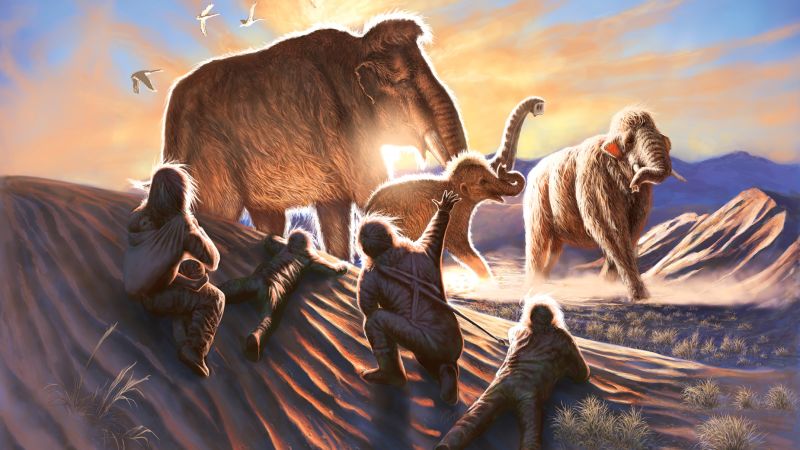
Migration of Alaska’s earliest people linked to woolly mammoth’s movements
CNN
Analysis of a 14,000-year-old tusk in Alaska helped scientists trace the movements of a woolly mammoth, revealing humans likely settled where the animals roamed.
Editor’s note: Sign up for CNN’s Wonder Theory science newsletter. Explore the universe with news on fascinating discoveries, scientific advancements and more. Early human settlements in what is now Alaska tracked closely with the movements of a female woolly mammoth that lived 14,000 years ago, according to a new study. The animal ranged about 620 miles (1,000 kilometers) from northwestern Canada to interior Alaska during her lifetime. The revelation sheds light on the relationship between the prehistoric giants and some of the first people to make their way across the Bering Land Bridge, suggesting that humans set up their seasonal hunting camps where woolly mammoths were known to gather. Researchers from the United States and Canada established the connection between the two species thanks to a new tool for isotope analysis, an ancient tusk and a map of archaeological sites in Alaska. The tusk belonged to a woolly mammoth later named Élmayųujey’eh or, for short, Elma. The specimen was discovered in 2009 at the Swan Point archaeological site in central Alaska. The research began, said lead author Audrey Rowe, a doctoral student at the University of Alaska Fairbanks, after the arrival of a “cutting-edge,” high-precision tool at the institution’s Alaska Stable Isotope Facility that breaks down samples to analyze strontium isotopes — chemical traces that reveal details of an animal’s life. Rowe’s adviser, Matthew Wooller, used the same method to identify the movements of an adult male mammoth for a paper published in August 2021. Wooller is the study’s senior study author, a professor at the university’s College of Fisheries and Ocean Sciences, and the director of the isotope facility.


A Supreme Court case examining state deadlines for election ballots sent in the mail is just the tip of the spear in President Donald Trump’s war on mail-in voting.

As a shrinking number of Transportation Security Administration agents work to keep hourslong security lines moving despite not being paid, President Donald Trump stepped into the fray Saturday, announcing he will send Immigration and Customs Enforcement officers to airports by Monday if Congress doesn’t agree to a plan to end the partial government shutdown.

Donald Trump wants us to believe that a deal with Cuba is close at hand. After this past week, I am not so sure.

The search for missing 84-year-old Nancy Guthrie, mother of “Today” show host Savannah Guthrie, has stretched into another anguished week, with mounting pressure on investigators and a family grappling with uncertainty.

Cuba’s Ministry of Energy announced Saturday evening that entire island has suffered another electrical blackout, leaving more than 10 million people without power.

Iran’s attempt to strike a US-UK base over 2,000 miles (over 3,000 kilometers) off its coast has renewed questions about Tehran’s military capabilities and how far its missiles can reach.

For years, President Donald Trump has offered crass and insensitive comments about people who died – especially his foes. That reached a new level on Saturday.

Robert Mueller, the former FBI director who led the historic probe into alleged collusion between Donald Trump’s 2016 campaign and the Russian government, has died. He was 81.

Marlon Batres is not OK. The assistant principal says he is in constant fear for his students, staff and even himself after federal agents swarmed the streets.

To hear some prominent MAGA voices tell it, the marathon Senate debate over the “SAVE America Act” is an existential one for the Republican Party. But the urgency to pass the legislation is not felt by Americans more widely.

In the days after winning the Democratic nomination for Senate, Illinois Lt. Gov. Juliana Stratton spoke to the two women with whom she could make history next year.

This month, terrorist suspects in the alleged bomb-throwing in New York City and the synagogue attack in Michigan visited Phantom Fireworks stores shortly beforehand.

In near-daily briefings with top military officials at the White House, President Donald Trump has reviewed options that include sending American troops into Iran.