Migration and memories at the heart of artist Arjun Das’ works in Hyderabad
The Hindu
The exhibits in discarded wood, stone, coal, metal and asphalt narrate stories of the migrant working class
Arjun Das draws from his own identity as a first-generation migrant from Jharkhand, to Kolkata. His solo show, Land of the Leal at Hyderabad’s Dhi Artspace provides glimpses of spaces inhabited by the migrant working class in cities. In search of a better life and livelihood, most migrants move to cities where they live in small, impermanent places. The narratives in wood, metal, stone, coal, terracotta roof tiles and asphalt reflect their lives, struggles and ways to survive in this new home which offers nothing in terms of space but carries the hope for their unrealised dreams. The show’s title, Land of the Leal, symbolises cities as dream places that lure them.
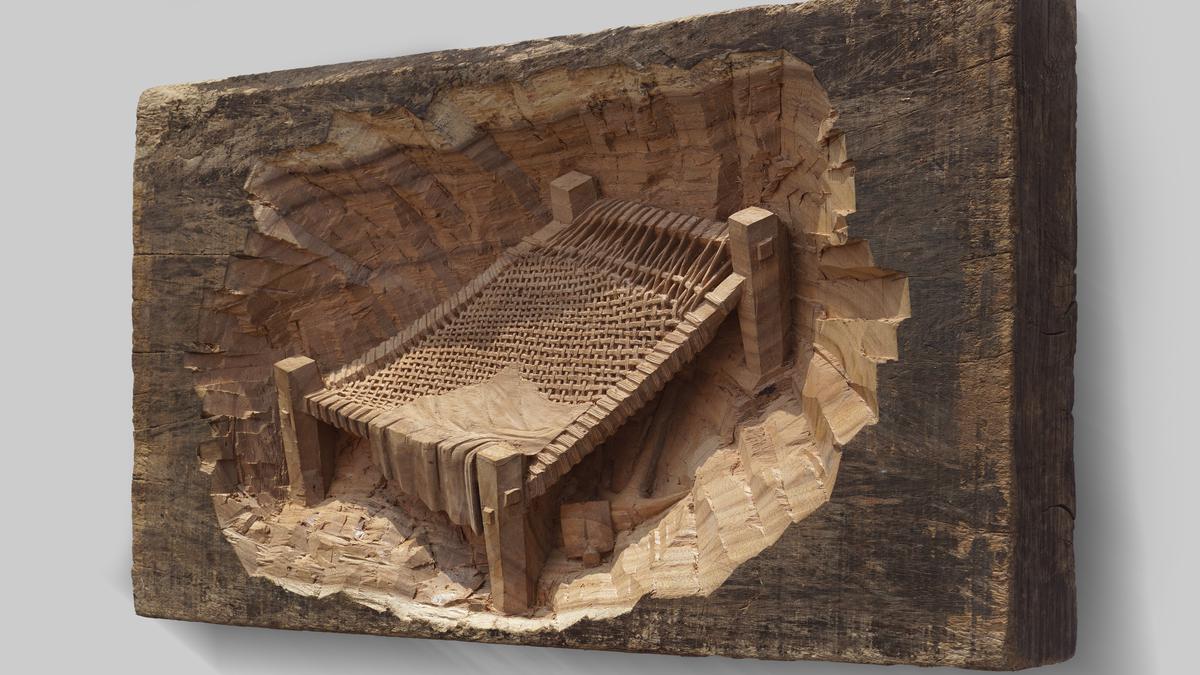
Artist Arjun Das works only with discarded material collected during his travels. One such 7x9x5 inches wooden board of a truck becomes his canvas on which he recreates a busy street of Bara Bazar in Kolkata.
Human figures are absent in this visual resembling cave architecture, with only the space and objects acquiring a symbolic identity. In fact, none of his works has a human element. It is a mocking idea, says the artist who equates it to architectural sites and temples that have no mention of the thousands of workers who built them.
Interestingly, he has carved tools with a screwdriver. “Migrants use many DIY tool hacks to manage lives. For instance, a damaged omlette pan handle is replaced with another available tool. I create my carving chisels in the same way,” says Arjun.
The Chai ki Dukaan series done during the lockdown reflects a sombre mood. Arjun had visited the street where he saw the space that used to be bustling with people was filled with melancholy during the lockdown. Images of tools strewn around, benches, tables and chairs put upside down, highlight the way migrant workers rushed to their hometown when the lockdown was suddenly announced.
Arjun was 11 when he moved to Kolkata from Jharkhand and worked as child labourer in a hotel for two years. “This was not the life I wished to lead,” says the artist who joined a school after those two years and continued working in the evenings for his expenses, until he graduated in fine arts. He went on to do his masters too.
Most of the works — inspired by his life — bear a stark reality. “It is an attempt to deliver a dialogue based on experiences. I see many youngsters getting married at 20; their studies are discontinued and they migrate to cities to fulfill responsibilities,” he says.


Uttarakhand CM Pushkar Singh Dhami expands his cabinet, inducting five MLAs to reach the maximum strength of 12 ministers.

Congress and Raijor Dal finalize their alliance for the Assam Assembly polls, sharing 11 seats and aiming to defeat the BJP.

BJP announces 112 candidates for West Bengal Assembly polls, including former MPs, lawyers, but excludes Abhaya’s mother’s candidature.

A man dies after a bar brawl in Alappuzha, Kerala; police detain five suspects for investigation.

Trainee veterinary officer dies from hippopotamus attack at Shivamogga safari during health check, prompting investigation into safety protocols.

The Voice of Hind Rajab, a film about a Gaza war tragedy, faces an oral ban in India by CBFC.

K. Sudhakaran returns to Kannur to ensure Congress victory, while T.O. Mohanan prepares to launch his campaign.

Qaffeine Bistro in Hyderabad has Baaghini, a six-coffee blend

Stock markets rebound as Sensex and Nifty recover early losses, driven by cooling crude oil prices and positive geopolitical signals.

A cooking gas crisis in Telangana is disrupting restaurants, households, and industries amid rising prices and panic bookings.

Taiwan warns of China's military threat, emphasizing the need for strong deterrence to prevent potential invasion plans.

A folktale from Australia tells how the crane and kangaroo rat discovered fire.

Lockie Ferguson will miss the start of IPL 2026 with Punjab Kings, prioritizing family after the birth of his son.