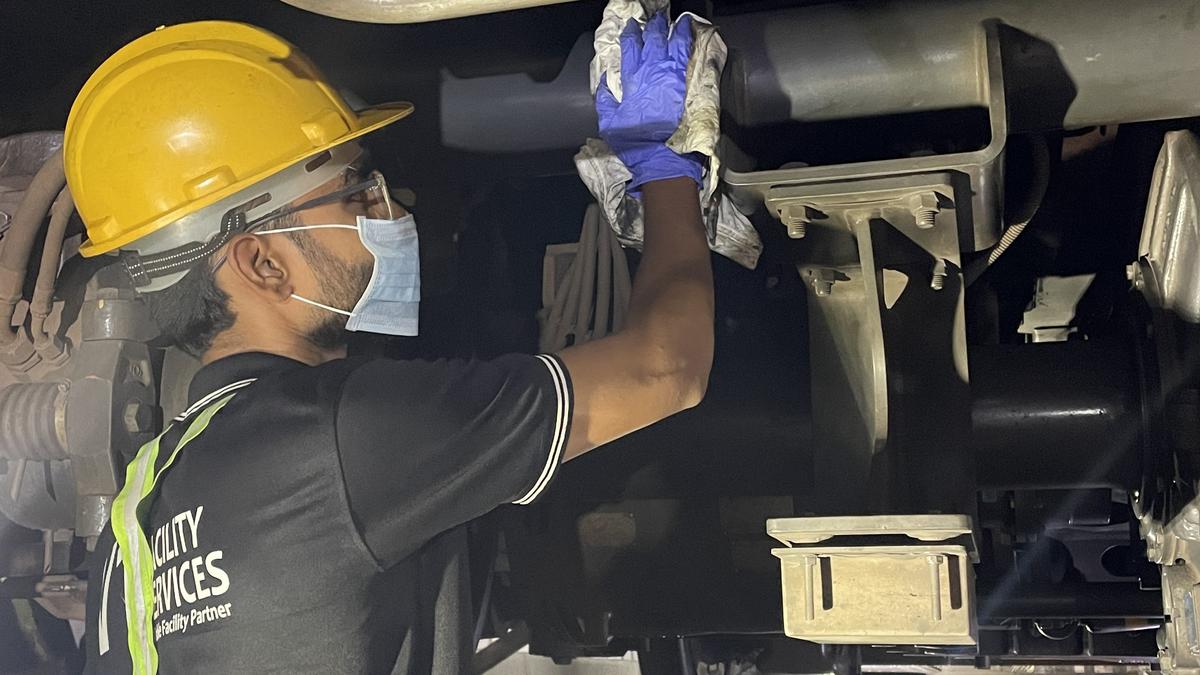
Midnight maintenance holds the key to Metro Rail operations
The Hindu
Midnight maintenance holds the key to Metro Rail operations
L&T Metro Rail Hyderabad, which has built and runs the Hyderabad Metro Rail, has been running all 57 three-coach trains almost 18 hours a day/night for making about 1,000 trips, but ever wondered what happens post midnight and early dawn before the first trip rolls out of the depots of Uppal and Miyapur?
While the city sleeps, an army of engineers and technicians begin their meticulously choreographed maintenance operations to keep the systems ready for the next day with the aid of a stringent Master Maintenance Schedule (MMS).
It is planned by the Progress, Planning Investigation Office (PPIO) for each and every train set considering usage, component wear, and safety standards outlining a specific sequence of checks and repairs to be performed at predetermined intervals to minimise the risk of unexpected breakdowns, said senior Metro Rail officials.
First, the trains are transported to the depot and moved to the automatic wash plant, a state-of-the-art facility equipped with high-pressure jets and eco-friendly detergents with sensors and control systems, for a thorough external cleaning to prevent corrosion and for retaining the train’s aesthetic appeal.
The rigorous cleaning process includes daily internal cleaning, monthly roof and under-frame cleaning, and periodic deep cleaning. Specialised equipment, such as wheel lathes and underfloor inspection pits address specific maintenance tasks as technicians minutely examine critical components like brakes, traction motors, bogies, and air conditioning systems.
Advanced diagnostic tools are employed to identify potential issues before they can escalate into major problems. “We have a comprehensive maintenance hierarchy in place. Daily checks assess train condition and cleanliness, while ‘A’, ‘B’, and ‘C’ service checks delve deeper into the train’s systems at 15,000 km, 45,000 km, and 125,000 km intervals, respectively,” they said.
Daily checks are for identifying leaks, validating door functionality, and verifying brake performance. Brakes, couplers, pantographs (devices that collect current from the overhead wires), and traction motors (electric motors that propel the train) are examined. Lubricant levels are checked and topped up if necessary. In-depth and additional inspections are done during ‘B’ and ‘C’ checks.


The government plans to amend the FCRA, introducing new regulations for NGO asset management and accountability for key functionaries.

The draft policy for “Responsible Digital Use Among Students”, released on Monday by the Department of Health and Family Welfare, has recommended that parents set structured routines with clear screen-time rules and prioritise privacy, safety, and open conversation with children on digital well-being.

Police Observer Sushant Kumar Saxena conducts surprise inspection at Shencottai police station, reviewing warrants and security arrangements ahead of elections.

Andhra Pradesh government to launch key projects in April, focusing on industrial growth and infrastructure development, says Nara Lokesh.

Lok Sabha refers the Corporate Laws (Amendment) Bill to a JPC amid opposition concerns over CSR provisions dilution.

SHG members in Kanniyakumari use snakes and ladders to raise election awareness and boost voter turnout.

Government accelerates consultations for early implementation of the Women’s Reservation Act to ensure women’s representation in 2029 elections.

CM A. Revanth Reddy distributes ₹1 crore insurance cheques to families of deceased Electricity department employees, enhancing financial security for workers.

The Bengaluru Traffic Police (BTP) registered 634 cases of drunk driving during a week-long special enforcement drive conducted across the city between March 16 and March 22.

GHMC intensifies action against property tax defaulters, seizing properties and offering a One Time Settlement scheme for payments.

CCB arrests three drug peddlers in Mangaluru, seizing ₹2.5 lakh worth of MDMA and other valuables.

TVK's 28 candidates in Puducherry include former BJP MLAs, a sitting Independent, and a retired police IG.

BRS submits notice on private member bill to Speaker