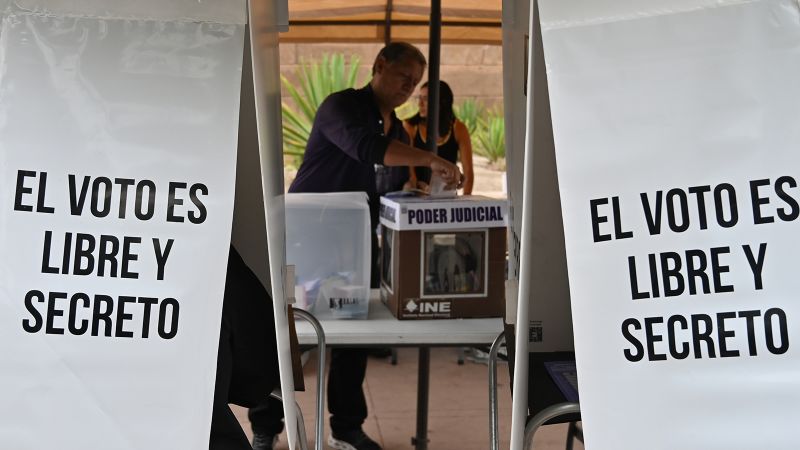
Mexican president hails first judicial election a ‘complete success’ after just 13% turnout
CNN
Around 13% of Mexicans likely turned out to vote in the country’s first-ever judicial election, Mexico’s INE electoral authority said on Monday, as the government hailed a successful process while analysts said the low turnout could undermine an already controversial reform.
Around 13% of Mexicans likely turned out to vote in the country’s first-ever judicial election, Mexico’s INE electoral authority said on Monday, as the government hailed a successful process while analysts said the low turnout could undermine an already controversial reform. President Claudia Sheinbaum estimated that some 13 million of around 100 million eligible voters cast ballots on Sunday to elect some 2,600 judges and magistrates, including all nine Supreme Court justices. Counting is set to conclude on June 15, but INE officials estimated the turnout at between 12.57% and 13.32% using a calculation based on several samples taken across the country. Sheinbaum called the process a “complete success,” citing a free vote and a frugal campaign at a morning press conference. “Everything can be perfected. We will draw conclusions from yesterday to make improvements for 2027,” she said, pointing to another vote in two years that is scheduled to fill over 1,000 more judicial positions. Interior Minister Rosa Icela Rodriguez said that “the voting took place in a climate of peace and tranquility across the length and breadth of the country.”


As Havana calls on Cuban exiles to invest in the island, many in the United States are rejecting the offer outright, viewing it as a desperate move by a government under mounting pressure.

After weeks of stalemate — and mounting airport delays nationwide — leaders in both parties are scrambling to work out a deal to reopen the Department of Homeland Security, though it remains unclear if a compromise is in reach.

Trump administration officials are making a desperate push to secure every available barrel of oil amid a worsening energy crisis — even if it means lifting sanctions on the very country that they’re fighting against.

A federal judge on Friday voided various parts of a restrictive press policy rolled out by Defense Secretary Pete Hegseth last year, ruling that they trampled on the constitutional rights of reporters who seek to cover the US military from within its sprawling headquarters.

President Donald Trump is reshaping a Colorado Republican primary by offering one of the candidates a role in his administration and returning his endorsement to the incumbent, whom he called a “RINO” just last month.

More than a month into the Department of Homeland Security shutdown, lawmakers on Capitol Hill are reckoning with their own travel privileges amid anxieties the funding crunch could exacerbate issues at already understaffed airports around the country.

TV host and comedian Bill Maher has been chosen to receive the prestigious Mark Twain Prize for American Humor, two sources close to the Kennedy Center told CNN.

Conventional wisdom has set in that President Donald Trump’s base is sticking with him on the Iran war, but he has alienated significant portions of his voters — and risks alienating more.

US officials are furiously trying to avert a potential monthslong closure of the Strait of Hormuz, privately acknowledging that reopening the key waterway is a problem without a clear solution and dependent at least in part on what lengths President Donald Trump is willing to go to force the Iranian regime’s hand, multiple administration and intelligence officials tell CNN.

The chief executive of Live Nation testified Thursday that it was “disgusting” that a top ticketing employee talked about “robbing fans blind” in internal messages.

Supreme Court revives First Amendment lawsuit from street preacher who called concertgoers ‘sissies’
The Supreme Court on Friday revived a First Amendment lawsuit from a street preacher who used a loudspeaker to call people “whores,” “Jezebels” and “sissies” as they tried to enter an amphitheater to attend concerts in a suburban Mississippi community.

As millions of Americans braced for a series of brutal storms this winter, the senior official in charge of the federal government’s disaster response had been on the job only a few weeks — and had previously claimed on podcasts that he once teleported to a Waffle House.

Air travelers across the US continue to face travel headaches as Transportation Security Administration workers go without full pay. Find the latest live updates here.