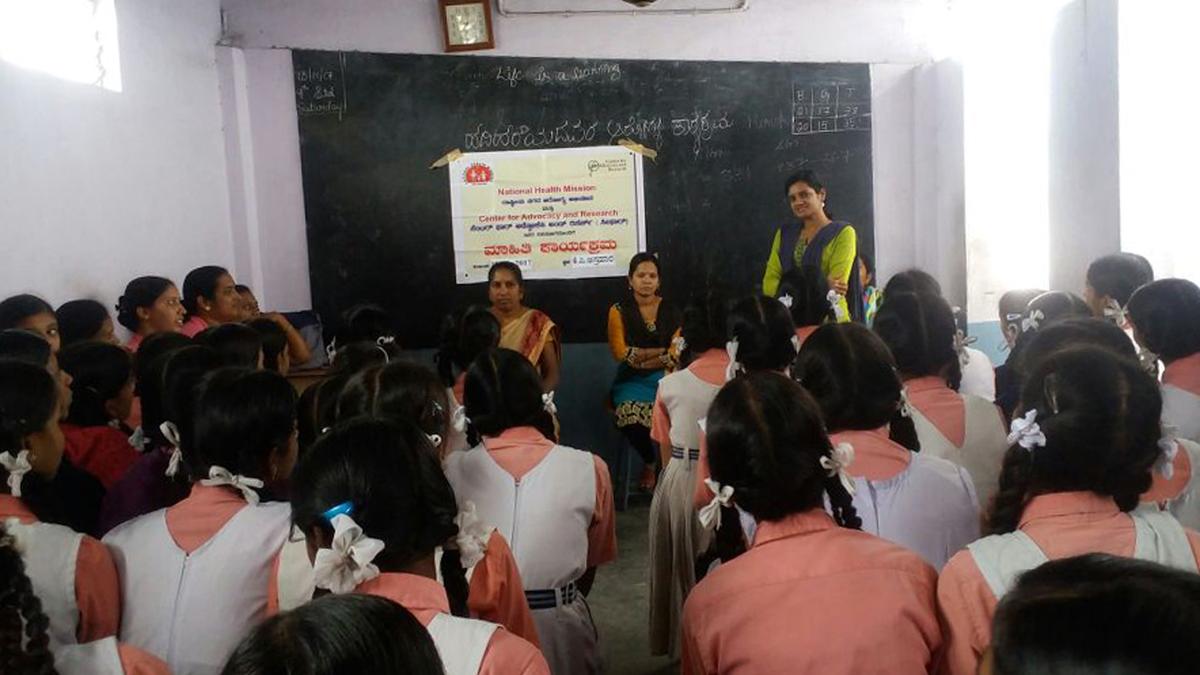
Menstrual education advanced from high school to middle school
The Hindu
Education Department advances adolescence education to class 6 due to early puberty, emphasizing menstrual hygiene and reproductive biology.
With the average age of menarche advancing to nine to 11 years, the Education Department has decided to start providing adolescence education from class 6 from this year instead of class 8.
“This year, we are introducing a moral science module in the curriculum and adolescence education is a part of it. We will start teaching it to the students from class 6 onwards in an age-appropriate manner as the age of puberty is earlier than before now,” said K.V. Trilok Chandra, Commissioner of Public Instruction.
According to doctors, the age of menarche has advanced due to multiple factors. “The average menarche age of India was between 11 and 13 years. Now, it is not uncommon for girls to attain menarche as early as nine or 10 years. The kind of food consumed, lifestyle, etc. have contributed to this advancement. This is the reason why it has become mandatory to empower girls with the knowledge of reproductive biology by the age of nine to 11 years, instead of 12 to 14 years like before,” said N. Venkatesh, a gynecologist at Jayanagar General Hospital and a National Board professor.
Teachers at many government and private schools said they have already begun teaching students about menstruation, menstrual hygiene, and other bodily changes that occur around puberty from class 5 or 6.
“At home, parents do not teach girls about menstruation or menstrual hygiene freely. In our school, the women faculty ensure that we talk to them about these things, especially hygiene, from class 6. We also get PG medical students from government medical colleges to teach about menstruation with a visual presentation,” said the headmistress of a Karnataka Public School in South Bengaluru.
The principal of a well-known private school in Bengaluru said they had conducted a joint session on sex education for boys and girls and a session for just the girl students. “Emotional and physical changes, period products and hygiene are some of the things that were discussed in these sessions. While we can provide a general overview of these things for boys and girls together, some girls say they are not comfortable discussing it in front of boys. However, we also sensitise boys about menstruation,” she said.
But the joint sex education is not the case in most schools, according to students. “I feel uncomfortable talking about it. In my school, I am aware that they provided sex education to girls. But we were not in the class and I do not exactly know what they were taught,” said a male student of a private school at Banashankari.


Srirangam residents seek improved infrastructure and amenities to support rapid urbanization and growing tourism demands in the constituency.

Alandur faces unresolved civic infrastructure issues, including lack of water and drainage, despite recent development efforts ahead of TN Election 2026.

Delhi's fiscal deficit surged by 62% in 2025-26, reflecting revenue declines and raising concerns about the city's economic health.

Kerala Assembly Elections 2026: Anvar and Firos face multiple namesake rivals in their constituencies amid a crowded candidate field.

Kamal Haasan announces support for DMK in 2026 elections, emphasizing the need for 'Dravidian Model 2.0' for Tamil Nadu's welfare.

DMK finalises seat-sharing for the 2026 Tamil Nadu Assembly elections, contesting 175 seats with allies DMDK and VCK.

Parliament may adjourn early for Assembly elections, allowing MPs to campaign in key election-bound states.

Indian vessels can freely sail through the Strait of Hormuz without needing permission, confirms a senior government official.

The Hindu Morning Digest gives a select list of stories to start the day. Read the top news today on March 25, 2026

An IndiGo flight at Vijayawada airport was grounded due to a tyre burst, but all 79 occupants are safe.

Tamil Nadu Assembly election 2026: TMC(M) gets five seats in NDA, to contest on BJP's 'Lotus' symbol
TMC(M) secures five NDA seats, to contest Assembly elections using BJP's 'Lotus' symbol in Tamil Nadu.

The Karnataka government will discuss with officials the possibility of creating a portal for unemployed youth to share their details and access job opportunities in micro, small and medium enterprises (MSMEs), Minister for Small Industries and Public Enterprises Sharanabasappa Darshanapur said in the Legislative Council on Tuesday.

AIADMK's 2026 manifesto promises free rations, women's benefits, education reforms, and economic growth initiatives for Tamil Nadu.