Melting polar ice due to climate change is making earth’s days longer Premium
The Hindu
Climate change-induced melting polar ice caps slow Earth's rotation, affecting technology reliant on precise timekeeping.
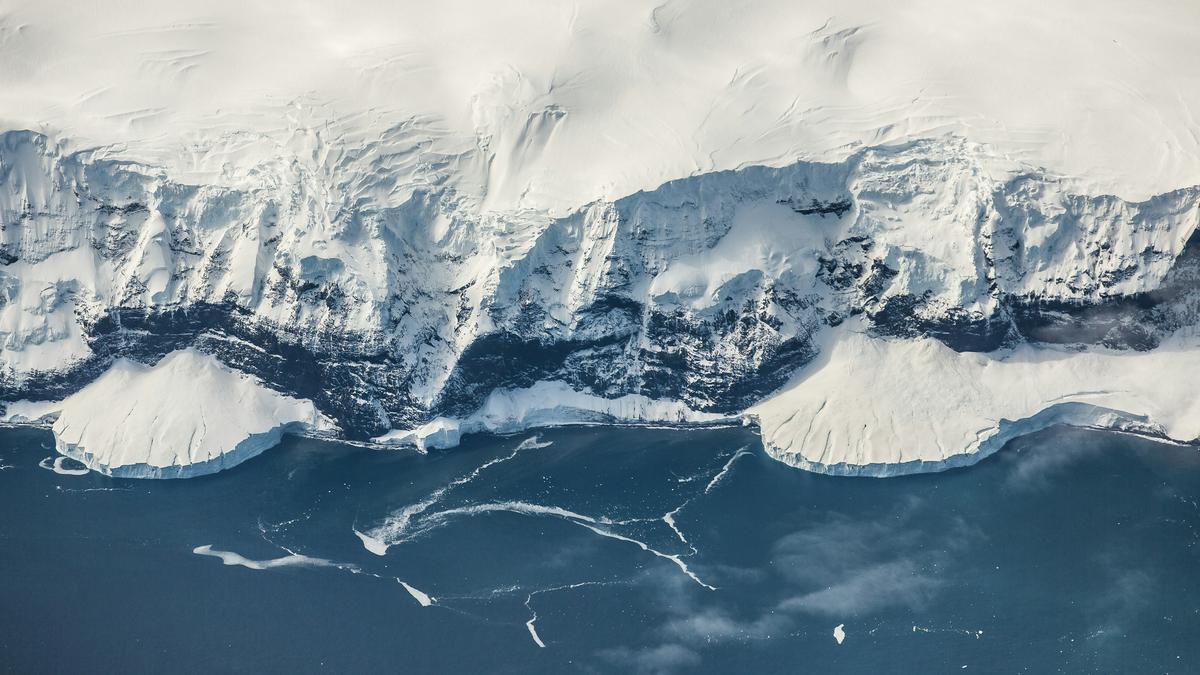
In yet another unprecedented effect of climate change, scientists find that the melting polar ice caps have caused the earth to spin slower. This can lead to minuscule changes in the actual duration of a day — something that, ironically, does not affect our daily lives as much but could affect the technology we rely on.
As we build more connections not just among ourselves in this world but also with outer space, tools that rely on precise timekeeping, like computer networks and the ones involved in space travel, can be thrown off course.
A basic physics phenomenon called the conservation of angular momentum is key to what is happening to the earth right now. When an ice-skater rotates, if their arms are held in tightly, their moment of inertia decreases and they spin faster. If they stretched their arms out wide, their moment of inertia would increase, making them spin slower. This is because angular momentum — a product of the moment of inertia and angular velocity — is conserved no matter how the skater is spinning.
As polar ice continues to melt rapidly in a warming world, the globe isn’t affected very differently from the spinning ice-skater.
“When polar ice sheets and global glaciers melt, then this would go to the equatorial regions — we call this pole-to-equator mass flux,” Mostafa Kiani Shahvandi, a geophysicist at ETH Zurich and the lead author of the July 15 paper describing the recent results, said. “As the ice sheets melt, the earth’s oblateness increases and the region around the equator elongates slightly. The moment of inertia increases and the rotation rate gets smaller.”
Water from the melt flows towards the equator, making the earth bulge out slightly, slowing its rotation and increasing the time taken to complete one rotation, lengthening our day.
Using a mix of climate models and real-world data, the scientists looked at a 200-year period, between 1900 and 2100. They found that over the last two decades, the changing climate’s effects on sea levels around the equator have slowed the rate of earth’s rotation by around 1.3 milliseconds (ms) per century.


76-year-old Kurian Jacob from Kerala triumphs with seven medals, including five golds, at the Open Masters Games in Abu Dhabi.

Explore the nature of the human mind as an emergent property of brain activity and complex neural interactions.

CERN's Large Hadron Collider discovers the Xi-cc-plus particle, enhancing understanding of quantum mechanics and baryon behavior.

Vibha Batra’s latest book, Spotless (Hachette India) is a novel in verse for young adults

In its first edition, the Madras Art Salon spotlights the works of journalist and artist Narayan Lakshman at The Botanical Club, a social space in the British Deputy High Commission, Chennai

Cholesterol enhances melanoma cell invasion by making nuclei squishier, revealing a potential treatment target in cancer progression.

The designers reinterpret the Swedish artist’s symbolic forms and colour energy through contemporary resortwear silhouettes

Discover the inspiring legacy of Bibha Chowdhuri, a pioneering woman in physics and a trailblazer in STEM history.

Discover the inspiring legacy of Bibha Chowdhuri, a pioneering woman in physics and a trailblazer in STEM history.

Ashdeen’s Spring 2026 collection features saris inspired by the designer’s Parsi gara archive

Red ochre burials, ritual markings and myths across cultures show that red repeatedly marks liminal thresholds such as puberty, sacrifice and death; anthropologists argue that the colour functions as a technology of collective ritual and value, binding communities through shared symbolic acts

India approves 23 institutions for quantum labs under the National Quantum Mission, aiming to advance quantum technology and research.

India approves 23 institutions for quantum labs under the National Quantum Mission, aiming to advance quantum technology and research.