Melting glaciers, drying sea highlight Central Asia’s water woes
Voice of America
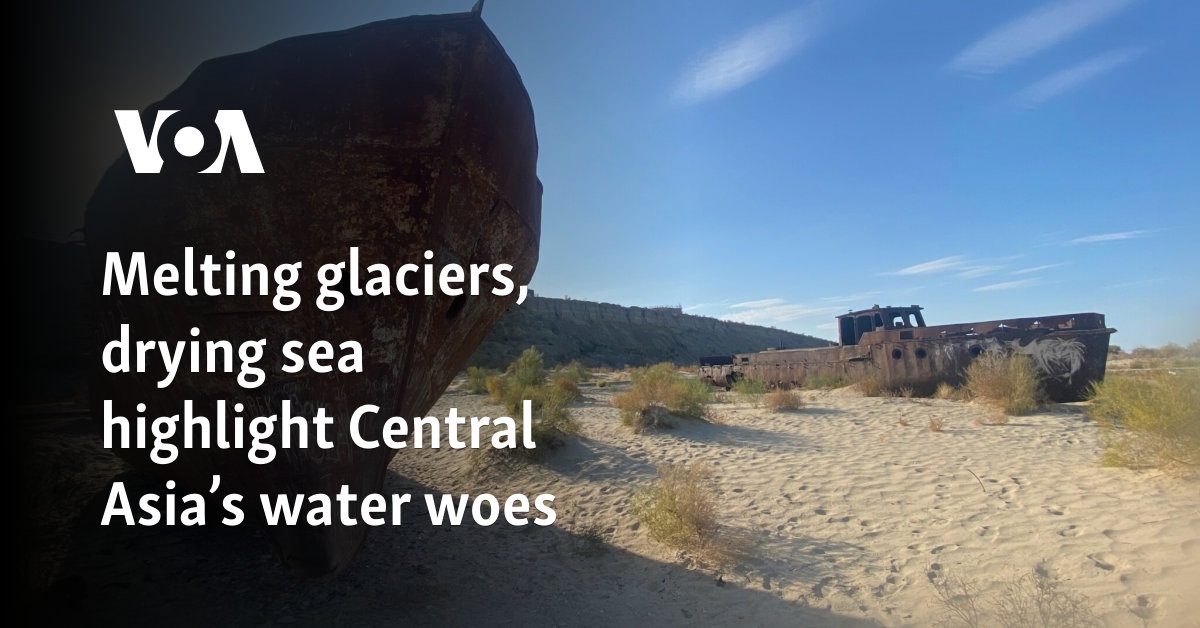
The site of the former port in Muynak, Karakalpakstan, Uzbekistan, is now an open-air museum — a ship graveyard of forlorn fishing vessels, Sept 12, 2022. The Syr Darya and Amu Darya rivers provide water for several former Soviet republics in Central Asia, but they are drying up. A board in Muynak, a former port on the Aral Sea, Karakalpakstan, Uzbekistan, Sept. 12, 2022, shows how the sea shrank from 2008 to 2016. A dirt road stretches through the desert that used to be the bed of the Aral Sea, on the outskirts of Muynak, Karakalpakstan, Uzbekistan, June 27, 2023. Children enjoy a hot day in the Karakalpak Canal in rural Karakalpakstan, Uzbekistan, which depends mainly on the Amu Darya River as a water source, July 22, 2023. This is what's left of Syr Darya River in a good year, say residents of Khujand, Tajikistan, pointing to a river steadily shrinking, Sept 4, 2023.
Climate change and water scarcity are harsh realities facing Central Asia. Glaciers in the east, in the mountains of Kyrgyzstan and Tajikistan, are rapidly melting, while in the west, Uzbekistan and Kazakhstan, the Aral Sea has turned into a desert.
