‘Matto Ki Saikil’ movie review: Prakash Jha shines in a tale of lopsided development and unkept promises
The Hindu
For its brilliant social commentary and Prakash Jha’s spirited performance, filmmaker M Gani’s ‘Matto Ki Saikil’ is a significant work of art that needs to be watched and discussed about
Squatting next to a signboard of the Delhi-Agra Expressway to answer nature’s call, Matto Pal (Prakash Jha) is disturbed by the sudden raid of officials to catch those indulging in open defecation. The Dalit daily wager mutters under his breath, “They don’t even allow us to crap in peace.”
Set in Bhartiya, a sleepy village on the outskirts of Mathura, the centre of Braj culture in Uttar Pradesh, Matto Ki Saikil ( Matto’s Bicycle) is a gutsy take on the lopsided development matrix that gently opens a window to the welfare state, seven decades after we pledged to give ourselves an equal shot at destiny.
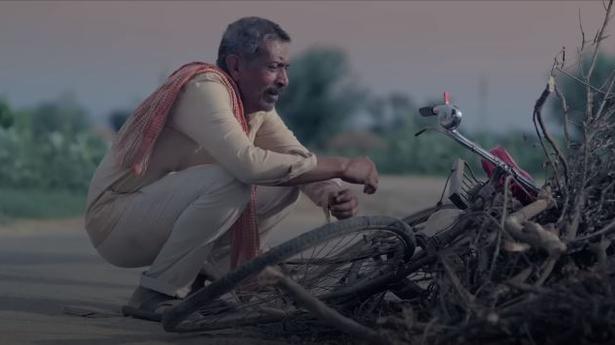
The compensation for Expressway has provided wheels to the aspirations and avarice of the landed and politically-connected in Bhartiya, but what about Matto, who only has a rickety cycle to navigate the changing landscape? The rusted vehicle becomes a character that drives the narrative; is there something for Matto as well in this smart, digitally-mobile India? He still has to carry his ailing wife on a borrowed motorcycle to the government hospital, where the ultrasound facility is not available. The neighbourhood school is used more for storing cow dung cakes than for imparting education.
Matto doesn’t complain, for he knows his place in society. After a hard day’s work, where payment is erratic and dignity is difficult to safeguard, Matto returns to his brood where his wife decides the menu and his two doting daughters seek his attention. However, when his cycle — his lifeline — is snatched away from him, Matto’s faith in the system gets fractured, and our eyes well up without prior notice.
Without using a scalpel, debutant director M Gani exposes the fissures in rural Indian society. Without allowing the pen to bleed, he captures the casual discrimination against Dalits and the changing mores in rural life. Easy access to mobile and Internet data is affecting the social behaviour of the youth and Panchayati Raj remains the rule of the powerful. For the Pradhan of the village, Matto is just a vote that needs to be worked upon before the election; he should not expect a change in the cycle of exploitation.
Gani, a known name in the theatre circuit who grew up in the Braj belt, captures the lilt of the region and the inherent elegance in the life of the poor through the dialogues and cinematography. Even the swear words have a lyrical quality to them, and the evocative folk songs that the daily wagers sing while riding back home, add to the sense of bucolic life.
The sharp everyday humour of the region is the highlight of the storytelling, best captured through the conversations between Matto and Kallu (Dimpy Mishra), the Muslim mechanic who stands by his friend. The way Kallu compares the shimmy in the wheels of Matto’s cycle with the walk of a Bollywood heroine leaves us in splits. Then there is an advocate who is struggling to get past his caste identity to find a footing in the local court. Always found reading a newspaper at the mechanic’s shop, he is like a theatrical device to tell us what is happening beyond the frame of reference.


India pledges 60% non-fossil fuel power by 2035, targeting 47% emissions reduction per GDP unit and enhanced carbon sinks.

Supreme Court rules land acquisition compensation and interest must uphold constitutional guarantees, unaffected by financial burdens.

Election officials accept 23 nominations for Bagalkot bypolls, rejecting three, with polling scheduled for April 9.

Students and women’s self-help groups in Madurai engage in vibrant voter awareness campaigns promoting 100% voting participation.

Congress signals a "friendly fight" with allies in select Puducherry Assembly seats ahead of the April 9 elections.

Airstrike in western Anbar kills 7 Iraqi soldiers, injures 13, prompting condemnation for violating international laws on medical facilities.

Plaque unveiled in Bengaluru honors 11 victims of RCB stampede, emphasizing safety responsibility for future events.

India and the U.S. reaffirm commitment to enhance strategic defense cooperation at the 18th Defence Policy Group meeting in New Delhi.

Chhattisgarh's Deputy CM reports only 30-40 Maoists remain in Bastar, highlighting recent surrenders and future development plans.

Explore the historical and industrial significance of Ariyalur constituency, highlighting its challenges, agriculture, and political landscape.

Dindigul and Madurai Collectors conduct joint inspection

In this episode, Kalki Subramaniam speaks to us about why the Transgender Persons Amendment Bill has sparked protests, and how these amendments threaten to push a marginalised community back into the shadows.

India's EU FTA is poised to attract more German companies, boosting bilateral trade and investment opportunities.