Mattel CEO confirms plans to raise prices as he calls for zero tariffs on toys
CNN
A prolonged trade war means that for many American families, an extensive Barbie or Polly Pocket collection could soon be a luxury.
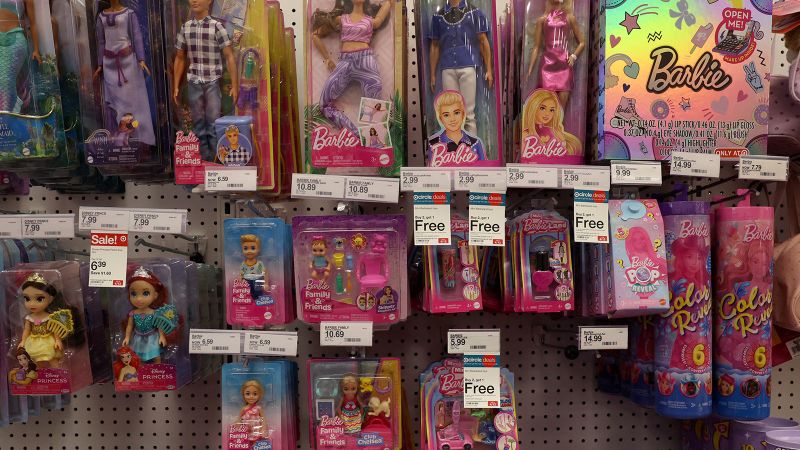
Last week, President Donald Trump advised Americans that his trade war could result in children’s dolls costing “a couple bucks more.” That, at least, seems to have come to fruition. The CEO of Mattel, the toy manufacturing giant and maker of Barbie, told the Wall Street Journal on Monday that the company plans to raise prices on American toys due to tariffs. “As we sit here today, we’re modeling different scenarios, but it’s hard to tell where things will land and how the tariff situation will evolve,” Chief Executive Ynon Kreiz told the newspaper. “It’s very volatile right now.” A prolonged trade war means that for many American families, an extensive Barbie or Polly Pocket collection could soon be a luxury. Trump’s 145% tariffs on most goods coming from China are slamming the toy industry. Nearly 80% of all toys sold in the United States are manufactured in China, according to industry group the Toy Association. Mattel CFO Anthony DiSilvestro said during its earnings call on Monday that the current tariffs would cost it roughly $270 million this year and “that’s before you consider any of the mitigating action.” There’s already evidence some prices are on the rise. According to a product pricing analysis from Telsey Advisory Group, a Barbie doll with swimsuit sold at Target rose 42.9% over a week in mid-April to $14.99. That’s among the largest jumps the consumer research firm tracked. Kreiz told investors Monday that “under the current scenarios we are considering” in response to tariffs, he expects 40% to 50% of its products to remain priced at $20 or less. However, he also advocated for zero tariffs on toys and games around the world.


Looking out his shop window, across the street, just to the right, Paloma Clothing co-owner Mike Roach sees one of Portland, Oregon’s, most expensive gas stations.

Oil and liquefied natural gas tankers moving through the Strait of Hormuz carry around 20% of the world’s supply. But for countries on the Persian Gulf, the waterway is more than just an energy route – it’s a lifeline for more than 100 million people.

A California jury has largely sided with Twitter shareholders who accused billionaire Elon Musk of defrauding them by intentionally driving down the social media company’s stock ahead of his $44 billion acquisition in 2022.

The war with Iran is disrupting global oil flows, damaging energy infrastructure and raising fears of prolonged conflict. But gold, usually considered a safe haven during periods of economic uncertainty, has slumped.

US stocks and bonds fell, oil prices rose and gold had its worst week in four decades as the Iran war continues to ripple through financial markets.

The White House on Friday released its long-awaited national artificial intelligence legislative framework, a move to prevent states from enacting their own laws and enforce the Trump administration’s light-touch approach to AI regulation.

“Today is a difficult day,” CBS executives wrote to staff, explaining the cuts as a tough but necessary reallocation of newsroom resources.

President Donald Trump has repeatedly promised that Americans will get larger tax refunds this year thanks to his “big, beautiful bill.”

President Donald Trump has repeatedly promised that Americans will get larger tax refunds this year thanks to his “big, beautiful bill.”

Oil prices edged lower on Friday after a tumultuous day that saw the international benchmark surge above $119 a barrel as the Middle East conflict deepened energy supply fears.

The war in Iran has delivered what economists call a “black swan” event — an unforeseen shock so destructive, no one is immune to it.

The war in Iran is driving up the cost of buying a home in America.

Eight state attorneys general have filed an antitrust lawsuit to block Nexstar’s pending acquisition of Tegna, which would strengthen the right-leaning Nexstar and shrink the number of station owners in the US.