Mastering the Art of Reading Nutrition Labels
The Hindu
Mastering the Art of Reading Nutrition Labels
Understanding nutrition labels can be one of the most empowering skills in your journey toward better health. Whether you are managing a medical condition, watching your weight, or simply aiming to eat healthier, decoding the nutritional information on packaged foods offers valuable insights that help you make informed decisions.
Nutrition labels are more than tiny text — they offer a transparent breakdown of a packaged product’s nutritional value, well beyond glossy packaging or eye-catching marketing slogans like “natural” or “low-fat”. They help spot essential nutrients, detect allergens, avoid potentially harmful ingredients, and steer clear of deceptive health claims.
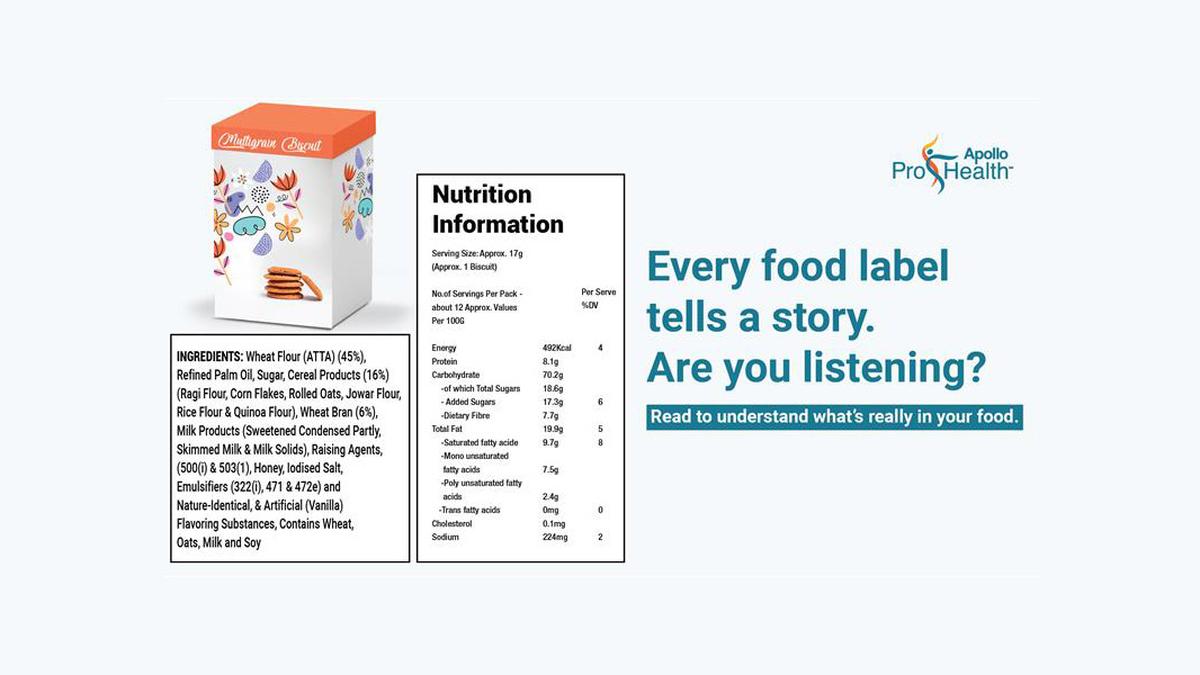
Start by checking the serving size, which indicates the amount to be consumed in one sitting (1 cup, 1 piece). Pay attention to the number of servings, as all nutritional information — calories, fats, sugars, and more — is based on a single serving. Consuming more than one serving means you will need to adjust the numbers accordingly.
Next, check the calorie count, which indicates the energy provided per serving. Then review the macronutrients:
Look out for vitamins and minerals too. Many diets lack calcium, iron, and vitamin D. Foods rich in these nutrients can help fill nutritional gaps. The % Daily Value (%DV) is another key metric; it indicates how much nutrient in a single serving contributes to your total daily intake — under 5% is low, over 20% is high. Aim for high %DV in fibre, vitamins, and essential minerals, and low %DV in saturated fat, sodium, and added sugars.
Ingredients are listed in descending order by weight, meaning the first few make up the bulk of the product. Watch out for long ingredient lists filled with artificial preservatives or additives.
Sugar is often disguised under names like sucrose, dextrose, corn syrup, maltose, and honey. Check for “added sugars” — added during processing — which are in addition to naturally-occurring sugars. Check for non-nutritive sweeteners. Natural options like stevia and monk fruit extract are considered safe in moderation.


The Railway Ministry has decided to regularise the services of Surat-Mangaluru Junction-Surat bi-weekly Special Express along with nine other special trains.

Training held for zonal election officers in Thoothukudi

Defence Minister highlights BRO's vital role in enhancing border infrastructure, national security, and socio-economic growth in India.

Andhra University celebrates its 91st and 92nd convocations, honoring graduates and distinguished personalities for their contributions and achievements.

Coimbatore students receive earthen bowls to provide water for birds, promoting conservation on World Sparrow Day.

Residents of Hosahundi village in Kasaba hobli of Mysuru taluk have opposed the proposed construction of a flyover at Devalapura Cross on National Highway 275-K (Outer Ring Road), urging the authorities to drop the project and adopt alternative measures to improve road safety.

A brain-dead head constable’s family consented to organ donation under the Jeevandan programme, giving two patients a new lease of life through kidney transplants.

A-G informs Madras High Court no govt. sanction needed for FIR in K.N. Nehru's cash-for-jobs scam case.

President of Karnataka Beary Sahitya Academy U. H. Umar on Wednesday appealed to Madhu Bangarappa, Minister for School Education and Literacy to introduce Beary as the third optional language from Class 6 from the academic year 2026-27.

Karnataka Dalit Sangharsha Samiti (DSS) has urged the State government to begin the process of filling up 56,432 posts only after rectifying the mistakes in fixing the roster and implementing the internal reservation among Scheduled Castes.

Rebel nominations in Karaikal expose tensions within electoral alliances, risking voter fragmentation ahead of the Puducherry Assembly elections.

CCPA prohibits restaurants and hotels from imposing unfair LPG charges, labeling them as unjustified and against consumer protection guidelines.

Andhra Pradesh receives ₹19.47 crore for 44 handloom clusters, benefiting over 10,000 weavers under the National Handloom Development Programme.