Primary Country (Mandatory)

Other Country (Optional)

Set News Language for United States

Primary Language (Mandatory)
Other Language[s] (Optional)
No other language available

Set News Language for World

Primary Language (Mandatory)
Other Language(s) (Optional)

Set News Source for United States

Primary Source (Mandatory)
Other Source[s] (Optional)

Set News Source for World

Primary Source (Mandatory)
Other Source(s) (Optional)
  • Countries
    • India
    • United States
    • Qatar
    • Germany
    • China
    • Canada
    • World
  • Categories
    • National
    • International
    • Business
    • Entertainment
    • Sports
    • Special
    • All Categories
  • Available Languages for United States
    • English
  • All Languages
    • English
    • Hindi
    • Arabic
    • German
    • Chinese
    • French
  • Sources
    • India
      • AajTak
      • NDTV India
      • The Hindu
      • India Today
      • Zee News
      • NDTV
      • BBC
      • The Wire
      • News18
      • News 24
      • The Quint
      • ABP News
      • Zee News
      • News 24
    • United States
      • CNN
      • Fox News
      • Al Jazeera
      • CBSN
      • NY Post
      • Voice of America
      • The New York Times
      • HuffPost
      • ABC News
      • Newsy
    • Qatar
      • Al Jazeera
      • Al Arab
      • The Peninsula
      • Gulf Times
      • Al Sharq
      • Qatar Tribune
      • Al Raya
      • Lusail
    • Germany
      • DW
      • ZDF
      • ProSieben
      • RTL
      • n-tv
      • Die Welt
      • Süddeutsche Zeitung
      • Frankfurter Rundschau
    • China
      • China Daily
      • BBC
      • The New York Times
      • Voice of America
      • Beijing Daily
      • The Epoch Times
      • Ta Kung Pao
      • Xinmin Evening News
    • Canada
      • CBC
      • Radio-Canada
      • CTV
      • TVA Nouvelles
      • Le Journal de Montréal
      • Global News
      • BNN Bloomberg
      • Métro
Massive Webb telescope may see close to the beginning of time

Massive Webb telescope may see close to the beginning of time

BNN Bloomberg
Saturday, December 25, 2021 01:55:47 AM UTC

Set to launch Christmas Day and peer back 13.5 billion years, the successor to Hubble could help answer some of humanity’s biggest questions.

The largest, most expensive and most sophisticated space telescope ever made is scheduled to lift off Dec. 25 from the north coast of South America. At its eventual orbital station 932,000 miles from Earth, the James Webb Space Telescope might just see to the beginning of time.

The farther one looks in space, the further back in time one goes. When Webb begins its work in mid-2022, it will help scientists study some of the earliest light in the universe and to peer more closely at planets in other galaxies. More than 30 years after NASA launched the Hubble Space Telescope, its much bigger successor is designed to see through the most ancient mists of deep space.

The almost US$11 billion telescope, more than two decades in the making, is a National Aeronautics and Space Administration collaboration with the European and Canadian space agencies. It’s currently scheduled to launch early on Dec. 25 from the European Space Agency’s South American spaceport in French Guiana aboard an Ariane 5 rocket.

For science, the Webb telescope’s ultimate promise is a greater understanding around two fundamental questions for humanity: Where did we come from and are we alone? But for NASA, it’s also a huge risk given everything that might go wrong.

The telescope is “a shining example of what we can accomplish when we dream big,” NASA Administrator Bill Nelson said Dec. 21 at a pre-launch briefing, calling it “one of the great engineering feats for the people of this planet.”

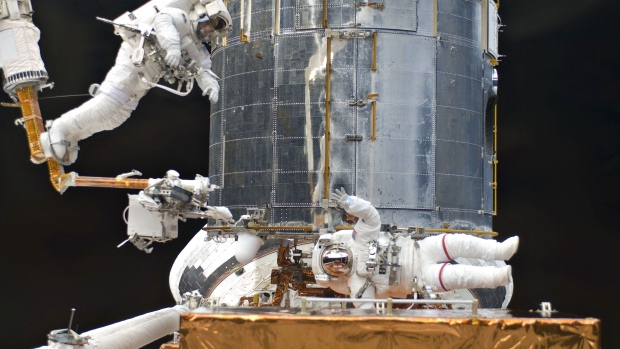
The Webb telescope will examine the infrared spectrum—thermal radiation humans can’t see and which is often obscured to ground-based telescopes. Hubble is still working, albeit from an orbit much closer to Earth (340 miles away), collecting data in the visible light spectrum. The older telescope, which had to be repaired after launch because of a flaw in its mirror, has been repeatedly updated with new technology and could last another two decades.

Read full story on BNN Bloomberg
Share this story on:-
More Related News
© 2008 - 2025 Webjosh  |  News Archive  |  Privacy Policy  |  Contact Us