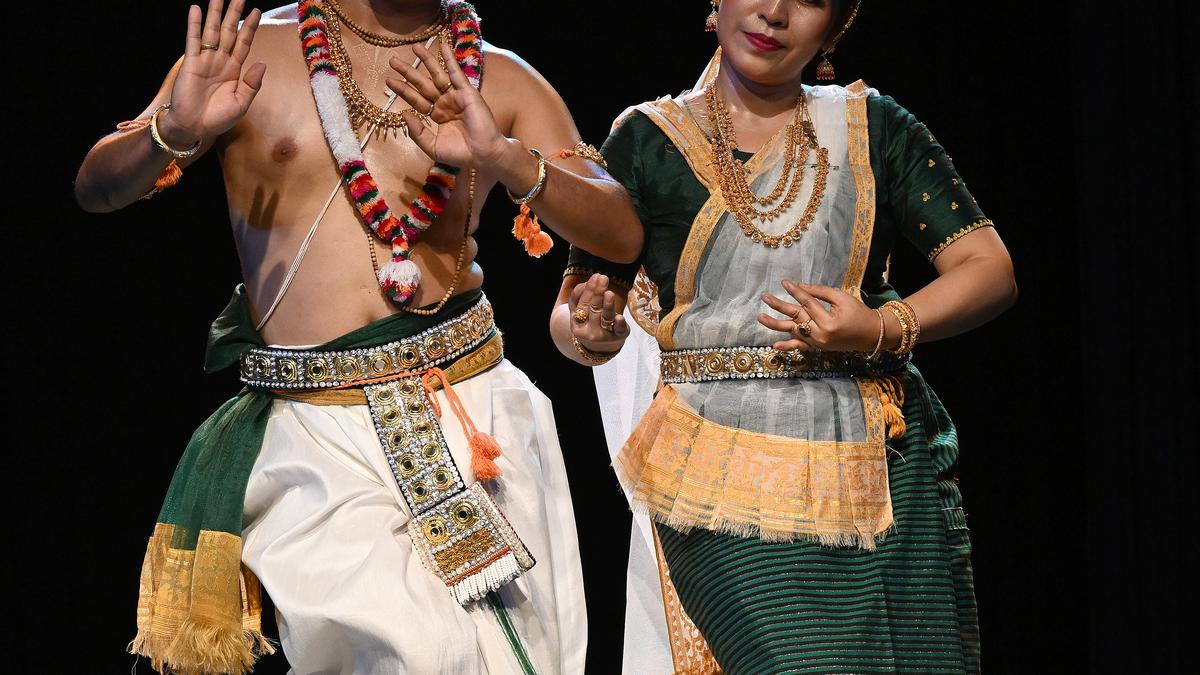
Manipur dancer appeals to audience to pray for peace in the strife-torn State
The Hindu
The beauty of Manipuri dance
Moving away from the world Bharatnatyam to watch a Manipuri dance performance felt like a breath of fresh air. Sinam Singh Basu ,a Bismillah Khan Yuva Puraskar awardee and his wife Monica presented short compositions at Kathak Darpan’s Smriti Festival at Kalakshetra in Chennai recently.
The audience was moved by what Sinam Singh said at the start of the performance. “It has been more than 25 months of ethnic clash. Houses have been burnt rendering several homeless. People have lost their livelihood. So I urge you all to pray for peace to return to the beautiful state of Manipur.”
Sinam Singh began the evening with ‘Kamadeva Natya’, showing how the god of love heralds the season of spring. The inherent grace and fluidity of the dance form made this piece a delight to watch. The depiction of Kama’s sugarcane bow and the arrow with five different flowers, and the colours of spring were strung together seamlessly.
Radha Rani is angry with Krishna for failing to keep his promise to meet her. Monica’s delineation of the piece — moving from disappointment and anger to disenchantment, was noteworthy for its sensitive and subtle display of emotions. The couple next performed the popular Ashtapadi ‘Kuru yadu nandana‘, which was full of romantic imageries.
Moving beyond the Vaishnavite tradition, which forms the core of Manipuri, Sinam Singh chose a Shiva composition ‘Nagendra Haraya’ and Panchakshara Stuti, and incorporated in it Thang Tham (Manipuri martial art), beats of Pung Cholam (Manipuri drum) and mudras of Lai Haroba (ritualistic dance and music theatre). The posture of Nataraja was different from the way it is depicted in Bharatanatyam. However, the representation of Shiva needed to be more dynamic, to differentiate it from the portrayal of Krishna.
Tejaswini’s winning Kathak moves
Earlier in the festival, Tejaswini Sathe and her group presented select compositions from their Kathak repertoire. The chakkars, parans and tihais were explored in an interesting manner in the first piece. Next came the bandish ‘Saajan saathi sahile’, beautiful portrayal of a nayika pining for her lover. The maturity of the artiste came to the fore in her subtle expressions and gestures.


South African naturalist Steve Boyes speaks on ghost elephants, ancestral tracking, and Werner Herzog’s documentary exploring Angola’s elusive highland giants

Actor-director Amol Palekar will receive META's Lifetime Achievement award for 2026 on March 25 in New Delhi.

India's artists unite against rising censorship, advocating for creative freedom and support for marginalized voices in the arts.

Written and directed by Kunal, the film also stars Sparsh Shrivastava and Vanshika Dhir

This year, Bharatnatyam artistes will present the Tyagaraja Aradhane as a dance performance

This year, Bharatnatyam artistes will present the Tyagaraja Aradhane as a dance performance

The actor, along with director Sushant Shah, speak about their upcoming series ‘Chiraiya’, Divya’s process of working on the dialect, Sushant’s approach to telling a story about women, and more

An independent video, ‘Feel the Spark’ by Raleigh Rajan with vocals by Ciera Dumas that celebrates Tamil literary giants, garnered 1.4 million views in less than 36 hours.

In ‘Jack Ryan: Ghost War’, John Krasinski is back as the savvy CIA analyst, diving headfirst into a high-stakes mission that unravels a deadly conspiracy and pits him against a rogue black-ops unit

Shriram Bharatiya Kala Kendra’s Shankarlal festival showcased rare ragas, radiant artistry, and inclusive performances, from Pt Madhup Mudgal’s serene morning ragas to Ramana Balachandran’s Saraswati veena.

Explore "Threads that Bind: The Kantha Project," an exhibition in Delhi reimagining kantha as a medium of repair and renewal.

Sean Penn skips the Oscars to meet Ukraine's Zelenskyy, who praises him as a "true friend" amid the war.

The teaser of Tamil star Suriya’s much-awaited film with director Venky Atluri, titled Vishwanath and Sons, was unveiled by the makers on Monday