Mandal, Mandir, and now Market Premium
The Hindu
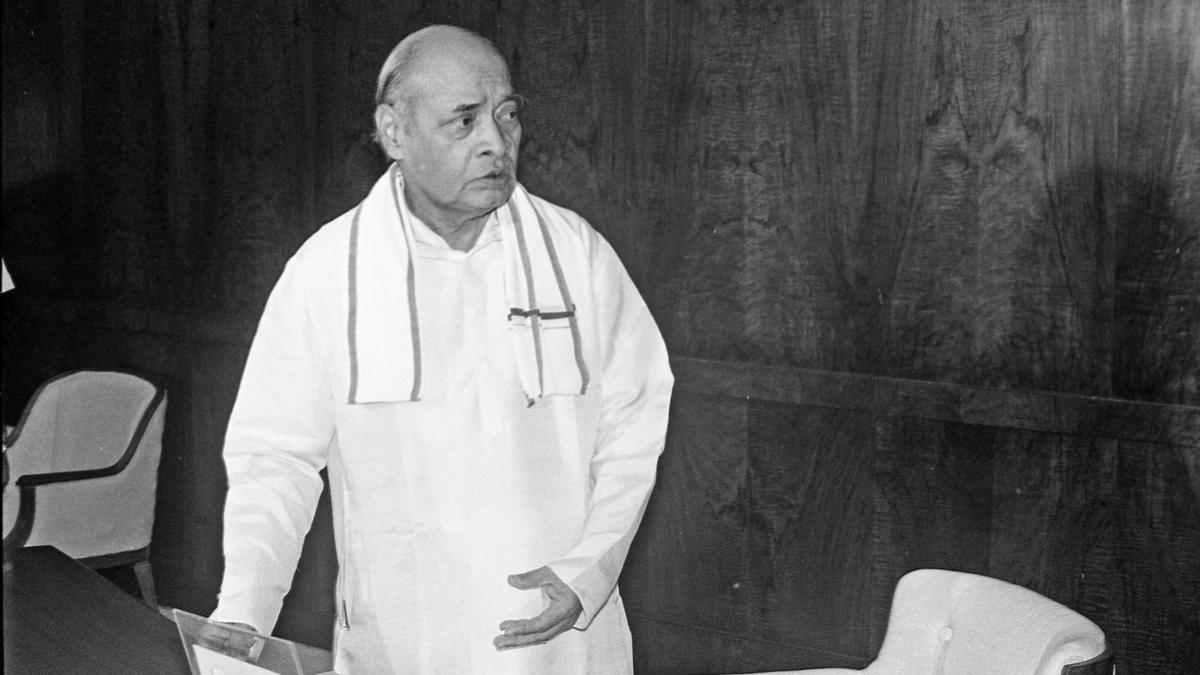
The sheer scale of the transformation former leader and Bharat Ratna recipient P.V. Narasimha Rao brought about needs a larger audience, in particular, the three lessons he holds for politicians today
The three forces that define today’s India were unleashed in the 12 months between August 1990 and August 1991. Thirty-three years later, it is these forces that are finally being rewarded with India’s highest civilian honour, the Bharat Ratna.
The first force, Mandal, was unleashed in August 1990, when the V.P. Singh-led government announced ‘backward caste’ quotas in central government jobs. While reservations for Scheduled Tribes and Scheduled Castes had been recognised in the Constitution itself, quotas for middle castes began in the southern States from the 1950s. Their adoption in the northern States was symbolised in the 1970s by Bihar Chief Minister Karpoori Thakur. And, in 1990, they became central government policy through the implementation of the Mandal Commission report.
The second force that defines today’s India is the building of a Ram temple in Ayodhya. The movement began in the early 1980s and was adopted by the Bharatiya Janata Party (BJP) as a political issue only later. As I argue in my book, Jugalbandi: The BJP Before Modi, L.K. Advani’s rath yatra on a converted Toyota, from Somnath to Ayodhya, that began in September 1990, was a signal to the movement faithful that the party was finally with them.
The third force unleashed on India was Prime Minister P.V. Narasimha Rao’s liberalisation. Like with Mandal and Mandir, the Market’s journey had begun earlier. Prime Minister Rajiv Gandhi had tried to free the economy from red tape but lacked the political skills to navigate reform. It was only in mid-1991 that P.V. Narasimha Rao, the most skilled of political operators, overcame his many political handicaps to finally open up the economy.
These three forces of Mandal, Mandir, and Market continue to define India; indeed, they define Narendra Modi himself. The consecration of the Ram temple last month brought the decades-long movement to its culmination. Mr. Modi’s BJP now brands itself as a backward caste party. As the scholar, Nalin Mehta, has shown in his book, the New BJP, the party’s candidates and voters represent lower caste Hindus, not just upper castes. The third ‘M’, markets, is just as central to Mr. Modi’s politics. He is spending unprecedented amounts on the capital expenditure required for business to grow, and he has improved India’s ‘ease of doing business’. The recent choice of Bharat Ratna recipients — conferred on Karpoori Thakur, L.K. Advani, and Narasimha Rao — is the ultimate sign that Mandal, Mandir, and Market continue to define India today. I will leave it to others to draw lessons from the two other recipients of the Bharat Ratna, i.e., former Prime Minister of India and farm leader Chaudhary Charan Singh and agricultural scientist M.S. Swaminathan. Let me, instead, focus on the politician I know best: P.V. Narasimha Rao.
When I decided to write his biography in 2014, Indians had forgotten their Prime Minister from 1991 to 1996. An Ivy-League educated scholar on South Asian politics asked me who Narasimha Rao was. On my drive from Hyderabad airport to the office of Narasimha Rao’s son for our first interview, my cab driver had barely heard of him and could only say, “He’s the man after whom a flyover is named”. Rao had been disowned by his own party and forgotten by everyone else (Manmohan Singh being an honourable exception).
Yet, my research showed that Narasimha Rao needed to be resurrected. To help me were 45 cartons of his private papers and over a 100 interviews with those who knew him — from his cook to his physician to his finance minister. It turned out that Narasimha Rao was no bystander. He actively plotted, outmanoeuvring the parliamentary opposition, domestic capitalists, and especially his own Congress party, to open India’s economy to the world.


Food adulteration: H-FAST to target supply chain, source units in crackdown

Bengaluru's new civic budget focuses on footpath policy, fund allocation, and parking restrictions to enhance urban mobility and safety.

Farmers threaten to boycott elections over early water release stoppage in Kalingarayan Canal, risking crops and livelihoods.

BJP's B.Y. Vijayendra criticizes Congress's Budget for failing farmers and sparking discontent, citing lack of development measures.

Kannada Development Authority Chairman Purushothama Bilimale on Friday, raised concern over the lack of updated linguistic data and the growing imbalance in language policy frameworks.

India Meteorological Department has issued a thunderstorm forecast for Mancherial, Peddapalli, Jayashankar Bhupalapally, Mulugu, Bhadradri Kothagudem and Mahabubabad districts on Saturday.

Mamata Banerjee unveils 10 commitments for a prosperous Bengal, promising industrial growth, healthcare, education, and 24/7 power supply.

Khushi IVF Centre launches in Hubballi, offering advanced fertility treatments and affordable services for couples in North Karnataka.

Senior railway engineer inspects the electrified Thiruthuraipoondi-Pattukottai stretch, ensuring readiness for operations and safety standards.

World Sparrow Day in Mysuru emphasised sparrow conservation, featuring educational games, eco-friendly initiatives, and community pledges for biodiversity.

After months of uncertainty, cricket will make a comeback at the iconic M. Chinnaswamy stadium in Bengaluru on March 28.

A tragic collision on the Salem-Coimbatore Highway kills eight, including a pregnant woman and an infant, injuring four others.

Kodagu district faces high human-wildlife conflict deaths; Minister mandates urgent repairs to elephant trenches and enhanced safety measures.