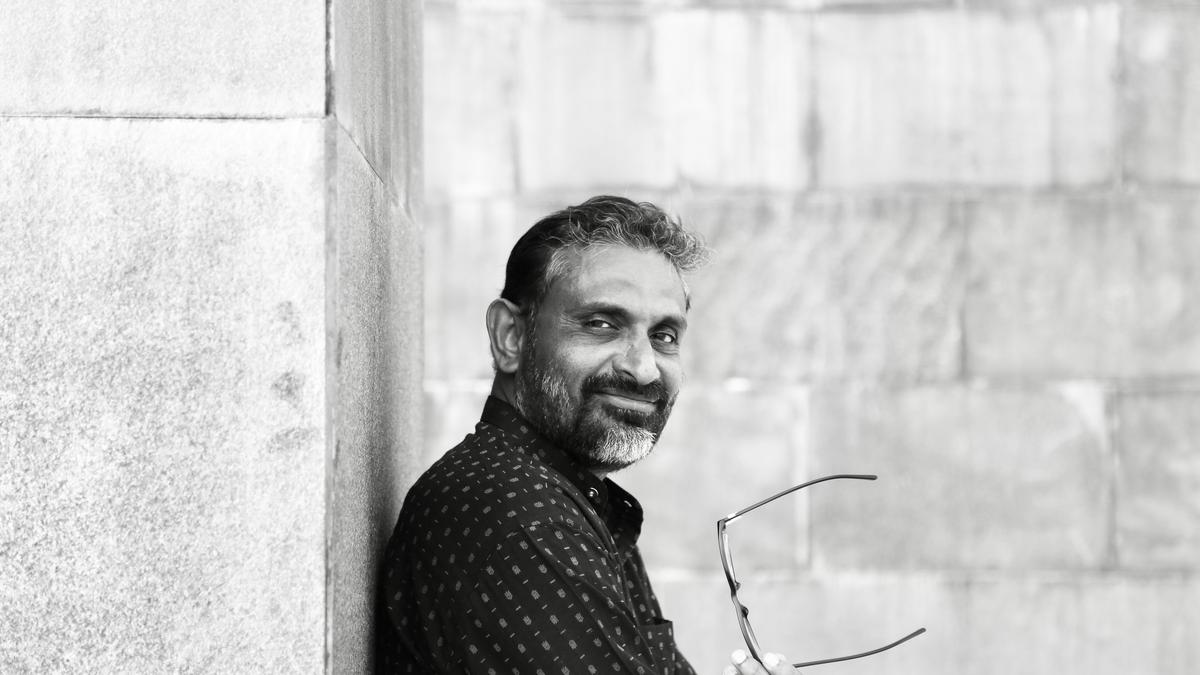
Malayalam writer Benyamin: Our scriptures have a lot to tell us
The Hindu
Benyamin's The Second Book of Prophets offers new insights and understanding religious scriptures
“All religious scriptures have something to say.” Author Benyamin, who won the JCB Prize for Literature in 2018 for his book, Jasmine Days, adds that this is what inspired him to write the The Second Book of Prophets, translated by Ministhy S and published by Simon and Schuster. The original, Pravachakanmarude Randaam Pusthakam (Malayalam) was published in 2007.
The book delves into the 1940s-50s discoveries of the Dead Sea Scrolls (a collection of ancient Jewish manuscripts discovered in 11 caves near the ruins of Qumran, on the northern shore of the Dead Sea) and the Nag Hammadi Library (a collection of over 50 early Christian and Gnostic texts discovered in Upper Egypt near the town of Nag Hammadi in 1945). Born into Christianity, Benny Daniel from Pathanamthitta, Kerala, grew up reading the Bible. “When you read it as a religious text, you don’t notice the characters or attempt to understand them. But, when one reads it as an academic text, you notice them, maybe think of their back stories,” he says.
“Bearing in mind that the Bible has been interpreted in several ways, with this reinterpretation, I hope, the reader is able to find new meaning and understanding of the scripture,” says Benyamin, a former NRI (non-residential Indian) or a pravasi as he likes to call himself.
Growing up in a fairly conservative Christian household, he was expected to go to church every Sunday and pray every day. Nonetheless, Benyamin always viewed the religious text with an objective eye. “The more you read, the stronger your base; the different themes and layers within the scriptures have a lot to tell,” he says.
His 2008 Malayalam-language novel Aadujeevitham, was published by Green Books Private Limited, Thrissur. The book won him recognition in the form of bagging the Kerala Sahitya Akademi Award for novel in 2009. It was translated into English and German in 2012, and later to Arabic in 2014. In 2024, it was adapted into a Malayalam-language biographical survival drama film, titled The Goat Life, directed, and co-produced by Blessy. Still basking in the success the film, Benyamin says it is simply awe-inspiring to be recognised by readers across regions.
If, in the Last Temptation of Christ, Nikos Kazantzakis humanises Christ by showcasing his tryst with various temptations. Benyamin, goes a step further and paints Christ as a revolutionary in The Second Book of Prophets, as someone who stands up to autocracy and class divide. “Bearing in mind that the Bible has been interpreted in several ways, with this reinterpretation, I hope, the reader is able to find new meaning and understanding of the scripture,” says Benyamin.
A mechanical engineer Benyamin Daniel, began his writing journey in 2000, with the publication of a collection of short stories. Benyamin is an incidental writer. His words — whether in Nishabda Sancharangal (Silent Journeys) or Jasmine Days — dig deep into the psyche of a reader. And this is what he hopes his latest work can do too. “Readers reflect on the struggles that often form within a rebellion — the difference in opinion among the rebels — in this case, among Christ and his disciples, like Lazarus being ratted out, Judas’ betrayal of Christ, and the conflict the leader himself faces from within when faced with temptations.”


Kamal Haasan emphasizes promoting sports culture as essential for India's health and global superpower status at a recent event.

HDK requests Railway Minister to launch Vande Bharat Express between Bengaluru and Madgaon, boosting trade and tourism in coastal Karnataka.

A.P. government's welfare schemes focus on job creation and skill development to enhance livelihoods for the state's youth.

M.K. Stalin highlights DMK's commitment to minority welfare and opposing authoritarianism during a Christmas event in Perambur.

Over 24 lakh voters in Kerala excluded from the draft electoral roll, raising concerns about representation ahead of elections.

Frost in Munnar causes significant tea crop loss, impacting the industry while boosting local tourism amidst sub-zero temperatures.

CUK Kalaburagi urges final-year degree students to apply for CUET (PG)-2026 for postgraduate admissions before January 15, 2026.

Congress selects V.K. Minimol and Shiny Mathew for Kochi's split mayoral term, emphasizing experience and community support.


BJP MP Basavaraj Bommai criticizes Congress' hate speech Bill, calling it draconian and a threat to free expression.

104 MMU employees in Ongole protest for salary hikes and better working conditions, threatening escalation if demands aren't met.

Telangana government conducted its first State-level mock exercise on disaster response on Monday in coordination with the National Disaster Management Authority, focusing on preparedness for floods and industrial accidents.

AINU in Visakhapatnam launches advanced robotic surgery, enhancing precision and patient care for complex urological procedures.