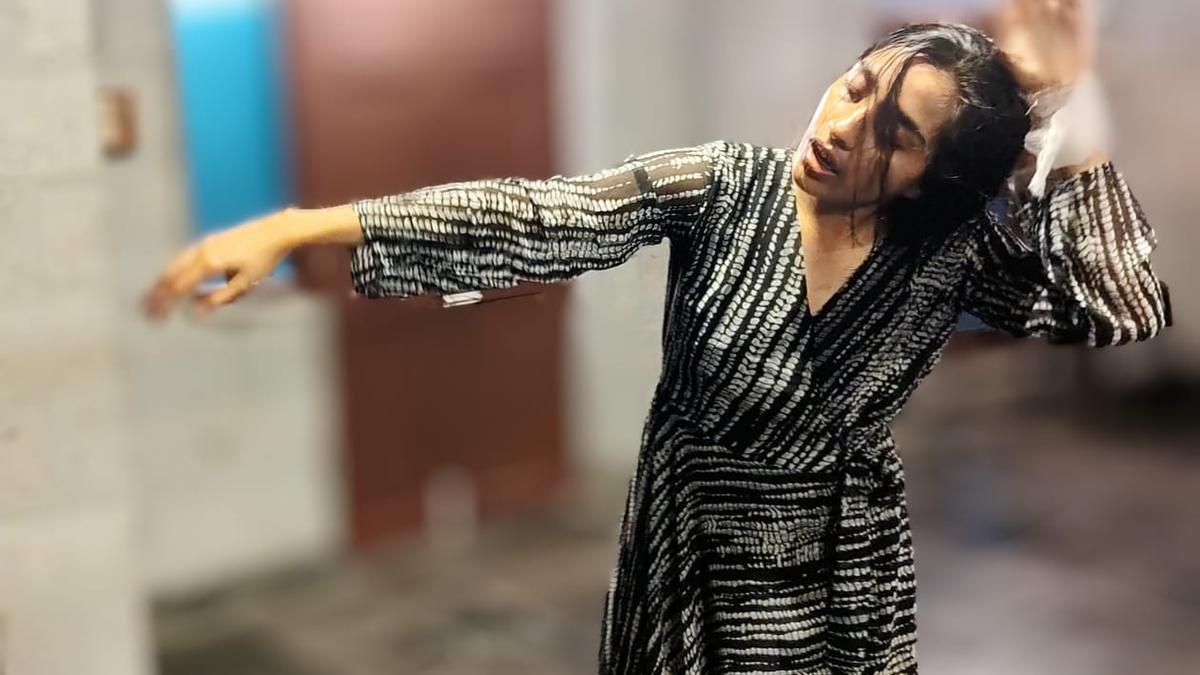
Malayalam play Agleyum Cleopatrayum by Lokadharmi Nadakaveedu to be staged in Kochi and Pune
The Hindu
Agleyum Cleopatrayum: A theatrical exploration of love, history, and female experience through the stories of Cleopatra and Egle.
When two love stories intertwine, there is bound to be drama. Especially if the characters involved are the enigmatic Egyptian queen, Cleopatra and the mythical queen of serpents, Egle. Agleyum Cleopatrayum, a solo theatrical piece in Malayalam, written, directed and designed by Chandradasan, founder of Lokadharmi Nadakaveedu, explore love and the female experience of it.
Essayed by Arya MK, the play builds connections across time, history and cultures to find commonalities in the way both Cleopatra and Egle were deeply enmeshed in the triumphs and tribulations of love. It also resonates with the contemporary female experience.
Inspired by William Shakespeare’s iconic work Antony and Cleopatra and the Lithuanian myth of Egle, Chandradasan creates a visual experience on stage, blending ritualistic elements, physical theatre and evocative music.
The performance takes place around a sarpakkalam (a ritualistic practice of drawing colourful geometrical patterns with natural colours as a form of worshipping snake Gods in Kerala), which add to the effect. The kalam will be created by Jinesh Kalamandalam and Sanosh Palluruthy, while Rajesh Mohan will manage the set and stage. The music is by Salim Nair. Sobha Menon has designed the costume; assisted by Sini PG. Jolly Antony will handle lighting and production coordination is by Sreedeep PS.
Artists Lekha Narayanan and Lekha Vyloppilly will paint during the performance.
Journeying into the depths of a woman’s heart, it also speaks the universal language of emotion.
The play will be staged on November 27 at Changampuzha Park, Edappally, at 6.30pm. It will also be staged on December 10 at Shreeram Lagoo Rang-Avakash, Pune, at 7pm.


Discover the inspiring legacy of Bibha Chowdhuri, a pioneering woman in physics and a trailblazer in STEM history.

Ashdeen’s Spring 2026 collection features saris inspired by the designer’s Parsi gara archive

Red ochre burials, ritual markings and myths across cultures show that red repeatedly marks liminal thresholds such as puberty, sacrifice and death; anthropologists argue that the colour functions as a technology of collective ritual and value, binding communities through shared symbolic acts

India approves 23 institutions for quantum labs under the National Quantum Mission, aiming to advance quantum technology and research.

India approves 23 institutions for quantum labs under the National Quantum Mission, aiming to advance quantum technology and research.

The Gaza conflict exacerbates environmental damage, emitting millions of tonnes of CO2 and threatening climate stability in West Asia.

Chefs and cookery experts share smart kitchen hacks, hybrid cooking methods and appliance tips to help households reduce LPG use without compromising on food

Discover groundbreaking research on Titan's lakes, bat vaccinations, and the unique aroma of ripening bananas in just one minute.

IRSO's NavIC system faces challenges as the last atomic clock fails, reducing operational satellites for navigation services.

Discover efficient pressure cooking techniques to save up to 50% on fuel. OPOS B Ramakrishnan tells you how

Mercedes-Benz CLA 250+ with EQ Technology review: design, performance, range and features explained. Discover how the new electric CLA combines advanced AI, long range, fast charging and futuristic styling for the next generation of luxury EVs.

Pi Day is celebrated every year on March 14, honouring the significance of the mathematical constant π and its applications in mathematics.

Discover how sculptural interior design transforms modern spaces, blending creativity and functionality to evoke emotion and identity.