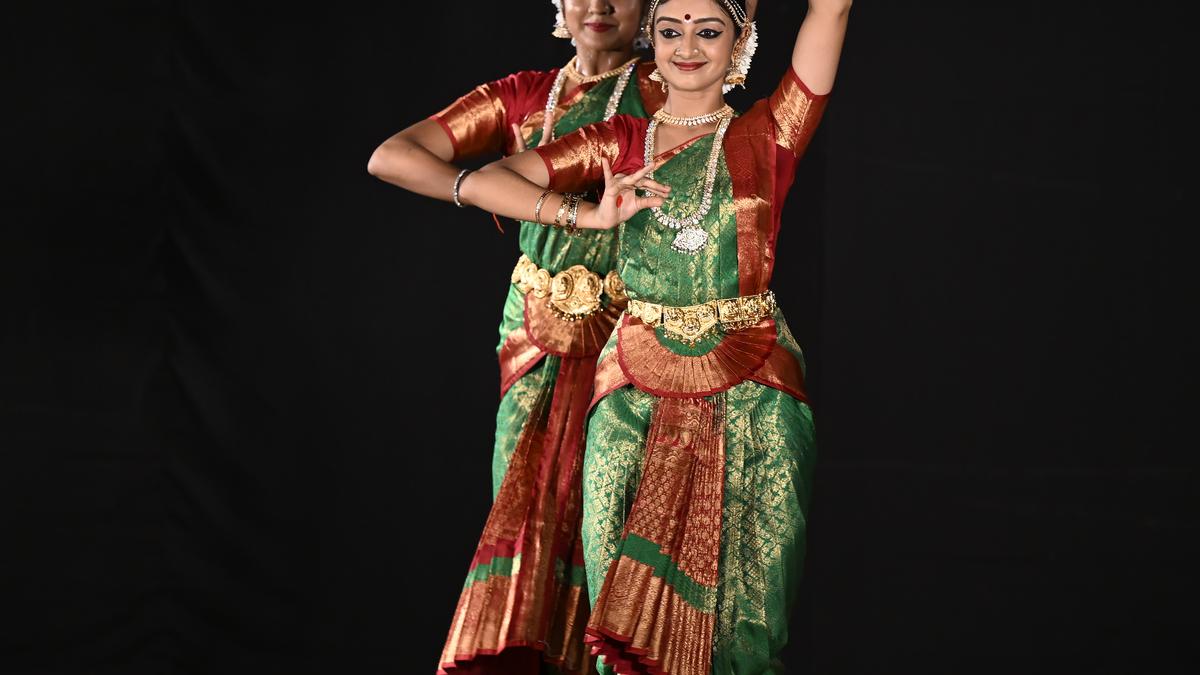
Mahati Kannan and Ramya Venkataraman explored the concept of Shakti through well-researched pieces
The Hindu
Mahati Kannan and Ramya Venkataraman explored the concept of Shakti in a seamless 95-minute Bharatanrithyam show
Seamless execution of profound truths Mahati Kannan and Ramya Venkataraman’s exploration of Shakti, the Divine Mother, was full of fervou
‘Prakrti to Para, An Exploration of Sakthi’, conceptualised and visualised by Bharatanrithyam dancers Mahati Kannan and Ramya Venkatraman of Nrithyodaya, was an exploration of the Divine Mother from the physical and the metaphysical plane, as described in the Vedas.
The dancers had practised well, their communication was direct in the seamless 95-minute show, for Bharat Kalachar, and their confidence came from a place of having understood the content.
Many stalwarts supported them, especially lyrics by Isai Kavi Ramanan in addition to excerpts from traditional texts, music by veteran dancer and scholar Padma Subrahmanyam with tribal tunes from Shyamala Balakrishnan’s research. This was in addition to the live orchestra comprising Gayatri Kannan (vocal, nattuvangam and anchor), Nagai P. Sriram (mridangam), Parur M.S. Ananthashree (vocal) and Sreelakshmy Bhat (violin).
‘The Earth and the Sky are the eyes of the formless… Do not search for Devi outside, look for her within,’ said the dancers in the Pushpanjali, quoting from Sri Devi Atharvashirsha. ‘Devi as Prakrti is everywhere — as the Earth Goddess, as the dense forest, the fruits and flowers, as the sacred cow and as the sacred Saraswati river which gave birth to the civilisation called Bharat and as Swaha, who gives shakti to Agni to burn…’
The visuals in the text were deftly translated into symbolic jathis interspersed with clear abhinaya, almost literal, but tinged with warm enthusiasm. The nritta, presented as mere punctuations in the narrative, was crisp, highlighted by good finishes and no blurred lines. In the sound track, melody ruled while percussion played a calm, supportive role. The experience was tasteful and classy. When speaking of such profound truths, softer tones convey it better.
Most endearing was the piece with child goddess Balatripurasundari and Kalidasa. When the poet was tasked with a poem to write with the first four aksharas of the alphabet, he meets a young girl Kanchanamala, who was writing the same. He is inspired after meeting her and presumes her to be the goddess in guise. Kalidasa’s realisation accompanied by two classical pieces, ‘Bhajare re chita Balaambika’ (Kalyani, Muthuswami Dikshitar) and ‘Baale balendhu bhooshani’ (Ritigowla, Tyagaraja), added a sudden depth of feeling, whichwhich was almost magical. They were rendered soulfully by Ananthashree, whose conscious attempt to keep to the ‘Nrithyodaya’ style of singing was remarkable.


India's artists unite against rising censorship, advocating for creative freedom and support for marginalized voices in the arts.

Written and directed by Kunal, the film also stars Sparsh Shrivastava and Vanshika Dhir

This year, Bharatnatyam artistes will present the Tyagaraja Aradhane as a dance performance

This year, Bharatnatyam artistes will present the Tyagaraja Aradhane as a dance performance

The actor, along with director Sushant Shah, speak about their upcoming series ‘Chiraiya’, Divya’s process of working on the dialect, Sushant’s approach to telling a story about women, and more

An independent video, ‘Feel the Spark’ by Raleigh Rajan with vocals by Ciera Dumas that celebrates Tamil literary giants, garnered 1.4 million views in less than 36 hours.

In ‘Jack Ryan: Ghost War’, John Krasinski is back as the savvy CIA analyst, diving headfirst into a high-stakes mission that unravels a deadly conspiracy and pits him against a rogue black-ops unit

Shriram Bharatiya Kala Kendra’s Shankarlal festival showcased rare ragas, radiant artistry, and inclusive performances, from Pt Madhup Mudgal’s serene morning ragas to Ramana Balachandran’s Saraswati veena.

Explore "Threads that Bind: The Kantha Project," an exhibition in Delhi reimagining kantha as a medium of repair and renewal.

Sean Penn skips the Oscars to meet Ukraine's Zelenskyy, who praises him as a "true friend" amid the war.

The teaser of Tamil star Suriya’s much-awaited film with director Venky Atluri, titled Vishwanath and Sons, was unveiled by the makers on Monday

A 'Golden' moment for a K-pop track at the Oscars.

Parvathi Nayar’s new exhibition, The Primordial, in Mumbai, traces oceans, pepper and climate change
Opened on March 12, the exhibition marks the artist’s first solo show in Mumbai in nearly two decades. Known for her intricate graphite drawings and multidisciplinary practice spanning installation, photography, video, and climate change, her artistic journey has long engaged with the themes of ecology, climate change and the natural world. In this ongoing exhibition, these strands converge through a series of works centred on water, salt, and pepper — materials that carry natural and historic weight across centuries.