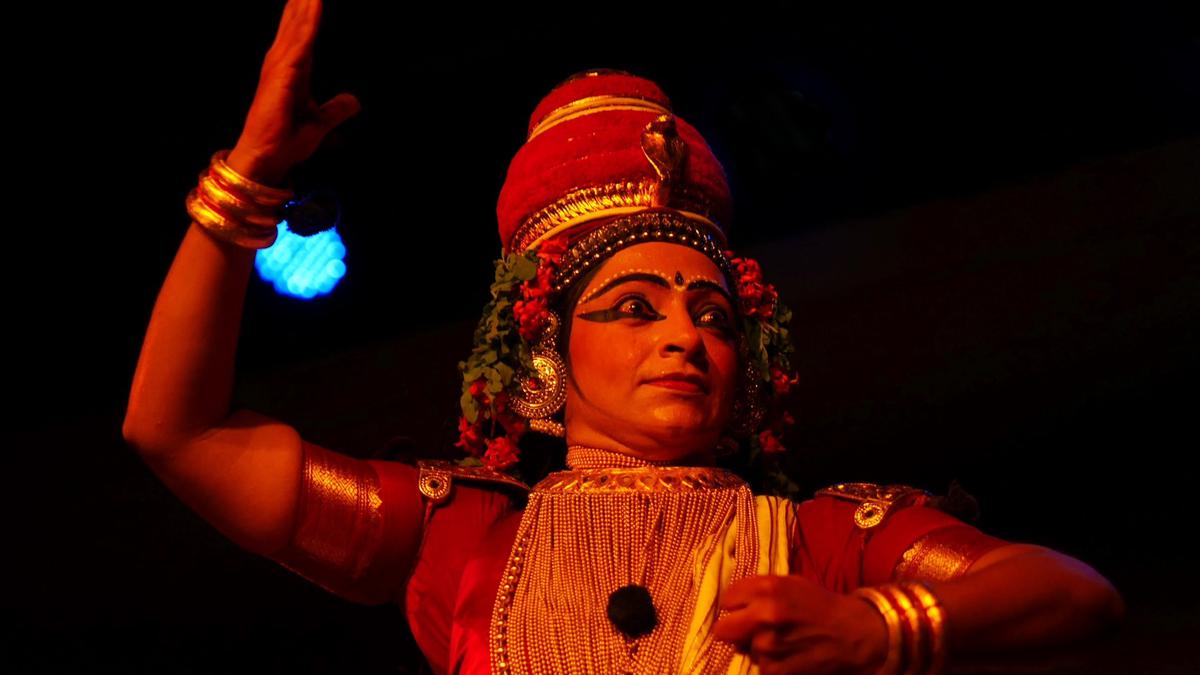
Madurai Veeran’s story in Nangiarkoothu style for the first time
The Hindu
Narrating the story of Madurai Veeran through Nangiakoothu
Koodiyattam cannot alienate itself from Tamil or Tamizhagam, though it is widely accepted as the Sanskrit theatre tradition that survives only in Kerala. Chakyars, the traditional performers of this art form, are believed to have hailed from Tamil Nadu. Still, stories culled from Tamil have been practically nil in Koodiyattam.
Viewed against this backdrop, Kapila Venu’s latest choreography in Nangiarkoothu (an off-shoot of Koodiyattam performed only by women) – ‘Madurai Veeran Kathai’ – is a path-breaker. The one-and-a-half-hour performance was staged by Kapila at the recently revived Kottichetham auditorium of Natanakairali, in Irinjalakuda.
Madurai Veeran is a Tamil folk deity popular in Tamil Nadu. His name was derived as a result of his association with Madurai as a protector of the city. He is widely worshipped as a hero of the people. His name literally means ‘warrior of Madurai’. Further, there have been innumerable folk songs, ballads and dramas anchored on him.
Veeran was born into a royal family but was abandoned. Subsequently, he was adopted by a couple from the Arunthathiyar community. Growing up among them, he eventually became a guard in the court of Bommanna Nayakan. His fame brought him to Madurai, where King Thirumalai Nayakar sought his assistance to protect the city from bandits.
During his stay in Madurai, Veeran sees the royal dancer Vellaiyammal and falls for her. Vellaiyammal too gets drawn to him due to his striking appearance and proficiency in various arts.
One fateful night, Veeran gets caught by the guards of nayakar while trying to elope with Vellaiyammal from Madurai.
He is subjected to severe punishment and the guards amputate his limbs Vellaiyammal, who witnesses this, decides to end her life. But prayers are offered to Madurai Meenakshi wishing for Veeran’s recovery. As an answer to the prayers, he gets back his limbs. But eventually Veeran, who believes it is god’s will that he must die, beheads himself. After this, Thirumalai Nayakar builds a temple for Veeran, who is now being worshipped and considered as the family deity of many communities in Tamil Nadu.


South African naturalist Steve Boyes speaks on ghost elephants, ancestral tracking, and Werner Herzog’s documentary exploring Angola’s elusive highland giants

Actor-director Amol Palekar will receive META's Lifetime Achievement award for 2026 on March 25 in New Delhi.

India's artists unite against rising censorship, advocating for creative freedom and support for marginalized voices in the arts.

Written and directed by Kunal, the film also stars Sparsh Shrivastava and Vanshika Dhir

This year, Bharatnatyam artistes will present the Tyagaraja Aradhane as a dance performance

This year, Bharatnatyam artistes will present the Tyagaraja Aradhane as a dance performance

The actor, along with director Sushant Shah, speak about their upcoming series ‘Chiraiya’, Divya’s process of working on the dialect, Sushant’s approach to telling a story about women, and more

An independent video, ‘Feel the Spark’ by Raleigh Rajan with vocals by Ciera Dumas that celebrates Tamil literary giants, garnered 1.4 million views in less than 36 hours.

In ‘Jack Ryan: Ghost War’, John Krasinski is back as the savvy CIA analyst, diving headfirst into a high-stakes mission that unravels a deadly conspiracy and pits him against a rogue black-ops unit

Shriram Bharatiya Kala Kendra’s Shankarlal festival showcased rare ragas, radiant artistry, and inclusive performances, from Pt Madhup Mudgal’s serene morning ragas to Ramana Balachandran’s Saraswati veena.

Explore "Threads that Bind: The Kantha Project," an exhibition in Delhi reimagining kantha as a medium of repair and renewal.

Sean Penn skips the Oscars to meet Ukraine's Zelenskyy, who praises him as a "true friend" amid the war.

The teaser of Tamil star Suriya’s much-awaited film with director Venky Atluri, titled Vishwanath and Sons, was unveiled by the makers on Monday