Madras Week | In the the bajjis, murukku sandwiches and fish fry of Chennai, we trust
The Hindu
Discover unique Chennai street food specialties like atlappam, kutty samosas, murukku sandwiches, and Marina Beach bajjis.
It is a dish unlike any other: a little like appam, but baked; a little like pizza, but sweet. Atlappam, a golden-yellow delicacy made of a batter of raw rice, split Bengal gram, semolina, eggs, and sugar, is a Kasimedu specialty. It is available only at the fish market there, that too for just a few hours in the morning. “We sell it from 6am onwards on Sundays and Wednesdays when there is crowd at the market,” says K Arokia Mary from Singaravel Nagar in Kasimedu.
The 63-year-old sells atlappam and kambankoozh (pearl millet porridge), alongside her brother’s daughter-in-law S Suba near the prawns market at Kasimedu. Atlappam is baked in aluminium pans in an arrangement of clay pots over firewood. “We get dry rice flour ground at a neighbourhood mill the night before,” explains Mary, adding that to this, they add semolina, sugar, roasted and ground kadalai paruppu, oil, powdered cardamom and fennel seeds. Egg is added right before it is baked, and the atlappam is garnished with coconut slivers, cashews and raisins. “The batter is mixed the previous night to let the ingredients soak,” she says.
A piece costs ₹60 and can be shared by two people. “One can never have a full atlappam, no matter how big one’s appetite is,” chuckles Mary. “It can be quite heavy since it has eggs and dried fruits,” she points out. Atlappam is a favourite among the fishermen, who pack one on their way to work at sea. “People who come to buy fish at the market too buy from us,” says Mary.
Mary does not know where the recipe originated. “All I know is that it has been passed down generations,” she says, “We’ve been selling it for several decades; back then, a piece would cost ₹10.” Atlappam is rarely made at home. “It’s a lot of work,” says Mary. “We are happy to sell it, and treat ourselves to a piece once in a while.”
- Akila Kannadasan
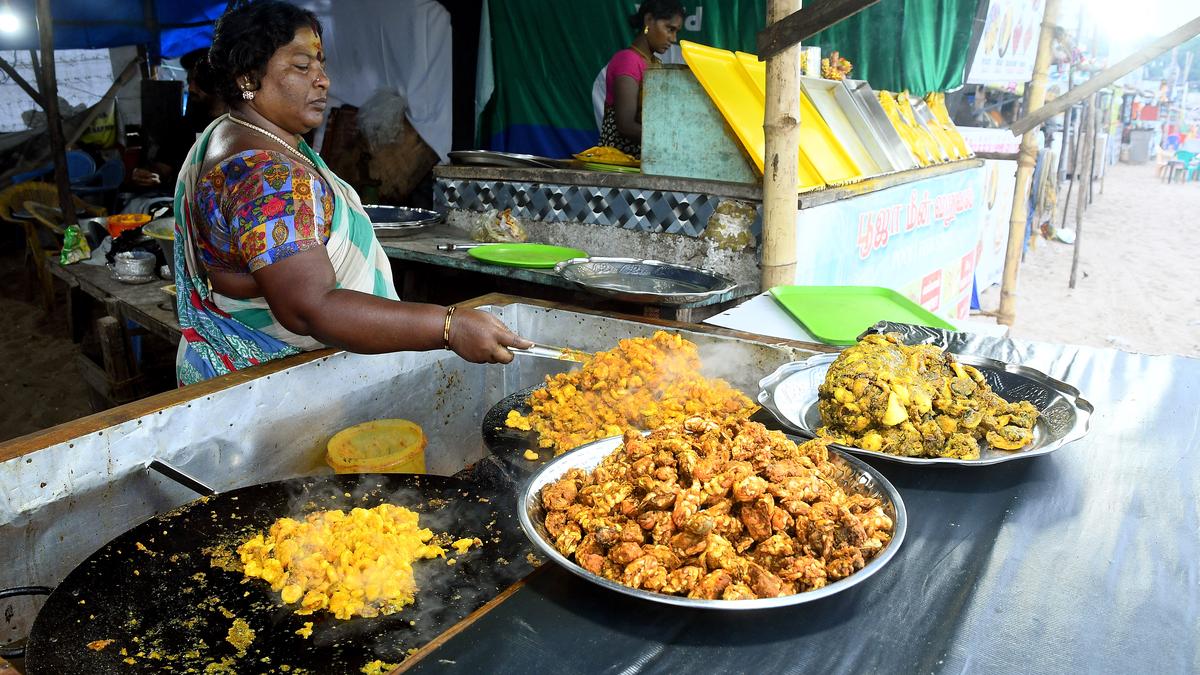
For tourists, tasting fried fish at one of the beaches in Chennai is a must-do. While Sundari akka was the pioneer who set up her food cart (Kaanavur Unavagam) right on the beachfront, two decades ago, many such shops sprang up eventually. Today, the Foreshore Estate’s Loop Road, is dotted with food stalls set up by the fisherfolk within their homes or on a cart, selling a wide range of sea food delicacies.
Most popular among Chennai’s fried fish is the nethili. A plate of nethili (anchovies) fry is priced at ₹100 in most of these stalls. Ayala (Indian mackerel) and sankara (Japanese thread fin) are pocket-friendly as they are sold between ₹40 to ̥₹60 depending on size. Big fish varieties (priced between ₹100 and ₹800) such as seela (barracuda), paarai (trevally), koduva (barramundi), vaaval (pomfret) and nei meen (cobia) are available in its entirety. It is fried on demand.


Explore 2026's wallpaper trends in India, highlighting botanicals and handmade designs that enhance modern homes with nature-inspired aesthetics.

Mercedes-Benz CLA 250+ with EQ Technology review: design, performance, range and features explained. Discover how the new electric CLA combines advanced AI, long range, fast charging and futuristic styling for the next generation of luxury EVs.

AI tool for sparrow conservation

BTS’s comeback with ‘Arirang’ marks a major global music event. When does the album release, and where can you watch their concert live stream? We have all the details

The 2026 U.S. cholesterol guidelines urge starting screening and treatment at 30 to prevent cardiovascular disease effectively.

Olam Festival 2026 in Thiruvananthapuram returns March 27-29 with 120+ vendors, music, art, and cultural zones.

A few storytellers in Thiruvananthapuram share their journeys, challenges, and evolving methods on World Storytelling Day, inspiring young minds.

76-year-old Kurian Jacob from Kerala triumphs with seven medals, including five golds, at the Open Masters Games in Abu Dhabi.

Explore the nature of the human mind as an emergent property of brain activity and complex neural interactions.

CERN's Large Hadron Collider discovers the Xi-cc-plus particle, enhancing understanding of quantum mechanics and baryon behavior.

Vibha Batra’s latest book, Spotless (Hachette India) is a novel in verse for young adults

In its first edition, the Madras Art Salon spotlights the works of journalist and artist Narayan Lakshman at The Botanical Club, a social space in the British Deputy High Commission, Chennai

Cholesterol enhances melanoma cell invasion by making nuclei squishier, revealing a potential treatment target in cancer progression.