Madras Labour Union’s fiercest battle
The Hindu
Madras Labour Union's historic battle for workers' rights in 1921, ending in tragedy, shaped Chennai's labor movement.
The role of Madras in establishing the first workers union in the country is a matter of record. The Madras Labour Union was set up in 1918, and in just a couple of years, it mediated in a stand-off with the management of an industrial unit. Over a century ago, to the month, the city witnessed what could arguably be called the fiercest battle that union workers fought in Chennai.
On August 29, 1921, a woman worker, along with six others, fell to the bullets of the policemen who fired on the striking workers of the Buckingham and Carnatic Mills (B&C Mills) in Perambur.
“Will Chennai create a memorial for the woman who was known for her bravery,” wrote labour leader Singaravelu Chettiar, narrating the funeral procession of the bodies in Chennai. Another prominent union leader and Tamil scholar Thiru. Vi. Kalyanasundaranar (Thiru. Vi. Ka.) cited this article and said it belongs to history.
What had happened in 1921 was the continuation of the unrest and the first strike in the mill, which was then known as Binny Mills. A European official had entered the mill with a revolver on October 20, 1920. It shocked the workers and caused an intense argument. One of the workers snatched the revolver from the official. The next day, the company announced a lockout and brought in workers from the outside. The mill workers, to protest, threw stones on the lorries carrying the outsiders, leading to violence and police firing.
“Two youth were killed and a few were injured in the police shooting on December 9, 1920. They were the first to lay down their lives for the sake of the trade union movement,” writes Thiru. Vi. Ka., who was the leader of the Madras Labour Union.
Thiru. Vi. Ka. was one of the 10 members of the lockout committee, who were prohibited by the Madras High Court from addressing any meeting. The others were B.P. Wadia, G. Ramanjala Naidu, Vedachalam, S. Natesa Mudaliar, Varadaraja Nayakar, Kesavalu Naidu, Saitjalal, K.M. Nadesa Nayakar and Namasivayam Pillai. The case of the management was that the leaders had instigated the workers and the strike had caused financial losses to the company. It demanded ₹75,000 as compensation. Noted lawyers, including C.P. Ramsamy Iyer, Alladi Krishnasamy Iyer, and S. Durasamy Iyer, represented workers in the Madras High Court presided over by Justice Philips.
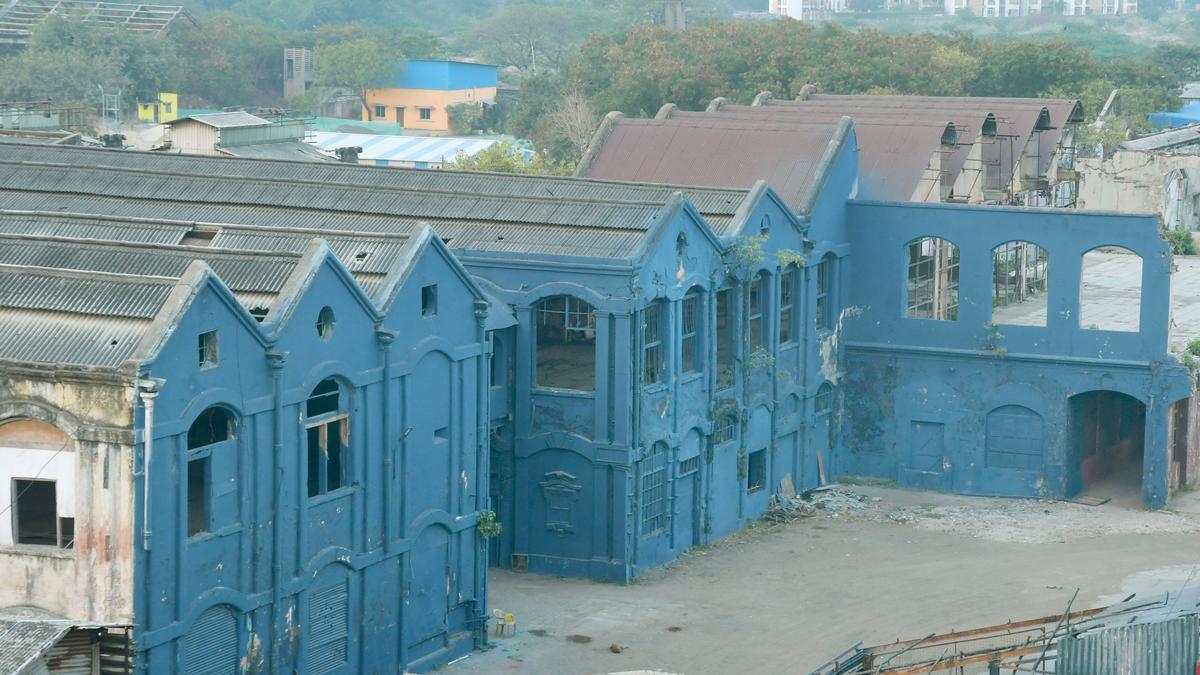
The Making of the Madras Working Class, a book by D. Veeraraghavan, gives a detailed account of the story of the disputes and the Buckingham Mill Co., owned by Binny and Co., an old and reputed business house. The mill itself was registered on August 17, 1876, with the objective of working a spinning and weaving mill, buying cotton, wool, and other fibres and spinning and weaving the same, and marketing the materials so manufactured. The mill commenced working on the site in Perambur in January 1878. Soon, Binny and Co. started a sister mill known as the Carnatic Mills in 1884, and the property came to be known as B&C Mills.


Telangana's revised pay scale implementation for employees will take timer. The tenure of Pay Revision Commission extended. Govt likely to take decision on reccomendation based on its report.

Vizianagaram's SP A.R. Damodar highlights 20 accident-prone areas and urges drivers to prioritize safety with helmets and seat belts.

Kerala HC stays disqualification of SNDP Yogam leaders, reversing a single judge's order regarding financial and regulatory compliance issues.

Karnataka announces daily supply of 10,000 LPG cylinders to hotels, easing the commercial shortage for the hospitality industry.

Malayalam superstar Mohanlal will be reuniting with filmmaker Priyadarshan, it was announced recently. It will mark the 100th film of Priyadarshan and is backed by Mohanlal’s longtime collaborator, Antony Perumbavoor

Gautham Vasudev Menon loses Madras High Court appeal, ordered to pay ₹4.25 crore to R.S. Infotainment with interest.

AIADMK faces its toughest challenge in 53 years as it prepares for the crucial 2026 T.N. Assembly elections.

Lakmé Fashion Week x FDCI 2026 in Mumbai: What worked and what didn’t

Telangana CM announces underpass beneath Begumpet Airport runway to alleviate traffic congestion in Hyderabad.

Congress leader Ramesh Chennithala claims an alliance between Pinarayi Vijayan, Modi, and Shah aims to undermine UDF in Kerala elections.

CCB arrests Bengaluru couple for running a fake government job scam, cheating over 100 victims out of crores.

The enduring legacy of Araiyar Sevai

Telangana integrates with the 'Vahan' platform and eliminates 2% tax on second vehicles, enhancing transport services and transparency.