MACE in Ladakh opens its one-of-a-kind eye to cosmic gamma rays Premium
The Hindu
MACE telescope in Ladakh is a cutting-edge gamma-ray observatory aiding in dark matter research and high-energy astrophysics.
The Major Atmospheric Cherenkov Experiment (MACE) telescope is a state-of-the-art ground-based gamma-ray telescope inaugurated in Hanle, Ladakh, on October 4. Located at around 4.3 km above sea level, it is the highest imaging Cherenkov telescope in the world. It boasts of a 21-metre-wide dish, the largest of its kind in Asia and second-largest in the world.
The facility was built by the Bhabha Atomic Research Centre, the Tata Institute of Fundamental Research, the Electronics Corporation of India Ltd., and the Indian Institute of Astrophysics.
Light comes in a wide range of wavelengths but humans can only see a small portion. In the electromagnetic spectrum, gamma rays have the shortest wavelength and the highest energy, with each light-particle possessing more than 100,000 electron volts. (Visible-light photons have around 1.63-3.26 eV each.)
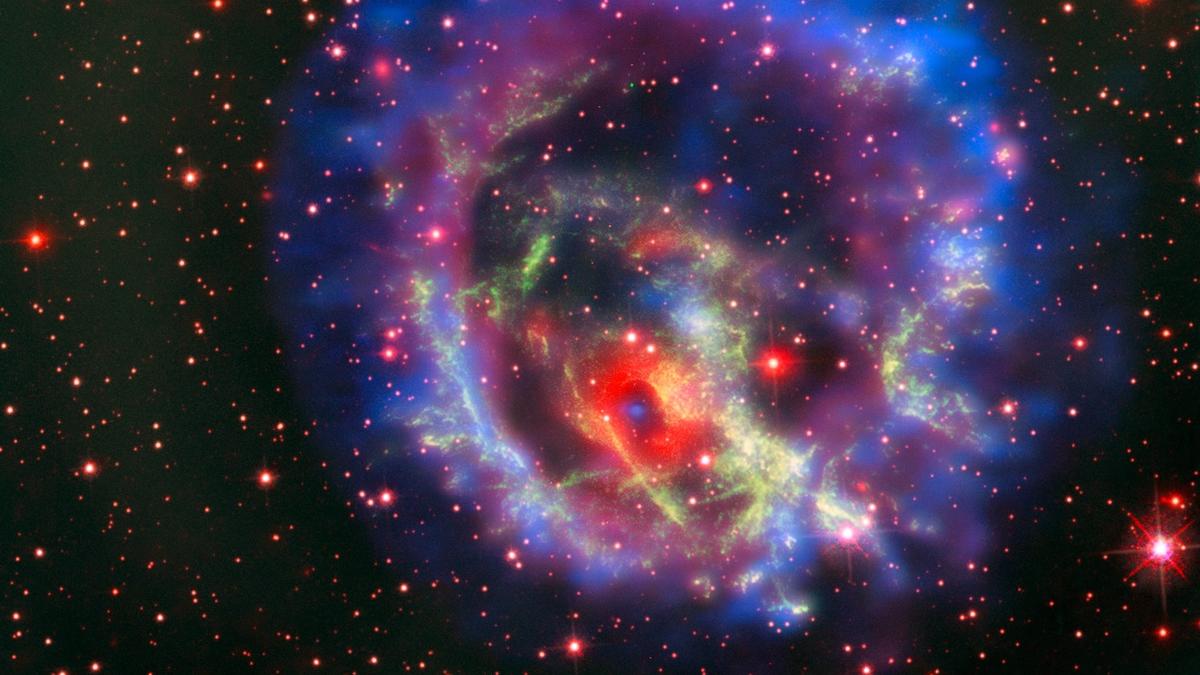
Gamma rays are produced by exotic energetic objects in the cosmos, including rapidly spinning pulsars, supernova explosions, hot whirlpools of matter around black holes, and gamma-ray bursts. Because of their high energy, gamma rays are a health hazard. They can damage living cells and may even trigger deleterious mutations in DNA. Fortunately the earth’s atmosphere blocks gamma rays from reaching the ground. Thus, astronomers who want to study objects that emit gamma rays prefer using space observatories — although there are indirect techniques to detect gamma rays with very high energies from the ground.
When a gamma ray from a cosmic source enters the atmosphere, it interacts with molecules in the air to produce a copious shower of electron-positron pairs. As these charged particles travel through the atmosphere at speeds greater than the speed of light in air, they emit a faint blue light, called Cherenkov radiation. This radiation has wavelengths typical of violet and blue light of the visible spectrum and of the ultraviolet wavelength range.
The light is emitted in about a fraction of a second, and the light-particles spread out evenly over a vast region on the earth’s surface. This region is a suitable place to locate a detector that can collect the photons and study them to indirectly understand the gamma rays. Instruments used for this kind of detection are called imaging atmospheric Cherenkov telescopes (IACTs). The MACE telescope is an IACT.
Every IACT has a light collector and a camera. The size of the light collector determines the minimum energy of gamma rays it can detect. MACE’s light collector has 356 mirror panels. Each panel consists of four smaller mirrors arranged in a honeycomb structure. These honeycomb arrangements have been shown to be lighter yet more stable than solid mirrors because they reduce the empty space between segments and increase the total reflective area. The James Webb Space Telescope uses honeycomb-segmented mirrors for this reason.


A folktale from Australia tells how the crane and kangaroo rat discovered fire.

Lockie Ferguson will miss the start of IPL 2026 with Punjab Kings, prioritizing family after the birth of his son.

BJP fields seven Christian candidates in Kerala 2026 elections, aiming to win Christian votes through focused outreach and issue advocacy.

FIFA mandates female coaches in women's tournaments, aiming to enhance opportunities and visibility for women in soccer.

Follow The Hindu's live updates on the Telangana state budget for 2026-27, presented on March 20, 2026

Iran's women's soccer team celebrated a warm welcome in Tehran after returning home, despite some players seeking asylum in Australia.

Assembly elections 2026 LIVE: First EVM, VVPAT randomisation conducted ahead of Assam Assembly polls
Assembly polls 2026: Follow updates from The Hindu on the upcoming elections in five States, on March 20, 2026

Protests surge in India against the Transgender Persons Bill, threatening the right to gender self-identification for trans communities.

Gudi Padwa celebrations in Maharashtra feature vibrant processions, traditional music, and community gatherings, attended by key political figures.

U.S. issues a new 30-day waiver for Russian oil sales, excluding transactions involving Cuba, North Korea, and Crimea.

Kim Jong Un and his daughter ride a tank during army training, showcasing their bond amid military preparations in North Korea.

The Hindu Morning Digest gives a select list of stories to start the day. Read the top news today on March 20, 2026

CSK faces a major setback as Nathan Ellis's hamstring injury rules him out of IPL 2026, prompting replacement plans.