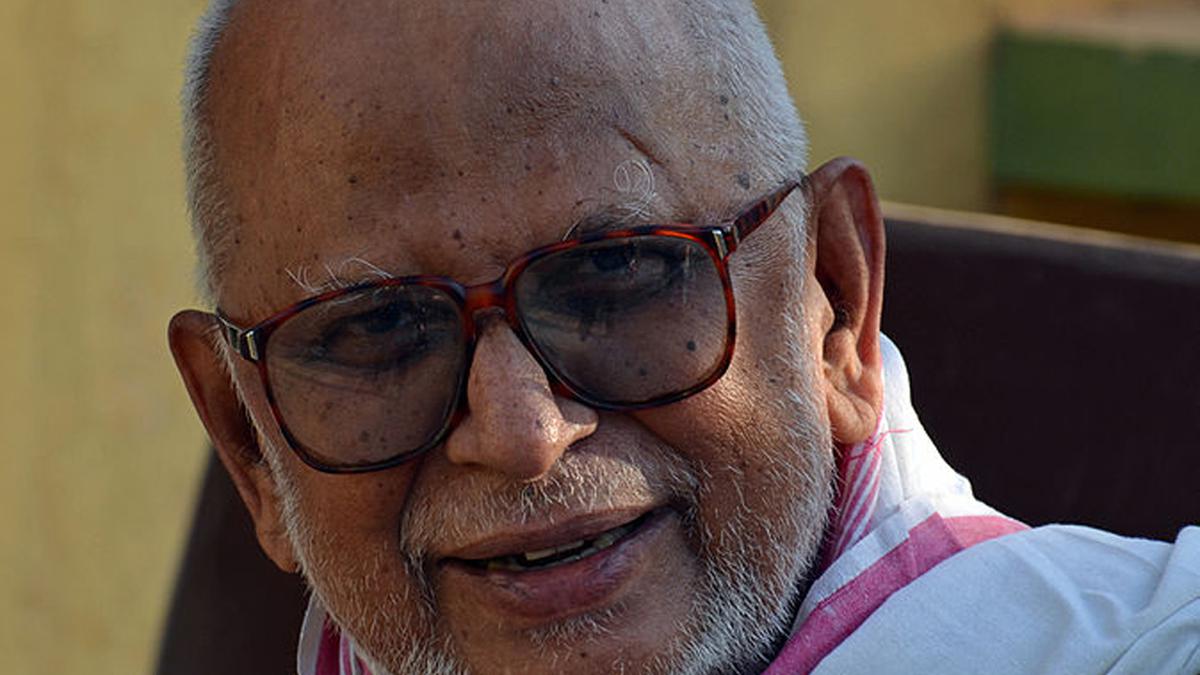
M.S. Prabhakara passes away
The Hindu
He had served as correspondent for The Hindu for many decades in Assam and South Africa.
M.S. Prabhakara, journalist, academic and author in English and Kannada, passed away at his residence in Kolar on Thursday. He was 87.
He had served as correspondent for The Hindu for many decades in Assam and South Africa.
Born in Kolar in Karnataka in 1936, he had lived for nearly three decades in Assam first as a teacher in Gauhati University and later as a correspondent of The Hindu. He lived for nearly a decade in South Africa, during its most turbulent years. He was The Hindu’s first correspondent in the continent.
Prabhakara held an Honours degree and a Master’s degree in English Language and Literature from Central College, Bangalore. He taught for four years in Bangalore and Dharwad before joining Gauhati University in 1962.
He resigned from Gauhati University in 1975, and joined Economic and Political Weekly. He returned to Guwahati in June 1983 as the Special Correspondent of The Hindu and, later, also Frontline, covering developments in Assam and its neighbourhood in Northeast, travelling widely in the region.
In June 1994, he went to Johannesburg as Special Correspondent and wrote extensively on the turbulent politics of Southern African countries. He returned to Guwahati in April 2002 and retired a month later.
Among his important works is a collection of essays, Words and Ideas, and a collection of his longer analytical essays, Looking Back into the Future: Identity and Insurgency in Northeast India.


The Railway Ministry has decided to regularise the services of Surat-Mangaluru Junction-Surat bi-weekly Special Express along with nine other special trains.

Training held for zonal election officers in Thoothukudi

Defence Minister highlights BRO's vital role in enhancing border infrastructure, national security, and socio-economic growth in India.

Andhra University celebrates its 91st and 92nd convocations, honoring graduates and distinguished personalities for their contributions and achievements.

Coimbatore students receive earthen bowls to provide water for birds, promoting conservation on World Sparrow Day.

Residents of Hosahundi village in Kasaba hobli of Mysuru taluk have opposed the proposed construction of a flyover at Devalapura Cross on National Highway 275-K (Outer Ring Road), urging the authorities to drop the project and adopt alternative measures to improve road safety.

A brain-dead head constable’s family consented to organ donation under the Jeevandan programme, giving two patients a new lease of life through kidney transplants.

A-G informs Madras High Court no govt. sanction needed for FIR in K.N. Nehru's cash-for-jobs scam case.

President of Karnataka Beary Sahitya Academy U. H. Umar on Wednesday appealed to Madhu Bangarappa, Minister for School Education and Literacy to introduce Beary as the third optional language from Class 6 from the academic year 2026-27.

Karnataka Dalit Sangharsha Samiti (DSS) has urged the State government to begin the process of filling up 56,432 posts only after rectifying the mistakes in fixing the roster and implementing the internal reservation among Scheduled Castes.

Rebel nominations in Karaikal expose tensions within electoral alliances, risking voter fragmentation ahead of the Puducherry Assembly elections.

CCPA prohibits restaurants and hotels from imposing unfair LPG charges, labeling them as unjustified and against consumer protection guidelines.

Andhra Pradesh receives ₹19.47 crore for 44 handloom clusters, benefiting over 10,000 weavers under the National Handloom Development Programme.