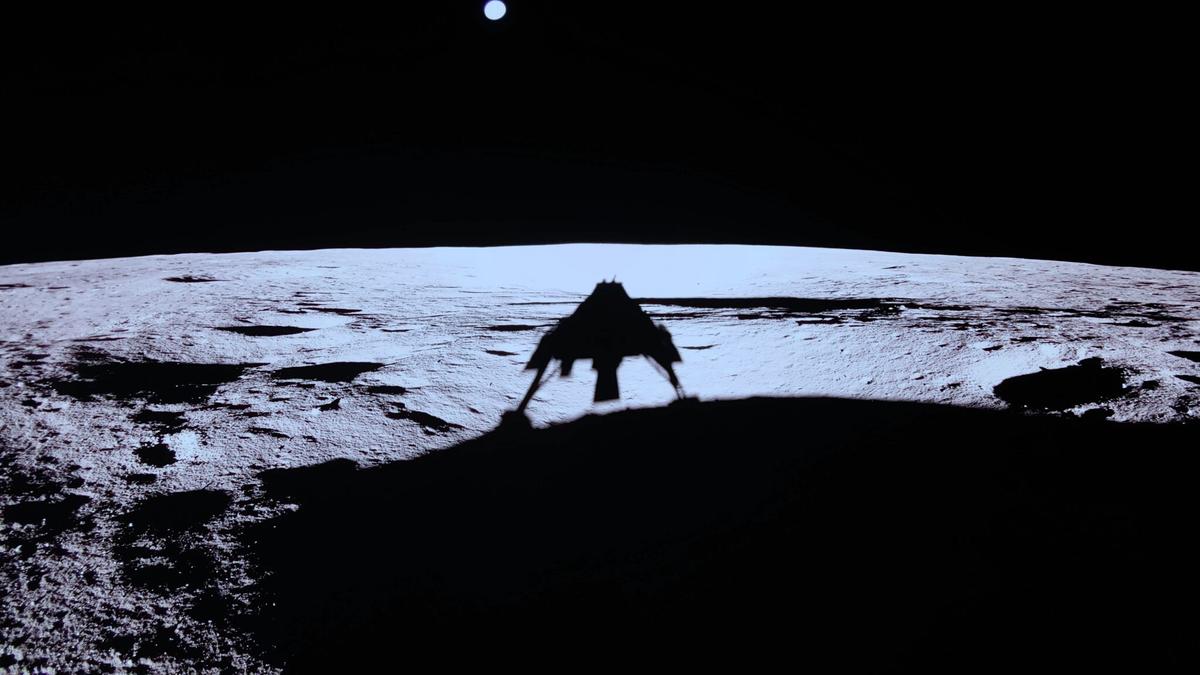
LunARC on board Firefly Aerospace’s Blue Ghost Mission 1 flies to the moon with 30,000 digital artworks
The Hindu
LunARC on board Firefly Aerospace’s Blue Ghost Mission 1 flies to the moon with 30,000 digital artworks
March marked a milestone in private space exploration as Texas-based Firefly Aerospace successfully landed its first robotic spacecraft, the Blue Ghost Mission 1 lander, on the moon. This technological feat was also a defining moment for art, as the lander carried the LunARC mission, a collection of 30,000 digital artworks, to the lunar surface.
These artworks, gathered from 40 countries, including India, were part of the Lunar Mission 1 - Community Art Gallery project. They represented diverse voices — marginalised communities, refugees, people with disabilities, and even laypersons who never imagined their work would be part of a lunar mission.
LunARC, a US-based non-profit initiative founded in 2022 by Lakshmi Karan and Topher Wilkins, has partnered with non-profit organisations worldwide. A significant portion of the artworks from India was collected through a campaign led by NGO Pratham.
“It was thrilling! We made history together,” says Lakshmi Karan, co-founder of LunARC. Over an email from Portugal, she explains that the mission is part of Phase 1 of their Lunar University goal, aimed at inspiring global communities to engage with space exploration. “The objective is to emphasise inclusivity—that space is not just for those with significant resources but for everyone,” she says.
Launched in the summer of 2023, the project also invited renowned artists to contribute. Among them was aerospace engineer and artist Priyanka Das Rajkakati, who submitted her artwork Brahmaputra by Sunrise. Notably, her earlier piece, Bhédadīpikā – An Illustration of Duality, was also part of the Moon Gallery project sent into space.
The creative exercise encouraged spontaneous expression, with participants — aware of the mission — submitting artworks that inspired them. Among the diverse themes, the majority centred around the moon and space exploration, reflecting a shared fascination with the cosmos.
The art project faced no technological hurdles, as the collected digital images were sent directly to LifeShip, which integrated them into Nanofiche—an advanced archival storage technology with an exceptionally high capacity. These were then placed into the LifeShip Pyramid payload.


AP cadre IAS officer A. Vani Prasad is reallocated to Telangana cadre following a Telangana High Court order.

TMMK hosts special Eid prayers in Chennai, emphasizing peace amid ongoing West Asia conflicts and supporting those in need.

Telangana CM Revanth Reddy to inaugurate oil palm factory and release ₹3,590 crore for farmers on March 22.

Maharashtra aims to lead India's orange economy, positioning esports as a viable career for youth, says CM Fadnavis.

Civic group urges BMTC to tackle air and noise pollution from buses in Bengaluru, calling for immediate corrective measures.

Air India mistakenly deployed an unapproved aircraft for Vancouver, prompting a seven-hour return to Delhi.

Explore how murals in Kochi transform streets into vibrant canvases reflecting community, politics, and art beyond the Biennale.

Mamata Banerjee alleges unofficial President's rule in West Bengal, claiming a plot to strip citizenship and divide the state.

Man arrested for allegedly molesting a Malayalam actor in Kochi after repeatedly sending unwanted messages on social media.

Delhi experiences a temperature drop to 13°C with returning fog, while air quality remains satisfactory at AQI 94.

PM Modi and President Murmu extend Eid-ul-Fitr greetings, promoting unity, harmony, and compassion for a progressive nation.

Security forces in Manipur seized 29 firearms and 50 IEDs during operations amid ongoing ethnic violence.

A data jam on March 28 by OpenCity will have participants studying how the Assembly constituencies in and around Chennai are faring on a set of parameters