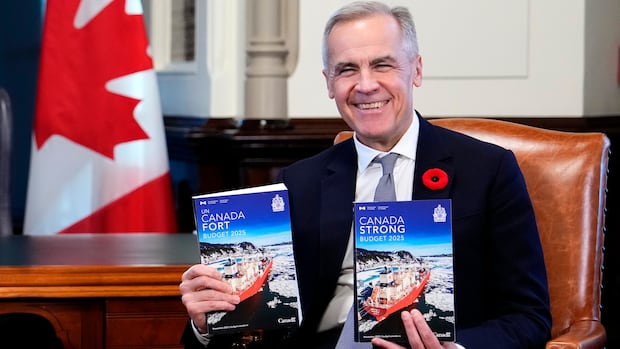
Let’s see how the federal budget compares to Liberal promises
CBC
Political parties and their leaders don’t always have a stellar reputation for keeping their promises. This week’s budget offers an opportunity to check on some of the things Prime Minister Mark Carney and his Liberal Party promised during the election campaign in the spring. Did they become reality?
We can’t be comprehensive. There are parts of the budget that didn’t start with specific campaign promises, and there were campaign promises that don’t have budget implications.
But some things can be checked, and they include some of the biggest priorities of Carney’s government.
After U.S. President Donald Trump imposed 25 per cent tariffs on Canadian-made vehicles on April 3, Carney announced retaliatory tariffs aimed specifically at the auto industry (by this time he was already prime minister, but the campaign was also underway). He promised that “every single dollar raised from these tariffs will go directly to support our autoworkers.”
It appears the government has not yet lived up to the letter of that promise, although it left itself wiggle room in the budget. It’s also complicated to measure because other retaliatory tariffs have been imposed, and help has been given to workers in other affected industries, such as in steel and aluminum.
In all, Canada has brought in $6.7 billion from counter-tariffs since Trump was elected.
Of that, $3 billion has been given back to companies and workers hit hardest by the trade war. That leaves $3.7 billion left over, so “every single dollar” hasn’t been handed out, but Ottawa says it may still give out more as the U.S. tariffs continue to bite.
Under intense pressure from Trump, the Liberals agreed during the campaign to increase Canada’s defence spending to two per cent of GDP by 2030, a key amount that all NATO countries have pledged to meet. Canada, however, has not lived up to that commitment.
After winning the election, Carney agreed to increase the NATO commitment further (once again, under pressure from Trump) to five per cent of GDP (which includes 1.5 per cent for support infrastructure).
In the budget, Finance Minister François-Philippe Champagne said Canada will meet the two per cent target this year, faster than the initial promise. Beyond that though, the budget’s numbers aren’t specific enough to figure out if the government is living up to its commitments. The defence section doesn’t offer a year-by-year breakdown of spending, and no comparison to GDP is offered for the coming years.
During the spring, Carney’s Liberal Party said it would get 500,000 homes built per year, doubling the current rate. It would do this by creating a new agency called Build Canada Homes, which would spend $10 billion on building affordable new homes, and loaning another $25 billion to developers.
The government created Build Canada Homes in September, and in this week’s budget it dedicated $13 billion over five years to fund it, characterizing that as an “initial” investment.
But the government has scaled back its promise slightly. The budget says homebuilding will now “nearly” double, to between 430,000 and 480,000 homes per year.
Artificial intelligence has been called one of the biggest technological innovations in human history, and is being fuelled by staggering levels of investment from both private companies and national governments.


Lawyers for a man acquitted in a high-profile Toronto murder trial where a police officer was killed are holding a news conference Thursday to address a recent Ontario Provincial Police report that re-examines evidence from the trial.

Quebec provincial police arrested two men after a suspicious package grounded flights headed to Montreal's Pierre Elliott Trudeau International Airport on Wednesday.

A nurse in Winnipeg says Canada's immigration system is undercutting efforts to address a shortage of health-care workers, after his application for permanent residency was rejected based on a technicality.

This year's provincial budget is "essentially" the status quo for wildfire preparation and response, the finance minister says.

Parts of B.C.'s coast continues to see heavy rain as Environment and Climate Change Canada warns of a prolonged atmospheric river this week.

Alberta teachers say they face increasingly dangerous conditions at school, with the most common threat coming from their own students.

Cataract surgeries at Charlottetown’s outpatient clinic are expected to resume in April, after procedures scheduled for March were cancelled due to the clinic reaching its annual funding target earlier than expected.

Shannon Elgazzar can see planes taking off from Cairo International Airport from her balcony.

Yellowknife city council has voted in favour of signing an agreement with the federal government that's aimed at bringing piped water and sewer service to the city's airport.

While Canada's economy is far more reliant on exports to the U.S. than vice versa, Canadian negotiators have crucial ammunition in their efforts to land a trade deal that reduces or eliminates tariffs imposed by U.S. President Donald Trump.

Nova Scotia PC MLA Rick Burns says he and his wife are victims of blackmail after hackers accessed and shared videos and intimate images on his personal devices this week.

The Saint John Board of Police Commissioners and Chief Robert Bruce have lost a bid to permanently deny public access to all court documents related to conduct complaints nine officers filed against the chief.

With the looming October election, Quebec Finance Minister Eric Girard has delivered a modest budget as the province aims to withstand ongoing trade disruptions and mounting geopolitical pressure.