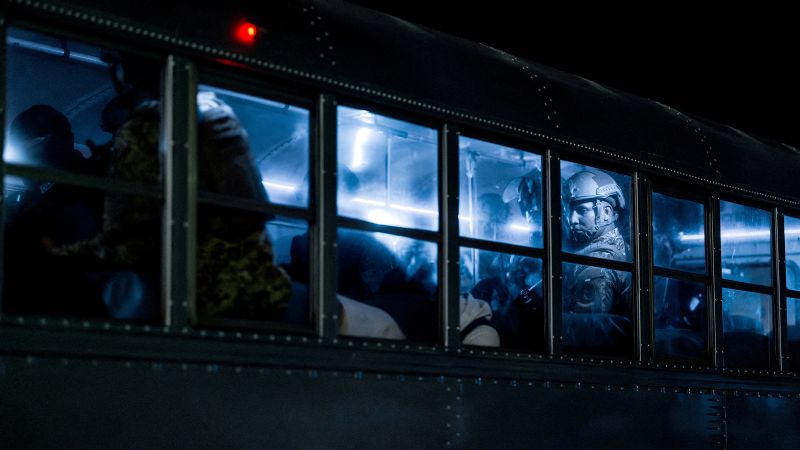
Lawyers ask El Salvador’s Supreme Court to evaluate legality of detention of Venezuelans deported by the US
CNN
A team of lawyers representing the families of 30 Venezuelans sent by the United States to a mega prison in El Salvador asked the Salvadoran Supreme Court of Justice on Monday to evaluate the legality of their detention.
A team of lawyers representing the families of 30 Venezuelans sent by the United States to a mega prison in El Salvador asked the Salvadoran Supreme Court of Justice on Monday to evaluate the legality of their detention. One of the attorneys, Jaime Ortega, said they were hired by the government of Venezuelan President Nicolás Maduro to file an appeal before the Constitutional Chamber of the Salvadoran Supreme Court, which would also apply to the rest of the 238 Venezuelans deported on the orders of US President Donald Trump. “We are asking the court to review their legal status and issue a ruling. If their detention is illegal, it should immediately order their release,” Ortega told reporters. CNN has requested more information from the Venezuelan government. Salvadoran President Nayib Bukele said last week that the US sent 238 alleged members of the Tren de Aragua criminal organization, though he didn’t identify them or provide evidence for that claim. El Salvador agreed to take them in and lock them up at its Terrorism Confinement Center (Cecot), considered the largest prison in Latin America. US authorities have acknowledged that not all deportees had criminal records. The Trump administration said 137 of those migrants were deported under the Alien Enemies Act. Use of the act, previously used only in wartime, under these circumstances is currently under judicial scrutiny in the US.


Top Trump administration officials testified publicly Wednesday for the first time since the launch of the Iran war three weeks ago.

The White House is temporarily lifting key limits on the shipping of oil, gas and other commodities throughout the US, in its latest effort to counter rising energy prices sparked by its war with Iran.

Any attempt by the United States to take control of Cuba would be met with “impregnable resistance,” Cuban President Miguel Díaz-Canel said Tuesday, as power returned to some parts of the island following a nationwide grid collapse.

Deputy Attorney General Todd Blanche defended the Justice Department’s handling of the Jeffrey Epstein files and asserted it does not have new evidence to prosecute anyone for crimes related to the convicted sex offender, in an interview released Tuesday.

TSA workers face reality of working without pay as passengers unaware of the shutdown see long lines
More than a third of the security screeners at Hartsfield-Jackson Atlanta International Airport didn’t show up to work Tuesday, the airport’s general manager said, causing passengers to have to wait in line for up to two hours.

Any attempt by the United States to take control of Cuba would be met with “impregnable resistance,” Cuban President Miguel Díaz-Canel said Tuesday, as power returned to some parts of the island following a nationwide grid collapse.

Many assume JB Pritzker’s run for president is just a year away. His effort to engineer a victory for his lieutenant governor, Juliana Stratton, in Illinois’ Senate primary was also a victory for him and a political operation with national ambitions.

Lt. Gov. Juliana Stratton’s win in the Senate Democratic primary was also a win for Gov. JB Pritzker, while big-spending groups like AIPAC got mixed results in Tuesday’s contests.

United Farm Workers is not participating in annual celebratory events this month of its co-founder Cesar Chavez over what it calls serious allegations the union did not specify

Illinois Lt. Gov. Juliana Stratton will win the Democratic primary for an open Senate seat, CNN projects, a stunning rise for a little-known state officer now on a glide path to Washington.

President Donald Trump promised his endorsement was forthcoming in the GOP Texas Senate runoff and said he wanted whoever he didn’t pick to drop out. But now — preoccupied with the Iran war and a doomed voting bill — he’s missed a critical deadline.

The Senate has kicked off extended debate on the “SAVE America Act” — one of President Donald Trump’s top legislative priorities.

Organized crime in Latin America is proving difficult to defeat with the kind of decapitation strategy apparently favored by US President Donald Trump.