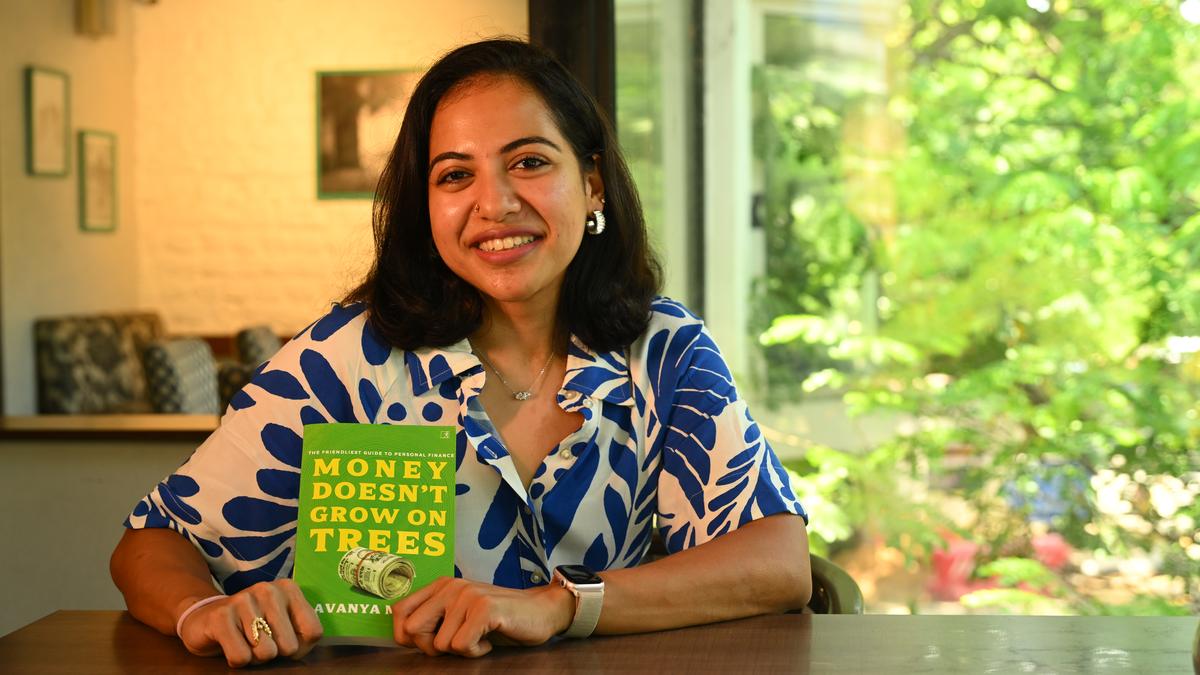
Lavanya Mohan’s Money Doesn’t Grow On Trees dives deep into personal finance
The Hindu
For millennials and Gen Z drowning in complex jargon and resigned ignorance, Lavanya Mohan attempts to simplify all things money, both practical and emotional, in her debut book Money Doesn’t Grow On Trees
In her debut book Money Doesn’t Grow On Trees, Lavanya Mohan makes a tongue-in-cheek comparison in the first chapter. “Money is a lot like high school mathematics, in that, perfectly intelligent people who are fully capable of mastering the subject are convinced that they will just not get it,” she writes.
This might sound all too familiar for many of us, whether we are millennials or Gen Z. For Lavanya too, the book, she says, is a handy personal finance guide she probably needed when she was in her twenties. “This is a very conversational guide for beginners who are trying to get their personal finances in order. There are no lectures, jargon, and most importantly, there is no condescension either. This book isn’t telling you what you are doing wrong, but it holds your hand and helps you understand money better,” she explains.
In a world that is teeming with finance bros and influencers talking in crores, Lavanya’s book sets its sights a lot more simpler. At 200 pages, the book tackles a range of topics — from mutual funds, types of insurance policies, ESOPs, and investing in gold, to name a few. Lavanya also goes beyond merely explaining the brass tacks of personal finance, and delves into our evolving relationship with money — whether in a marriage, when planning for children, and ultimately, for retirement.
“I think the book is unique in how it acknowledges how money makes you feel, and not just how you should be managing it,” she says. “All of us have grown up with different values with money and different experiences. This book acknowledges that, and it also gives you the tools to recognise when you are being emotional with money and how to handle it in a more practical way,” she says.
Through her blog pennmoney, and on her Instagram, Lavanya has been an advocate for simplifying personal finance for women in particular. This is an important part of her book as well. “I realised a few years ago how unapproachable we have made the world of finance for women and the boys club it has become. We hear so many stories of domestic abuse, and of women who stay in bad marriages and realise the impact money can have on their lives. Understanding finance and figuring out what to do with their pay checks will go a long way in making women deal with money better,” she says.
Early on in the book, Lavanya candidly describes millennials as a generation that is ‘woke’, but unfortunately terrible at managing money. Every year when tax season comes around, jokes are aplenty on the internet as to how knowing all about what the mitochondria is, or what parallelograms are, has proven to be hardly useful in the real world where a large part of ‘adulting’ involves budgeting, filing for taxes and exploring investments.
“Children are so much more perceptive, and I believe we can introduce finance to them in a systematic way from as early primary school,” she explains. Lavanya says many adults are uncomfortable discussing this with their children. “Instead of holding back, there are so many fun ways you can initiate these conversations with children. With my son for example, I took to a Dr Seuss story, The Sneetches,” she laughs.


India pledges 60% non-fossil fuel power by 2035, targeting 47% emissions reduction per GDP unit and enhanced carbon sinks.

Supreme Court rules land acquisition compensation and interest must uphold constitutional guarantees, unaffected by financial burdens.

Election officials accept 23 nominations for Bagalkot bypolls, rejecting three, with polling scheduled for April 9.

Students and women’s self-help groups in Madurai engage in vibrant voter awareness campaigns promoting 100% voting participation.

Congress signals a "friendly fight" with allies in select Puducherry Assembly seats ahead of the April 9 elections.

Airstrike in western Anbar kills 7 Iraqi soldiers, injures 13, prompting condemnation for violating international laws on medical facilities.

Plaque unveiled in Bengaluru honors 11 victims of RCB stampede, emphasizing safety responsibility for future events.

India and the U.S. reaffirm commitment to enhance strategic defense cooperation at the 18th Defence Policy Group meeting in New Delhi.

Chhattisgarh's Deputy CM reports only 30-40 Maoists remain in Bastar, highlighting recent surrenders and future development plans.

Explore the historical and industrial significance of Ariyalur constituency, highlighting its challenges, agriculture, and political landscape.

Dindigul and Madurai Collectors conduct joint inspection

In this episode, Kalki Subramaniam speaks to us about why the Transgender Persons Amendment Bill has sparked protests, and how these amendments threaten to push a marginalised community back into the shadows.

India's EU FTA is poised to attract more German companies, boosting bilateral trade and investment opportunities.