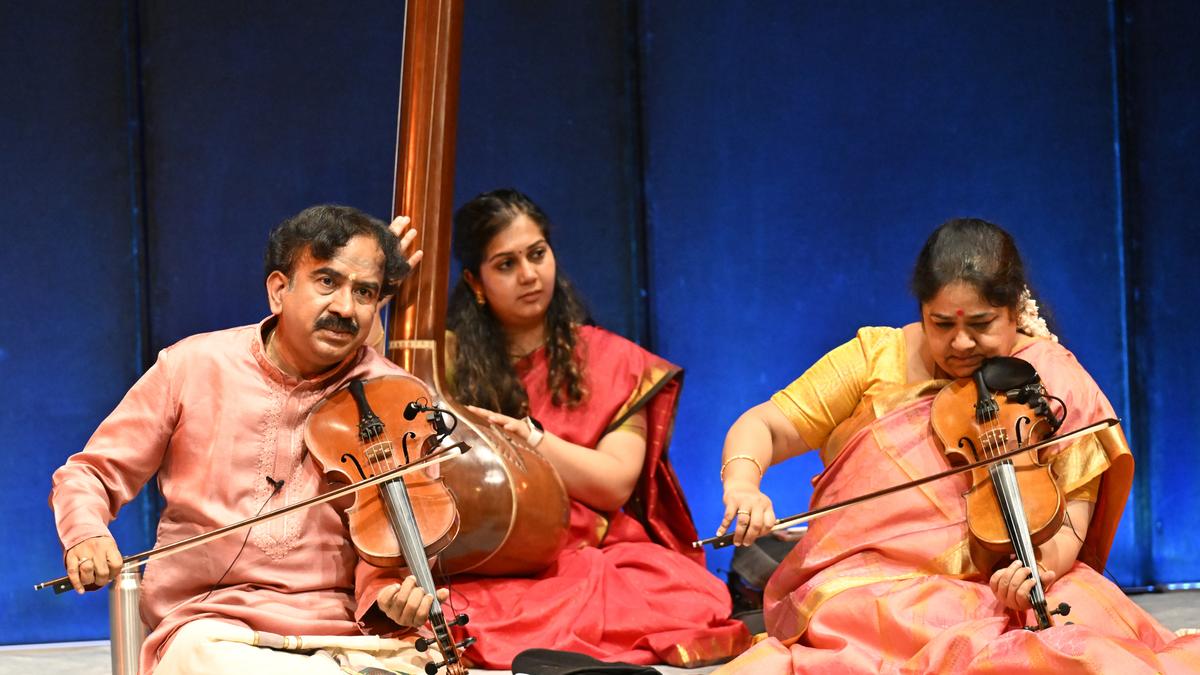
Lalgudi GJR Krishnan and Vijayalakshmi’s showcased the purity of sound at MadRasana’s unamplified concert
The Hindu
Lalgudi GJR Krishnan and Vijayalakshmi display their melodic string theory at MadRasana
The inaugural concert of MadRasana’s Margazhi series unfolded with a performance by Lalgudi GJR Krishnan and Lalgudi Vijayalakshmi at the M.S. Subbulakshmi Arangam. The Lalgudi bani, celebrated for its melodic precision and emotional depth, found perfect expression through their violins and transported listeners to a sublime plane. Their efforts were enhanced by the rhythmic finesse of B. Harikumar on the mridangam and Giridhar Udupa on the ghatam.
The compositions for the day were chosen based on the feel of the space. The venue’s acoustics, eschewing electronic amplification, emphasised the purity of sound. This allowed the performers to establish an intimate, direct connection with their audience.
The concert began with the Nalinakanti varnam ‘Neeve gathi’, a gem from their guru Lalgudi Jayaraman’s repertoire. The brother-sister duo then transitioned to Tyagaraja’s only kriti in Bhavapriya, ‘Srikanta neeyada’ set to Misra Chapu. Brimming with bhava, this rare and evocative pratimadhyamam raga was explored with pathos, showcasing intricate swara patterns that resonated deeply with the audience.
The musical seers said ‘kaveri snanam, saveri ganam’, and Periyasami Thooran ‘Muruga muruga’ in Saveri radiated karuna rasa through its soul-stirring melodic arcs. The duo’s interpretation brought out the raga’s contemplative facets, while Harikumar and Giridhar Udupa provided a rhythmic backdrop of subtle intensity.
A detailed exploration of Nattakurinji followed, led by Vijayalakshmi’s fluid bowing. Krishnan’s innovative dual-bow technique unveiled the multifaceted textures of the raga (graceful and majestic), with one bow producing sharp clarity and the other creating a resonant base. Filled with intricate gamakas and prayogas, their rendition of Swati Tirunal’s ‘Mamava sada varade’, enriched with elaborate kalpanaswaras, reflected an effortless command over manodharma.
Patnam Subramania Iyer’s Apoorva raga kriti, ‘Srivenkatesha’ in Phalamanjari added vibrancy to the concert by emitting a burst of energy — with brisk melkala tala.
In a composition where nadam is described as mooladhara, the inaugural concert fittingly featured Tyagaraja’s ‘Swara raga sudha’ in Sankarabharanam. Celebrated as the ‘Chakravarthy’ raga by Lalgudi Jayaraman, Sankarabharanam’s majestic scope made it an ideal choice for the occasion. This centrepiece began with Krishnan’s alapana suffused with nuanced gamakas, harmonised effortlessly with Vijayalakshmi’s eloquent interjections. The intricate playing brought out the raga’s multifaceted beauty. The rendition progressed through an emotive niraval and the cascade of kalpanaswaras transported the rasikas to a transcendental realm.


Sean Penn skips the Oscars to meet Ukraine's Zelenskyy, who praises him as a "true friend" amid the war.

The teaser of Tamil star Suriya’s much-awaited film with director Venky Atluri, titled Vishwanath and Sons, was unveiled by the makers on Monday

A 'Golden' moment for a K-pop track at the Oscars.

Parvathi Nayar’s new exhibition, The Primordial, in Mumbai, traces oceans, pepper and climate change
Opened on March 12, the exhibition marks the artist’s first solo show in Mumbai in nearly two decades. Known for her intricate graphite drawings and multidisciplinary practice spanning installation, photography, video, and climate change, her artistic journey has long engaged with the themes of ecology, climate change and the natural world. In this ongoing exhibition, these strands converge through a series of works centred on water, salt, and pepper — materials that carry natural and historic weight across centuries.

Explore the highlights and key winners of the 98th Academy Awards, featuring memorable moments and historic achievements from Oscars 2026.

Spring season celebrated at Ramakrishna Mission Institute, Kolkata, with ‘Evening of Basant’

The Spirit of the Land, a solo show by artist Shivakumar Sunagar, is a vista of Nature-inspired emotions

Tal Fry is all set for an exciting new performance season

Netflix is making a bold move by snagging InterPositive, the AI filmmaking company founded by Ben Affleck, in a deal that could hit $600 million

Watch the eerie trailer for 'Hokum,' where Adam Scott faces a witch haunting in a mysterious Irish inn.

Oscars 2026 security heightened amid FBI warnings of a potential Iranian drone threat ahead of the Hollywood ceremony.

Directed by Rahul Pandey, the series also stars Naila Grewal, Nidhi Bisht, Anant Joshi, Anjum Batra and Kusha Kapila

A tribute to the versatile actor and comedian V.K. Ramasamy in his birth centenary year.