Korea Week in Chennai: traditional music and instruments in focus
The Hindu
Traditional Korean music and instruments have been at the forefront atof this year’s Korea Week celebrations in the city. On Friday, a two-women folk ensemble takes stage
Ongo jishin. This Korean proverb of yore translates to “understanding the new by learning things of old”. Traditional instruments are simply a gateway to the future, believes ID, a Korean band whose sound is a delightful dance of traditional wind instruments like piri, taepyeongso and saenghwang. As Sir Mutha Venkata Subbarao Concert Hall fills with a timbre that is reminiscent of a time unknown to us all, it is colorfully dotted with guitar riffs and keyboard interludes that are familiar. This is what ID thrives on: creating contemporary sounds through traditional means.
The band recently performed in Chennai as part of the city’s Korea Week celebrations, organised by the Korean Cultural Centre, New Delhi, and InKo Centre in association with the Consulate. Later this week, a two-women folk music act, titled DUO BUD will perform in the city, ahead of the closing day celebrations.
ID derives its music from Korean folk songs and legends: it is something that has made its music stand out, since the band’s formation in 2015. “‘Jeongsun arari’, a folk song, describing the landscape of Mt. Geumgangsan in the Korean peninsula became the motif of our song, ‘Yeoumbul Arari’,” says frontman Nam Kimun.
Their song ‘Nanani’ was inspired by ‘Nanani taryoung’, a traditional work song sung by women while harvesting oysters in the seashore of Incheon. “We intended to describe the city at night with neon lights in this song,” he continues. Though piri (small reed instrument made of bamboo) was the instrument that the founding members of the band specialised in, taepyeongso (double reed instrument of the oboe family), saenghwang (free reed mouth organ), guitar, drums, keyboard and janggu (an hourglass-shaped drum) complete the ensemble. The band’s next aim is to collaborate with Indian folk musicians. “
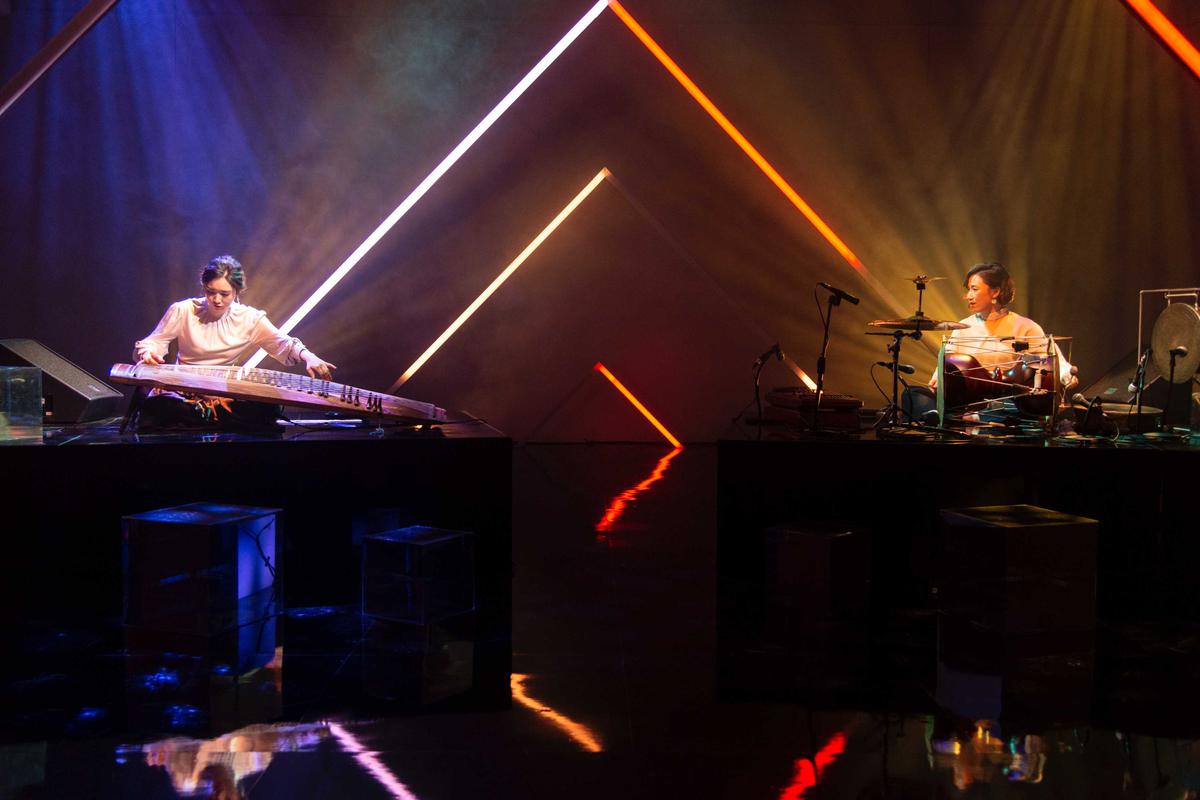
While ID’s soundscape flits between traditional and contemporary, DUO BUD relies on folk sounds — its the result of a healthy battle between janggu and gayageum (a plucked zither with a minimum of 12 strings). Also formed in 2015, when DUOBUD started out, it was rare to find a female duo. Percussive sounds were only considered as background music, and not as solo. “Deviating from the existing style of wild and intense percussion elements, we focussed more on the delicate and lyrical tone in Korean sensibility by utilising the characteristics of gayageum,” says Jinhe Lyim who plays the gaeryang gayageum (that has 25 strings, a modernised version) in the ensemble.
Janggu is a drum played with a stick, and it is the only percussion instrument that can be tuned to produce pitches, says Sora Kim. “For the better accompaniment with each musical piece’s timbre, mood, and pace, we have selectively used Pungmul (farmers’ music) janggu and Musok (shamanistic music) janggu. The repertoire of the band is largely inspired by Nature. “Nature is always nearby and delivers comfort but can be unconsciously oblivious like the moon in the night sky and the tree in front of the house and by reinterpreting Korean traditional music, we want our songs to be there for the people who need comfort from everyday life,” adds Jinhe.
ID admits to being in a constant struggle to find the balance between preserving traditional music and adapting it to contemporary times. “Traditional music has its own virtue. We simply wish to look at it from more diverse angles and share the results with more people,” says Nam. With K-culture increasingly becoming strong throughout the world, Jinhe believes that K-traditional music, dance and craft are also being accepted in the global market.


South African naturalist Steve Boyes speaks on ghost elephants, ancestral tracking, and Werner Herzog’s documentary exploring Angola’s elusive highland giants

Actor-director Amol Palekar will receive META's Lifetime Achievement award for 2026 on March 25 in New Delhi.

India's artists unite against rising censorship, advocating for creative freedom and support for marginalized voices in the arts.

Written and directed by Kunal, the film also stars Sparsh Shrivastava and Vanshika Dhir

This year, Bharatnatyam artistes will present the Tyagaraja Aradhane as a dance performance

This year, Bharatnatyam artistes will present the Tyagaraja Aradhane as a dance performance

The actor, along with director Sushant Shah, speak about their upcoming series ‘Chiraiya’, Divya’s process of working on the dialect, Sushant’s approach to telling a story about women, and more

An independent video, ‘Feel the Spark’ by Raleigh Rajan with vocals by Ciera Dumas that celebrates Tamil literary giants, garnered 1.4 million views in less than 36 hours.

In ‘Jack Ryan: Ghost War’, John Krasinski is back as the savvy CIA analyst, diving headfirst into a high-stakes mission that unravels a deadly conspiracy and pits him against a rogue black-ops unit

Shriram Bharatiya Kala Kendra’s Shankarlal festival showcased rare ragas, radiant artistry, and inclusive performances, from Pt Madhup Mudgal’s serene morning ragas to Ramana Balachandran’s Saraswati veena.

Explore "Threads that Bind: The Kantha Project," an exhibition in Delhi reimagining kantha as a medium of repair and renewal.

Sean Penn skips the Oscars to meet Ukraine's Zelenskyy, who praises him as a "true friend" amid the war.

The teaser of Tamil star Suriya’s much-awaited film with director Venky Atluri, titled Vishwanath and Sons, was unveiled by the makers on Monday