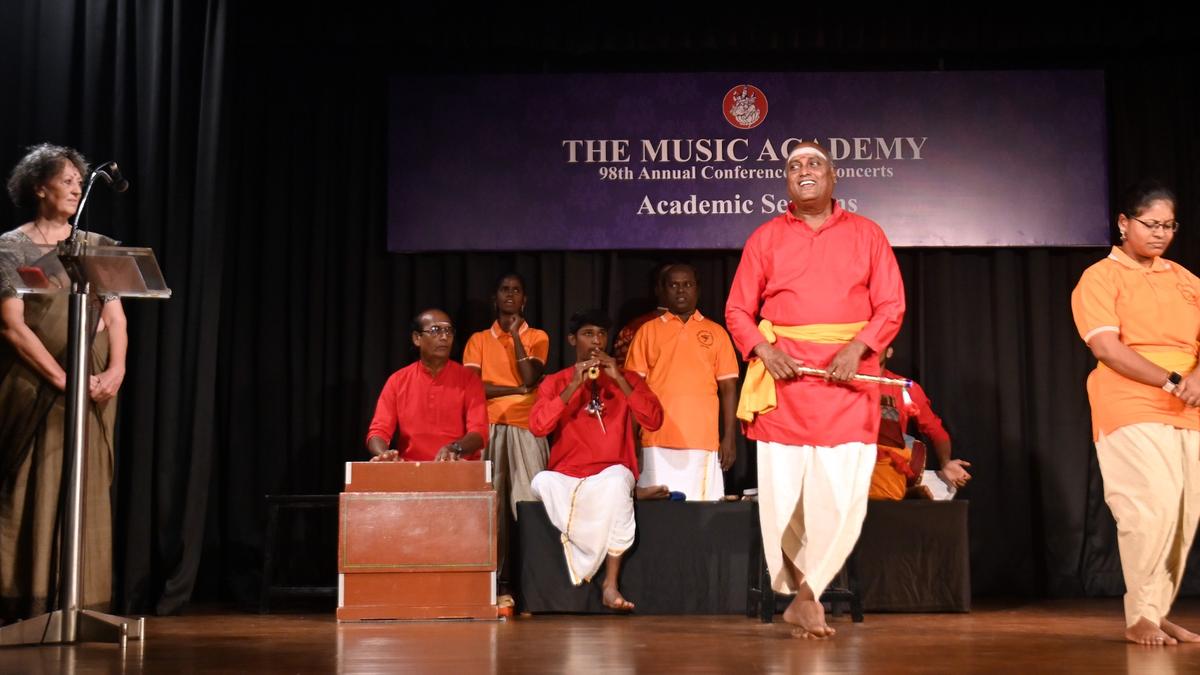
Koothu met classical at The Music Academy’s lec dem session
The Hindu
The Music Academy’s academic session on day four celebrated the inclusive nature of music
Day four of the lec dems at The Music Academy featured two interesting topics. The first, on the topic ‘Kuttu Raga-s : Evoking the character’ presented by vidwan P. Rajagopal and Hanne M. de Bruin, began with an unamplified musical performance by P. Rajagopal and his ensemble, featuring Vijayan on the harmonium, Sasikumar on the mukhaveena, and Selvakumar on the mridangam and dholak. The absence of amplification emphasised the natural and emotional depth of the art form. Hanne provided insights while Rajagopal demonstrated various aspects of Kattai Koothu, a traditional art form combining dance, drama, and storytelling.
Kattai Koothu performances are unamplified, requiring a high vocal range, particularly for male performers singing at the pitch of F#, considered very high today. This practice harks back to an older, unamplified era, lending the art form a unique timbre that conveys emotion more naturally. Performances often last through the night, spanning over eight hours, with storylines rooted in Indian mythological epics such as The Mahabharata. Historically performed only by men, women have recently begun participating in the performances. Hanne highlighted how practitioners, traditionally from marginalised communities, were often overlooked by the privileged urban elite.
One of the key rasas (emotions) expressed in Koothu is Veera (heroism), often showcased through raga Mohanam. Rajagopal enacted a scene from Hiranyavilasam, depicting Hiranyakashipu’s boastful proclamation of his glory. In Koothu, the dialogues are sung, merging seamlessly with the music to create a unified narrative reminiscent of a musical. Hanne explained how Koothu’s adaptability evolved as a response to social hierarchies, incorporating colloquial dialects into epic narratives for greater audience relatability. Rajagopal demonstrated a humorous scene between Krishna and Subhadra from The Mahabharata, showcasing the art form’s flexibility in infusing traditional stories with modern slang and humour.
The structure of Koothu songs typically involves two lines repeated by the chorus, followed by rhythmic or dance interludes. The melodies, often simple and repetitive like namavalis, are rooted in Carnatic music but bear the distinctive aesthetic of Koothu. Common ragas such as Kaanada, Kambhoji, Mohanam and Sindhubhairavi were identifiable from the demonstrations, but infused with the unique Koothu sound, as noted by Sangita Kalanidhi designee T.M. Krishna during his summation. Krishna also emphasised the need to keep the ragas as they are in each art form and not try and tamper with them under the pretext of cleansing it.
Another fascinating element was the concept of ‘Thiraipravesham’, demonstrated by Rajagopal through Karnan’s introduction in’’ The Mahabharata’s Kurukshetra war. In this technique, a translucent curtain initially reveals only the character’s head, with the accompanying text/dialogues highlighting the character’s traits. The curtain is then removed to fully unveil the character, creating a dramatic effect.
The expert committee discussed the adaptability of ragas in character representation and reflected on the mukhaveena, once a temple instrument, now eclipsed by the clarinet. Sasikumar expressed his dream of reviving the mukhaveena and passing on his knowledge to future generations. Rajagopal emphasised the lack of formal training structure in Koothu, fearing its essence might be diluted by rigid syllabuses. Krishna elaborated on the distinction between community art and organised art, advocating for minimal use of the term “folk.” The session concluded with an interactive performance by Rajagopal and Krishna, exploring the nuances of word-splitting in Carnatic and Koothu music while preserving melodic integrity.
This lecture-demonstration offered a deep dive into the intricate artistry of Kattai Koothu, blending scholarly insights with vibrant performances to highlight its cultural and musical significance.


Telangana MP urges Centre to expedite ₹1,270 crore dues transfer from Andhra Pradesh for financial fairness and development.

A Karnataka man was detained with ₹62.5 lakh in cash during election checks on NH 544, claiming it was from a property sale.

Telangana Government issued 16 notifications to fill 31,798 vacancies, with 67,763 total recruitments since Congress took power.

Supreme Court directs Tarun Butolia's family to seek safety assessment from Delhi Police after fatal Uttam Nagar clash.

CM Stalin asserts unity in the DMK-led alliance, dismissing division attempts and emphasizing collaborative efforts for the upcoming elections.

Rahul Gandhi to skip Kerala rally due to Sonia Gandhi’s ill health; Kharge to attend Kozhikode event
Rahul Gandhi will miss the Kerala rally due to Sonia Gandhi's health; Congress president Kharge to attend instead.

Thunderstorms with lightning and gusty winds forecasted for 20 Telangana districts on March 26

TGSRTC reduces Metro AC and Deluxe bus fares by 30% in Hyderabad to encourage public transport amid the fuel crisis.

Supreme Court criticises Haryana Police for mishandling a four-year-old rape case, mandates swift action and oversight with a Special Investigation Team.

On World Theatre Day 2026, artists in Hyderabad call for affordable venues as rising costs and infrastructure gaps challenge the city’s theatre ecosystem.

Madhapur police seize 31 illegally transported commercial gas cylinders, ensuring public safety and compliance with regulatory norms.

Punjab AAP MLA Harmeet Singh Pathanmajra arrested in Gwalior after evading police in a rape case for over six months.

Bose Krishnamachari resigned from the Kochi Biennale Foundation amid sexual harassment allegations, confirmed by the foundation's chairperson.